

Workleap Review: Features, Pros&Cons, Pricing, and Alternatives






If you want a single platform to manage employee engagement, performance management, and compensation, Workleap is one of the tools you will likely encounter. Its popularity is exactly why I decided to take a closer look at what it actually offers and whether it delivers on that promise.
In this Workleap review, I’ll cover Workleap’s features, pricing, integrations, user reviews, and how it compares with alternatives, so you can decide whether it is the right tool for your HR team.

Workleap Overview
Workleap is an employee engagement and performance management platform built for HR teams and managers who want better visibility into employee experience.
It groups several tools inside one platform, including
- Workleap Officevibe
- Workleap Performance
- Workleap Compensation
Each tool supports a different part of the employee lifecycle, from engagement measurement to performance reviews and compensation discussions.
After reviewing the platform, I see a strong emphasis on employee engagement and feedback. Workleap Officevibe helps teams measure engagement through pulse surveys and anonymous feedback. Managers receive insights into employee satisfaction, engagement levels, and potential problems within their teams.
Workleap Performance supports performance management and employee development. Managers can run a performance review, organize a review cycle, and collect feedback, such as 360-degree feedback. Performance conversations happen continuously rather than once per year, which helps teams track employee performance more closely.
Workleap also promotes AI capabilities through Workleap AI. AI helps managers analyze feedback and engagement data and turn it into actionable insights.
Overall, the Workleap platform aims to give HR professionals and managers a single tool to manage employee engagement, performance, and the employee experience across the team.
Workleap Pros
- All-in-one employee experience platform
Workleap combines engagement, performance management, and compensation tools inside one platform. HR teams can manage employee feedback, performance reviews, and engagement data without switching between multiple tools. - Strong employee engagement capabilities
Workleap Officevibe includes pulse surveys, anonymous feedback, and engagement reporting. Managers can monitor employee satisfaction and identify engagement problems within their team. - Continuous feedback and performance conversations
Workleap Performance supports regular feedback instead of one annual performance review. Managers can run a review cycle, collect 360-degree feedback, and track employee performance progress over time. - Actionable insights for managers
The platform turns survey responses and feedback into engagement insights and recommendations. Managers receive guidance on how to respond to team feedback and improve employee engagement. - Recognition and culture features
Employee recognition tools allow teams to celebrate achievements and reinforce company values. Recognition helps improve employee satisfaction and supports a positive team culture. - Structured tools for HR teams and managers
Workleap provides frameworks for performance management, engagement tracking, and feedback collection. HR professionals and managers receive structured processes instead of building systems manually.
Workleap Cons
- Large platform with many separate tools
Workleap includes multiple products. Some organizations may find the platform complex if they only need one specific tool. - Pricing structure depends on multiple modules
Workleap pricing varies depending on which products a company uses. For organizations that need engagement, performance management, and compensation features, costs can quickly add up. - Heavy reliance on manager participation
Many features depend on managers actively reviewing feedback and responding to insights. Engagement programs may lose impact if managers do not regularly act on employee feedback. - Limited value without consistent employee participation
Pulse surveys, feedback systems, and recognition tools rely on active employee input. Low participation can reduce the quality of engagement insights. - Learning curve for new HR teams
The platform includes many engagement, feedback, and performance tools. HR teams and managers may need time to understand the full structure of the platform. - Best suited for organizations with structured HR processes
Companies without established HR workflows may struggle to use the full performance management and engagement capabilities effectively.
Workleap Features
While the platform includes many capabilities, I concentrate mainly on employee engagement features in this Workleap review. Next, I’ll explain how it handles surveys, feedback collection, employee recognition, and engagement insights across teams.
Pulse and Custom Surveys
Workleap Officevibe uses pulse and custom surveys to regularly measure employee engagement and collect employee feedback.
- Pulse surveys run frequently and ask short questions about engagement, workplace experience, and employee satisfaction. Regular surveys help managers and HR teams track engagement trends across the platform without waiting for a yearly performance review.
- Custom surveys give HR professionals more flexibility. HR teams can design their own questions, adjust survey frequency, and target specific teams or topics. Custom surveys allow organizations to collect feedback about leadership, workplace culture, employee performance, or specific changes inside the company.
Survey responses feed directly into the Workleap platform, where managers can analyze engagement and feedback data. Results help HR leaders understand how employees feel about their work environment and identify potential problems inside a team before they grow into larger performance or engagement issues.
Anonymous Employee Feedback
Employees can share anonymous feedback about their work experience. That helps them speak openly about engagement, management, workload, or workplace culture without worrying about negative consequences. The approach encourages more honest employee feedback and increases participation in engagement programs.
The platform protects anonymity by only showing feedback when privacy rules are met. Managers and the HR team receive aggregated feedback instead of individual responses.
Anonymous feedback also helps managers understand problems inside a team earlier. They can respond to feedback and take action before engagement or employee satisfaction declines.
Good Vibes Recognition Cards
Good Vibes recognition cards are simple digital cards that include messages such as thank-you notes, appreciation shoutouts, or celebration of completed work.
Employees can use them to recognize coworkers for their work and contributions. The feature supports employee recognition by making appreciation visible across the team.
Managers and HR leaders can also use Good Vibes to strengthen company culture. Over time, consistent recognition can improve employee satisfaction and strengthen engagement across the organization.
Engagement and Feedback Reports
Workleap Officevibe turns survey responses and employee feedback into structured reports that help managers understand engagement across their team. The platform compiles data from pulse surveys, feedback submissions, turnover metrics, and Good Vibes recognition activity.
Managers and the HR team can review engagement reports to identify patterns in employee sentiment and performance conversations. Reports highlight areas where engagement is improving and where employees may be struggling, so managers can act promptly.
Officevibe also allows teams to export survey reports. Exported reports help HR professionals analyze engagement trends outside the platform or share insights with leadership.
AI-Powered Insights
Workleap Officevibe uses Workleap AI to analyze survey results and employee feedback across the platform. AI reviews engagement metrics and highlights patterns that managers or the HR team might miss when reviewing raw survey data.
The system interprets survey responses and feedback trends to explain the results. Managers can quickly see where engagement is improving, where employee satisfaction may be declining, and which teams might need additional support.
AI-generated insight helps managers understand engagement signals faster. Instead of manually analyzing large volumes of survey responses, managers receive summarized explanations of the data and clearer visibility into what is happening across their team.
One-on-One Conversation Support
Workleap Officevibe includes agendas and discussion prompts that help guide regular conversations about engagement, feedback, and employee performance.
Managers can use these conversations to discuss survey results, employee concerns, and development goals. Regular one-on-one meetings create space for ongoing feedback instead of waiting for a formal performance review or review cycle.
Trend and Sentiment Reporting
Workleap Officevibe tracks engagement and feedback data over time and presents it through trend and sentiment reports. The platform analyzes responses from pulse surveys, employee feedback, and recognition activity to identify patterns across the team.
Managers and HR professionals can monitor changes in engagement across different periods. Trend reporting helps teams see whether employee satisfaction is improving, declining, or staying stable after organizational changes or management actions.
Sentiment reporting also helps managers detect early signals of disengagement. Reports highlight areas where engagement drops, where feedback increases, or where teams show stronger participation.
Workleap Integrations
Workleap integrates with HR systems and collaboration tools so engagement, performance, and employee data stay connected across the platform. Integration mainly happens through HRIS platforms and workplace communication tools. HR teams can sync employee data, reporting structures, and organizational changes without manual updates.
| Integration Type | Platforms | Purpose |
| Collaboration Tools | Slack, Microsoft Teams | Send engagement notifications, survey reminders, and platform alerts directly to team communication channels |
| Workspace Platforms | Google Workspace, Microsoft 365 | Support authentication, communication workflows, and platform access |
| HRIS Platforms | BambooHR, Workday, SAP SuccessFactors, ADP Workforce Now, UKG, Namely, Paylocity, Personio | Sync employee data, reporting lines, departments, and organizational structure |
| Payroll and HR Systems | Paychex, Paycor, Square Payroll, Sage HR, Deel | Connect HR records with engagement and performance data |
| HR Platforms and Workforce Systems | HiBob, Factorial, Darwinbox, Freshteam, Humaans, Zoho People | Centralize employee data used across engagement and performance tools |
Workleap lists dozens of supported HRIS integrations, including BambooHR, Workday, SAP SuccessFactors, UKG Pro, Paylocity, Personio, and Zoho People.
The integration ecosystem allows HR professionals to combine employee engagement data with existing HR infrastructure while keeping employee records synchronized across systems.
Workleap Pricing
Workleap uses a simple per-user pricing model. Each product inside the Workleap platform has its own plan. Companies can use one or combine several tools depending on their HR needs. Pricing changes based on the number of users and the product selected.
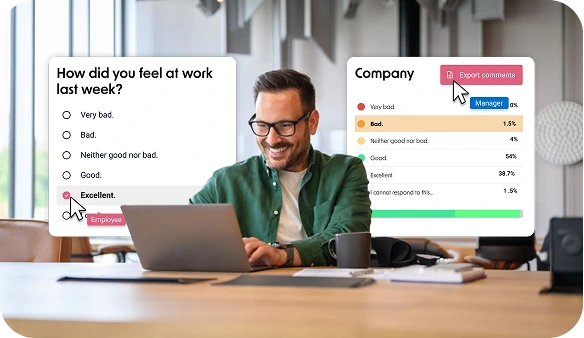
- Officevibe supports employee engagement programs. The tool includes pulse surveys, custom surveys, anonymous feedback, and Good Vibes employee recognition. Managers can also review engagement reports and get AI insights.
- Performance helps managers run performance reviews and manage review cycles. Teams can collect self-reviews, peer feedback, and manager evaluations. The platform also includes performance rating analytics and AI assistance.
- Compensation helps HR teams manage pay and rewards programs. The platform includes pay band management, compensation analytics, and budget tracking. HR leaders can also run compensation reviews and monitor pay equity across the team.
Every plan includes access to Workleap AI features, while an upgraded AI+ option unlocks unlimited AI insights and suggestions across the platform.
| Plan | Price | Minimum Users | Main Purpose |
| Officevibe | $5 per user/month | 10 | Employee engagement surveys, feedback, and recognition |
| Performance | $5 per user/month | 10 | Performance management and performance review tracking |
| Compensation | $5 per user/month | 100 | Compensation planning, pay bands, and rewards management |
| Officevibe + Performance Bundle | $8 per user/month | 10 | Combined engagement and performance management tools |
Workleap Reviews
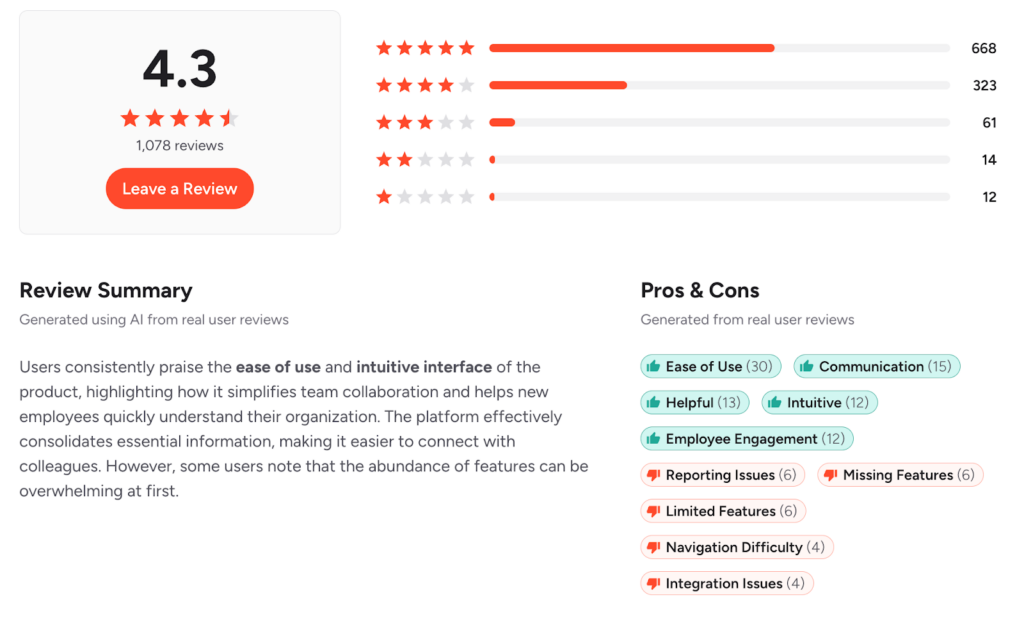
Workleap reviews are strong overall, at least on the two review platforms I checked. On G2, Workleap has a 4.3/5 rating from 1,078 reviews. On Capterra, it has a 4.8/5 rating from 115 reviews. That tells me most users have a positive view of the platform, but the experience is not identical across products or use cases.
What users like:
- Easy to use
Many reviewers say the platform is simple to learn, with a clean interface and quick setup. - Strong engagement tools
Users often mention pulse surveys, feedback, recognition, and team engagement as clear strengths. - Good mix of engagement and performance features
Several reviews point to the value of having employee engagement, performance management, and recognition in one place. - Helpful for managers and HR teams
Users say the platform gives visibility into employee sentiment, team issues, and performance trends. - Integrations save time
Some reviewers mention that integrations with existing tools reduce switching and make workflows smoother. - Useful reporting and insights
Positive reviews often mention reports, analytics, and visibility into feedback and engagement data.
What users do not like:
- Too many features at first
A common complaint is that the platform can feel overwhelming when users first log in. - Some workflows feel complex
Several reviewers say certain parts of the product take time to understand or navigate. - Integration issues
A few users mention that some integrations are not as smooth as they expected. - Missing HR functionality
Some reviewers say Workleap does not cover every HR need, especially areas like payroll or benefits administration. - Pricing can feel unclear
A few users call out modular pricing as harder to understand than expected. - Customer support response time
Some reviews mention slow support, especially when urgent issues come up.
My take:
I think the review pattern is pretty clear. Users like Workleap when they want one platform for engagement, feedback, recognition, and performance. Ease of use comes up a lot, which matters because platforms in this category often get bloated fast.
At the same time, the complaints also make sense. Workleap aims to cover a broad range of people management. That creates breadth, but it can also create setup overhead, navigation friction, and confusion around what a team actually needs. I also would not treat it as a full HR system. User feedback suggests it works better as a layer on top of existing HRIS platforms than as a replacement for core HR operations.
Workleap Alternatives
Workleap works well for companies that want engagement, performance management, and compensation tools inside one platform.
The trade-off shows in how engagement is handled. Workleap mainly measures engagement through surveys, which do provide useful insights, but they often stay in dashboards and reports. Managers can see the data, but the system does not always drive ongoing team follow-ups or real-time employee signals.
HeartCount approaches engagement from a different direction.
HeartCount
HeartCount treats employee engagement as the core system, not one module inside a broader HR platform. It concentrates on engagement signals, employee sentiment, and early risk detection. That difference changes how feedback is collected, analyzed, and acted on.
Below are the concrete reasons HeartCount works as a good Workleap alternative:
Continuous engagement tracking
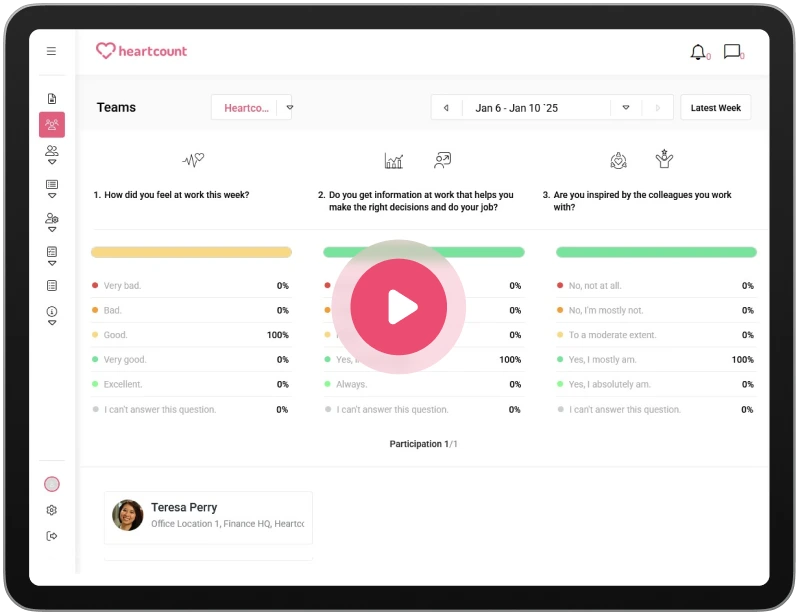
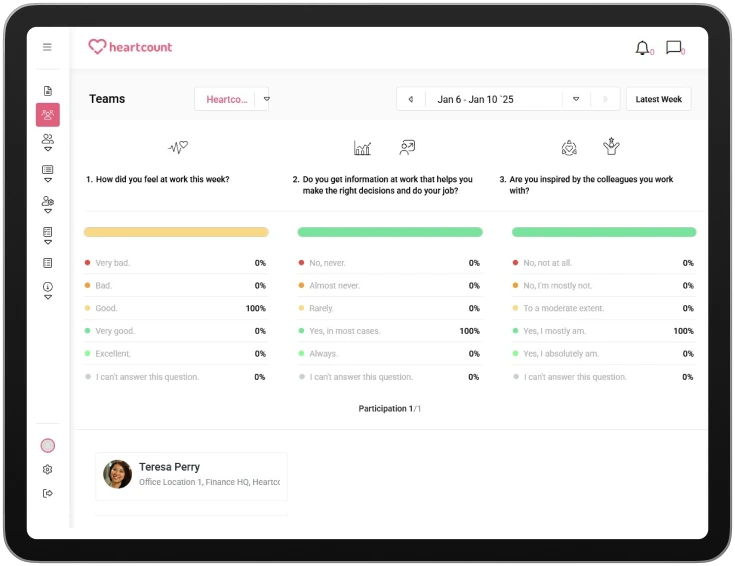
HeartCount runs weekly pulse check surveys that capture employee sentiment in real time. Each survey takes around 30 seconds and contains only three questions, which increases participation and provides a continuous signal of employee engagement.
Questions rotate across multiple engagement categories, such as:
- Job satisfaction
- Personal development
- Relationships with management
- Collaboration with colleagues
- Productivity and efficiency
- Employee well-being
Weekly responses create a long-term dataset that shows changes in engagement over time, rather than one-time survey snapshots. In practice, that gives HR teams and managers a weekly view of team sentiment. They do not need to wait for quarterly or annual surveys to identify problems.
Predictive engagement analytics
HeartCount uses AI to analyze patterns in survey responses and engagement signals. The system detects early signs of disengagement, burnout, or churn risk before they become major issues.
AI insights highlight sentiment shifts across teams, engagement trends over time, early warning signs of employee dissatisfaction, and employees at risk of leaving. Once a risk appears, the system provides a clear explanation and suggested actions for managers.
This predictive model is different from tools that only visualize survey results. Instead of simply showing engagement scores, HeartCount analyzes patterns and identifies the root causes.
Individual employee insights
HeartCount stores engagement data at the employee level. Managers can review engagement history, well-being signals, and feedback trends for individual employees over time.
Each employee profile includes:
- Engagement history
- Feedback comments
- Recognition activity
- Well-being indicators
- Participation trends
The goal is to help managers understand each employee’s experience and support them before issues escalate. This approach helps organizations move from generic engagement scores to personalized employee support and development planning.
Structured communication
HeartCount includes a communication module that keeps employee feedback within a single structured system. Employees can send messages, comments, or suggestions directly to managers or HR through the platform. Messages can also be anonymous if employees prefer privacy.
Managers can:
- Respond directly to employee feedback
- Track conversations over time
- Mark issues as resolved
- Connect messages to engagement insights
Communication structure closes the feedback loop. Feedback does not disappear into survey dashboards or emails.
Recognition tied directly to engagement data
HeartCount includes employee recognition features that reinforce engagement signals. Employees can publicly recognize coworkers and celebrate achievements inside the platform.
Recognition appears on shared walls and becomes part of engagement analytics. Managers can see which employees receive recognition and how recognition patterns affect engagement levels.
Recognition data can then influence reward strategies, development plans, and team culture initiatives. Recognition becomes part of engagement analysis instead of a separate feature.
Detailed engagement reporting and metrics
HeartCount generates detailed engagement reports that track changes across teams and over time. Reports include metrics such as:
- Employee Engagement Index (EEI)
- eNPS
- Well-being scores
- Motivation levels
- Autonomy indicators
- Intent-to-leave signals
These reports allow HR teams to compare teams, identify trends, and measure the impact of engagement initiatives over time. Reports can track engagement weekly, monthly, or across longer time periods to show improvement or decline.
Centralized employee experience data
HeartCount centralizes engagement-related information in one system. HR teams can access employee feedback, engagement scores, recognition activity, and survey responses from the same dashboard.
This centralization allows organizations to analyze engagement across departments, identify cultural or leadership problems, and evaluate the impact of management decisions. Instead of using several disconnected HR tools, engagement signals stay inside a single system built specifically for employee experience management.
Faster engagement action cycles
Because HeartCount collects data weekly and analyzes it continuously, organizations can act quickly on engagement issues. Managers receive updated insights as soon as survey cycles finish. The system’s goal is to move engagement management from reactive reporting to proactive decision-making.
Other Workleap alternatives
HeartCount is one of the best options on the market when it comes to visibility into employee engagement and real-time sentiment tracking. However, it is not the only alternative available. Several other platforms offer capabilities that may fit different organizational needs.
Depending on how your HR team operates and which parts of employee experience matter most, you can also consider the following tools when you evaluate Workleap alternatives:

Workleap: Final Verdict
Workleap is a capable platform, and for HR teams that want an all-in-one HR solution that covers multiple people management processes, it can be a good fit. However, engagement is not its primary focus. While the platform collects feedback, runs surveys, and generates reports, engagement is still just one part of a broader system.
HeartCount is built entirely around engagement signals, employee sentiment, and continuous listening. That specialization leads to deeper insights into engagement, stronger predictive analytics, and faster feedback loops for managers and HR teams.
Book a demo to see how HeartCount helps teams measure, understand, and improve employee engagement in real time.