

Leapsome Review 2026: Features, Pros&Cons, and Alternatives








Are you considering Leapsome for measuring employee engagement and managing performance? This platform promises to bring everything, including feedback, reviews, goals, learning, and surveys, into one place. Now I’m breaking it down to see how well it succeeds in that intention.
In this Leapsome review, I’ll walk you through what the tool actually does, how it fits into daily HR processes, and where it might fall short. We’ll look at features like performance reviews, engagement surveys, instant feedback, goal tracking, and analytics. You’ll also see where Leapsome stands out and where simpler, faster tools might be a better fit.

Leapsome at a Glance
Leapsome is a tool that helps companies manage how their teams grow, work, and feel at work. It combines performance reviews, feedback, goals, learning, and engagement surveys all in one place. Instead of juggling separate HR tools, companies use Leapsome to keep everything connected and easy to track.
With Leapsome, managers can run 360-degree feedback, set clear goals, track progress, and give instant feedback without waiting for review season. Teams can also send praise, fill out pulse surveys, or follow personalized learning paths based on their strengths and gaps.
The platform is easy to use, works well with tools like Slack and Google Calendar, and gives HR professionals solid analytics to understand how people are doing. Whether it’s improving feedback loops, running engagement surveys, or building a performance management system, Leapsome helps teams stay aligned and grow.
It’s built for scaling companies, especially those with 50 to a few thousand people, and works best for organizations that want continuous improvement, not just yearly check-ins.
Leapsome Pros
Leapsome stands out as a strong all-in-one platform for performance, feedback, and employee development. Below are the key advantages it offers, explained clearly and simply:
- All-in-one platform
Leapsome brings together performance reviews, feedback, goal tracking, engagement surveys, and learning into one system. This keeps everything organized and easy to manage. - Easy to use for everyone
The design is clean and simple. Whether you’re a manager running a review cycle or an employee giving peer feedback, it’s clear what to do. There’s not a lot of training needed to get started. - Built-in flexibility
You can customize just about everything—review templates, goals, rating scales, competencies, and survey questions. This means companies can shape it to match their HR processes and company culture. - Strong analytics and insights
Leapsome shows clear reports on performance, engagement, and goal progress. HR teams and managers get helpful data to spot trends, understand employee performance, and make better decisions. - Helps build a feedback culture
With tools for instant feedback, praise, and structured 1:1 meetings, Leapsome makes it easy to keep the feedback loop going. It’s not just about once-a-year reviews—it supports continuous feedback. - Supports remote and global teams
The platform is cloud-based, works well for remote teams, and supports over 30 languages. It’s built for modern, distributed workplaces that need everyone on the same page. - AI support without overkill
Leapsome uses generative AI to help managers write review answers or spot issues in survey results, but it doesn’t take over the process. It saves time and gives useful suggestions while keeping humans in charge. - Great for growing companies
It’s ideal for mid-sized organizations that are growing fast and need a scalable performance management system. You can start with a few modules and add more over time as your team grows.
Leapsome Cons
Leapsome is a strong platform, but it’s not perfect. Here are the main downsides to be aware of, explained in plain terms:
- It can be overwhelming at first
There’s a lot packed into the platform. Setting up review cycles, goals, surveys, and feedback flows takes time. If you don’t plan it well, things can get messy fast. - Takes time to learn for admins
Regular employees can use it easily, but HR teams and admins may need to spend more time figuring out all the settings and options, especially when customizing workflows or surveys. - Manual goal updates without API
Unless you’re using Jira, updating goal progress is manual. There’s no open API to automate this, which can be a pain for teams managing many OKRs or key results. - Too many notifications
Leapsome sends a lot of reminders via email, Slack, and other channels. This helps with engagement, but for some teams, it feels like notification overload. You can’t always fine-tune the volume. - No native mobile app
There’s no proper mobile app. You can use it on your phone’s browser, but it’s not as smooth. Writing reviews or giving feedback from a small screen isn’t ideal. - Not cheap for small teams
The pricing starts around $8 per user per month and adds up fast if you use all the modules. Smaller companies might find it pricey, especially without the budget for a full HR stack. - Limited for complex enterprises
If your organization has tons of custom workflows, advanced reporting needs, or deep integration requirements, Leapsome may feel too basic. It’s built for growing companies, not huge global enterprises with rigid structures.
Leapsome Features
Leapsome brings together key tools that help manage people, track progress, and improve how teams work and grow. Let’s take a look at its main traits:
Performance Reviews
Performance reviews in Leapsome are structured evaluations in which employees and managers reflect on performance over a set period—usually quarterly, biannually, or annually. The system supports self-assessments, manager reviews, and peer feedback (also called 360-degree feedback) in a single flow.
Templates are customizable, so HR teams can choose the questions, rating scales, and competencies that match their process. You can also automate review cycles, set deadlines, and track progress across teams.
Review answers can be written from scratch or drafted with help from Leapsome’s AI assistant, which uses past feedback and performance data to suggest input. The review results feed into analytics dashboards, giving the HR team insight into performance trends and helping with evaluation, promotions, or development plans.
360-degree Feedback
360-degree feedback lets employees receive input from multiple sources—not just their manager. This includes peers, direct reports, and, if needed, external collaborators.
It’s part of the performance review cycle, but can also be run on its own. HR sets up the process, selects who gives feedback to whom, and chooses whether responses are anonymous. The feedback focuses on strengths, development areas, and alignment with company values or skills.
This gives a fuller picture of someone’s performance, helps reduce bias, and supports more balanced evaluation and development planning. All responses are collected and displayed in a single view, making it easy to spot patterns and areas for improvement.
Instant Feedback
Instant feedback in Leapsome lets employees and managers give quick, informal feedback at any time, outside of formal review cycles.
You can send praise for good work or share constructive input directly through the platform or integrated tools like Slack or Teams. Feedback can be public or private, and it’s stored so it can be referenced later during a review.
This feature helps keep the feedback loop active, supports continuous improvement, and builds a culture of open communication and recognition across teams.
Goal Setting and Tracking / OKR Management
Goal setting and tracking / OKR management in Leapsome helps teams set clear objectives and track progress over time.
You can create individual, team, or company-wide goals using the OKR (Objectives and Key Results) format. Goals can be linked together to show alignment, and progress is updated manually or through tools like Jira.
Dashboards show how goals are moving, what’s off track, and where attention is needed. Regular check-ins and reminders help keep things moving. This keeps everyone aligned and focused on what matters most.
Engagement and Pulse Surveys
Engagement surveys in Leapsome help HR teams measure how employees feel about their work, team, and company. These surveys use science-backed questions on topics like leadership, growth, workload, and company culture.
Pulse surveys are shorter check-ins sent more frequently (weekly or monthly) to track changes in sentiment over time. Both types can be anonymous, and results are shown in dashboards and heatmaps so HR can spot trends and problem areas.
Leapsome also includes eNPS (employee Net Promoter Score) and gives benchmarks to compare results. After each survey, the system can suggest actions or follow-up plans, making it easier for managers and HR leaders to close the loop and improve engagement.
Analytics and Reporting
Every module (performance reviews, surveys, goals, feedback) feeds into centralized dashboards so HR teams and managers can see patterns and act on them.
You can track review completion rates, average ratings, skill gaps by team, engagement scores over time, and goal progress. Filters let you break down results by department, role, or location to find trends or problem areas.
Leapsome also lets you compare engagement scores with performance data—for example, spotting if high-performing teams are disengaged or at risk of burnout. Reports are visual, exportable, and updated in real time, helping HR leaders make informed decisions fast.
1:1 Meeting Tracking
1:1 meeting tracking in Leapsome helps managers and employees run better check-ins with less effort. You can schedule regular 1:1s, set shared agendas, and keep notes and action items in one place.
The tool syncs with your calendar (Google or Outlook) so meetings show up automatically. Both people can add topics before the meeting, mark what’s been discussed, and follow up on tasks afterward.
Meeting history stays saved, so it’s easy to look back at past conversations during a review cycle or when planning development. This keeps communication consistent and focused, even across busy schedules.
Competency Framework
Competency framework in Leapsome lets HR teams define the key skills, behaviors, and values expected for each role or level in the organization.
You can create custom competencies like communication, leadership, or technical expertise, and assign them to roles or departments. These are then used in performance reviews, 360-degree feedback, and development plans to ensure evaluations are consistent and tied to real expectations.
This makes it easier to spot strengths, identify skill gaps, and plan targeted learning or coaching. It also helps employees understand what’s expected if they want to grow or move up.
Development Plans
Development plans in Leapsome are structured goals created to help employees grow specific skills or competencies over time.
Managers and employees can build these plans together based on feedback, performance review results, or skill gaps identified in the competency framework. Each plan can include clear objectives, learning activities, deadlines, and check-ins.
Progress is tracked in the system, making it easy to follow up during 1:1s or the next review cycle. This keeps development focused and visible, not just a vague intention discussed once a year.
Leapsome Pricing
Leapsome doesn’t show exact prices on their site, but here’s how it works. Pricing is modular, meaning you can pick only the features my team actually needs, like performance reviews, engagement surveys, or goals. You’re not paying for the full suite unless you want it. That keeps things flexible and focused.
They also offer discounts if I bundle more modules or have more users. There’s no free plan, but if you’re stuck in a contract with another HR platform, you can Leapsome for free until that contract ends (up to Dec 2026). You’ll have to reach out to sales to get a custom quote based on your company size and which features you want.
Every plan includes the basics: analytics, integrations, AI support, 38+ languages, data security (ISO 27001, GDPR), and access to customer success resources. If you want extras like compensation benchmarks or learning content, those are considered add-ons.
In short, Leapsome pricing adjusts to your setup, but you won’t know the exact number until you talk to sales. Most reviews say it’s affordable for mid-sized teams, but may be a stretch for very small ones. I don’t like the lack of transparency; it makes it harder to compare options or plan budgets without going through a sales process.

Leapsome Integrations
Leapsome connects with many tools to keep HR processes smooth and avoid duplicate work. These integrations help sync data, send reminders, and bring feedback into the flow of work.
- HRIS & payroll systems: Sync employee data automatically from platforms like Thrivea, Workday, BambooHR, Personio, HiBob, Gusto, ADP, Rippling, and more.
- ATS (Applicant Tracking Systems): Bring in new hires from tools like Greenhouse, Workable, and Lever to start onboarding or surveys.
- Slack & Microsoft Teams: Give feedback, receive reminders, and send praise directly in chat, keeping engagement active in tools teams already use.
- Calendars: Sync with Google Calendar or Outlook to connect 1:1 meetings and reviews to scheduled events.
- Jira: Link Jira tickets to goals or OKRs to update progress automatically from engineering work.
- SSO & Security: Supports Okta, OneLogin, Azure AD, Google Workspace, and other SSO providers for secure login.
These integrations help make Leapsome more useful day-to-day, but some users mention that custom integrations or niche tools may need manual work or API help.
Leapsome Reviews
Leapsome earns strong ratings across review platforms, with a 4.8/5 rating on G2 (2,200+ reviews) and 4.6/5 on Capterra.
Users consistently highlight how the tool combines performance management, feedback, engagement, and goal tracking in one system. Many say it’s “easy to use,” “visually clean,” and “helps standardize HR processes.” Bruno M. notes, “Instead of relying on separate tools, Leapsome brings all of this together in one connected environment.”
Reviewers also point to helpful automation, robust meeting tracking, and effective feedback tools. Shivam A. shared, “I use Leapsome for 1-1s and daily reports. I like the templates, and I can always look back on past conversations—super useful.” Another user, Amanda R., emphasized its strategic value: “It has made scenario planning clearer and helped me offer data-driven recommendations to stakeholders.”
Still, not all feedback is glowing. Several users say Leapsome can feel overwhelming or “too feature-heavy” for smaller teams. Moustafa A. observed, “The pricing is higher compared to other platforms, especially when using advanced features.” Others mention that setup takes effort and some workflows could be more intuitive. One user compared it to “a washing machine with too many settings.”
The overall sentiment is that Leapsome delivers depth, power, and flexibility, but it’s best suited for teams ready to invest time and structure into their performance management system.
Leapsome Alternatives
Leapsome’s a solid platform, and for a lot of teams, it gets the job done. But that doesn’t mean it’s the best choice for everyone. Depending on your size, budget, or what you’re trying to improve in your HR processes, other tools might be a better fit. One of the best options out there is HeartCount.
HeartCount
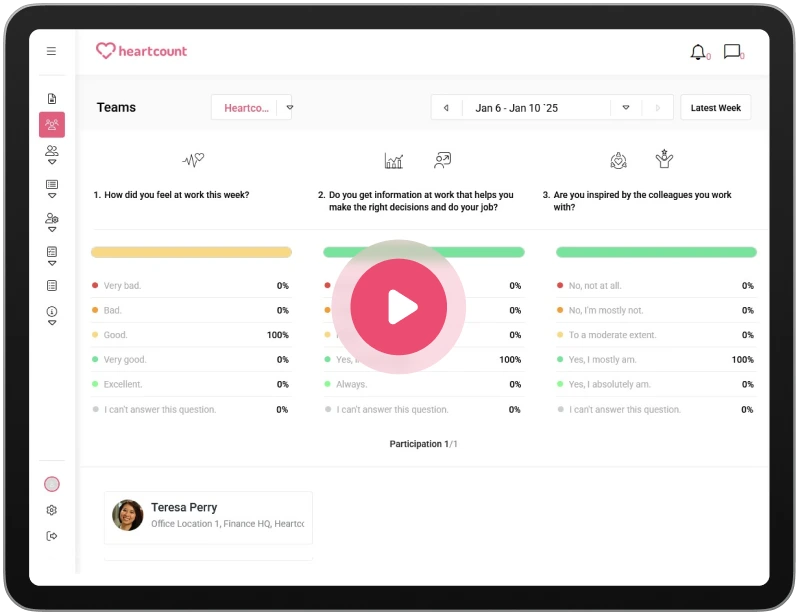
Leapsome is built for a broad HR infrastructure. It covers performance, engagement, learning, compensation, and more — but that breadth comes at the cost of immediacy and usability. That’s where HeartCount stands apart.
- Fast signals vs. formal cycles
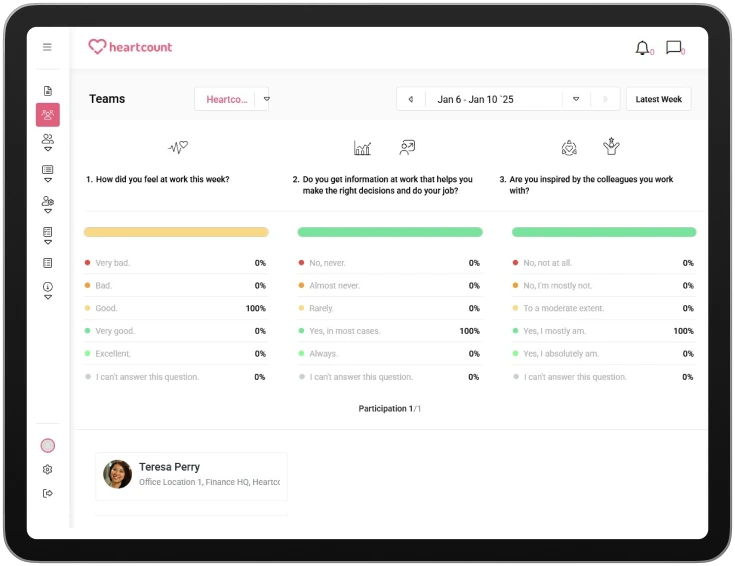
Leapsome’s strength lies in structured review cycles and long-term development planning. But for companies that need to act quickly on team morale or burnout risk, the system may be too slow. HeartCount uses weekly pulse surveys, not quarterly reviews, so issues show up early. That difference turns insight into intervention before people check out or quit. - Clarity over complexity
Leapsome’s feature set is broad, but it can feel bloated, especially for HR teams that don’t need goal frameworks or formal learning paths. HeartCount strips it down. It focuses only on engagement, feedback, and recognition, which makes it faster to adopt and easier for employees to use without training. It feels more like a tool for action than a performance manual. - From feedback to action
Many Leapsome reviews mention a lack of guidance after survey results come in. HeartCount’s AI-generated insights explain not just what changed, but why, and what to do about it. Combined with anonymous comments, two-way communication, and manager alerts, it becomes a full loop from data to action. Leapsome has the data, but HeartCount makes it simpler to act on it. - Recognition and culture built in
While Leapsome offers praise features, they’re often buried inside broader review or meeting workflows. In HeartCount, peer recognition is native, public, and tied directly to engagement signals. That makes culture and morale part of the daily rhythm, not a side note to reviews or OKRs. - Transparent, affordable pricing
HeartCount’s pricing is simple and public: a free plan for up to 25 users, $2.5/user/month for growing teams, and enterprise support when needed. Leapsome hides pricing behind sales calls and tiers, which frustrates small teams trying to plan or compare costs. - Real-time use, not set-and-forget
Leapsome works best when set up as a full system: goals, reviews, meetings, surveys. That’s powerful but requires commitment. HeartCount is more flexible. You can plug in pulse surveys, get feedback weekly, and take action, all without full HR ops behind it. For fast-moving companies or lean teams, it’s simply easier to maintain.
HeartCount doesn’t try to replace what Leapsome does. It narrows in on what Leapsome treats as one part of a bigger puzzle. If the goal is to improve how people feel, communicate, and perform together, without the weight of a full HRIS, HeartCount fits where Leapsome often overreaches.
Also, if your team needs fast, actionable insight into employee sentiment without a 6-month rollout or 15 tools stitched together, HeartCount fills that gap cleanly, where Leapsome gets bulky.
Other Leapsome Alternatives
While HeartCount is one of the best options out there, I have to acknowledge other Leapsome alternatives worth exploring, depending on your needs and goals:
- Lattice
- Culture Amp
- 15Five
- Engagedly
- TINYpulse
- HiBob
- BambooHR

Does Leapsome Solve Your Problems or Add New Ones?
Leapsome is a good choice for structure-heavy HR teams that want full control over performance management, reviews, goals, and learning workflows. If you’ve got the time, headcount, and processes to match, it delivers. But if your real need is fast, honest feedback and clear engagement signals without spinning up a complete HR machine, it might feel like overkill.
On the flip note, HeartCount prioritizes action, not process. It helps you see how people really feel, every week, not once a year. You get quick pulse surveys, honest feedback (even anonymous), clear reports, and early warnings about problems like disengagement or burnout. You won’t have to deal with setup headaches or long support calls. Just insight you can use right away.
If you want to understand your teams, improve culture, and act before it’s too late, start with HeartCount now. It’s free for small teams and takes minutes to launch.