

15Five Review: Features, Pros & Cons, and Alternatives








If you’re evaluating the 15Five review, there’s usually a reason. Performance reports feel disconnected from real work, managers struggle to give consistent feedback, or HR lacks a clear picture of how teams are actually doing between review cycles.
On paper, 15Five promises to fix that by bringing check-ins, feedback, goals, and engagement data into one platform. The question is whether it actually simplifies your day-to-day HR work or just adds another layer to manage.
In this 15Five review, I’ll break down what the platform really does in practice, how it fits into everyday HR and manager workflows, and where it delivers value versus where it can feel heavy.
I’ll cover performance reviews, weekly check-ins, engagement surveys, goal tracking, analytics, and manager tools, so you can see if 15Five matches what your organization actually needs.
15Five at a Glance
15Five is a performance management and employee engagement platform designed to help teams move away from rigid annual reviews and toward ongoing conversations. It’s built for HR teams and managers who want a clearer, more consistent way to understand how employees are doing week to week.
At a basic level, 15Five focuses on weekly check ins, feedback, and structured performance reviews. Employees regularly share updates, challenges, and reflections. Managers review those inputs, respond with coaching, and track employee performance over time. The goal is simple: fewer surprises at review time and better communication throughout the year.
The platform also includes tools for continuous feedback, pulse surveys, peer review, and peer recognition. Features like high fives make recognition visible, while review tools support different review cycles, including manager review, self reviews, and more formal performance review management. Everything lives in one system instead of being spread across docs, forms, and surveys.
Overall, 15Five works best for organizations that want performance and engagement to be ongoing, not occasional. It’s not trying to be just an HR database or a one-time review tool. It’s meant to support regular habits between managers and team members, and to give HR leaders a clearer picture of performance, engagement, and feedback across the organization.
15Five Pros
- Continuous check-ins: 15Five makes weekly check ins a regular habit, not a one-off event. That keeps feedback flowing and gives managers a clear view of what employees are working on.
- Builds stronger manager-employee conversations: The platform nudges manager and team members to stay connected between reviews, which improves coaching and reduces surprises in performance management.
- Supports formal and informal feedback: You get both structured performance reviews and ongoing continuous feedback plus informal peer review and high fives to recognize good work.
- Gives HR leaders real engagement insight: Built-in employee engagement and pulse surveys help HR see patterns in morale, engagement, and performance across teams.
- Flexible review frameworks: You can run different review cycles (self, manager, peer) in the same system. That means fewer spreadsheets and scattered docs.
- Goal tracking is tied to performance: OKRs and goals can live alongside check-ins and reviews, so individual work links up with team and company priorities.
- Centralized feedback and data: Instead of feedback lost in email or Slack, everything stays in one place. That helps with consistency and transparency.
15Five Cons
- Can feel heavy early: Setting up weekly check ins and new habits takes effort. Teams used to annual feedback can resist at first.
- Requires behavior change: To get value from continuous feedback, managers must actually read and respond. If they don’t, the system just becomes another to-do list.
- Some features aren’t deep: Tools like pulse surveys and engagement analytics are useful but not as advanced as standalone survey platforms.
- Learning curve for structured reviews: Configuring review cycles and performance review management takes planning. Smaller teams without dedicated HR may find setup confusing.
- Cost adds up: Mid-sized and larger organizations may find expenses grow quickly as more users and modules are added.
- Not a full HR suite: 15Five focuses on performance and engagement. It doesn’t replace core HRIS or payroll systems.
- Risk of data overload: Regular check-ins and comments create lots of data. Without a clear process, feedback threads can become noisy.
- Integrations might be limited: Integrations are helpful, but not as extensive as some broad HR ecosystems.
- Dependent on active use: If employees and managers skip regular inputs, value drops fast. It works only if people stick to the rhythm.
- Best for certain cultures: Organizations that don’t value frequent check-ins or open feedback may not see big returns.
15Five Features
15Five can help you manage performance, feedback, and employee engagement in a more continuous, practical way. Instead of relying on isolated performance reviews, it brings check-ins, recognition, surveys, and development tools into one system that managers and employees use regularly. Below, I’ll walk through the key features and explain what each one actually does in day-to-day use.
Continuous Performance and Check-In Tools
Continuous performance and weekly check ins are the foundation of how 15Five works. Instead of waiting for a quarterly or annual performance review, employees share short, regular updates about what they worked on, what went well, what didn’t, and where they need support. These check-ins take a few minutes to complete but create an ongoing record of work, priorities, and obstacles.
For managers, this becomes a steady stream of context rather than a last-minute scramble for feedback. They can respond directly in the platform, give feedback, spot issues early, and coach in real time. Over time, this makes employee performance easier to understand because it’s based on consistent input, not memory or isolated moments.
From an HR perspective, this supports continuous performance management rather than one-off evaluation cycles. Patterns emerge naturally through repeated check-ins, making reviews more accurate and conversations more grounded. It works best in organizations that want performance discussions to feel normal and ongoing, not stressful or reactive.
Performance Reviews with AI Support
Performance reviews with AI support reduce the friction that usually comes with review cycles. The platform supports different review types, including self-reviews, manager, and peer review. Because check-ins and feedback are already captured throughout the year, reviews are built on real input instead of last-minute recollection.
The AI helps summarize themes, suggest clearer language, and reduce bias when writing reviews. For managers, this speeds up performance review management and makes it easier to turn ongoing notes into a fair, readable review.
It doesn’t replace judgment, but it does help managers articulate feedback more clearly and consistently, especially when reviewing multiple employees.
For HR teams, this approach makes performance reviews feel like a continuation of regular conversations rather than a stressful annual event. Reviews are still structured and formal when needed, but they’re grounded in continuous data. This works well for organizations that want reviews to be more accurate, less subjective, and easier to execute at scale.
Engagement Surveys and Insights
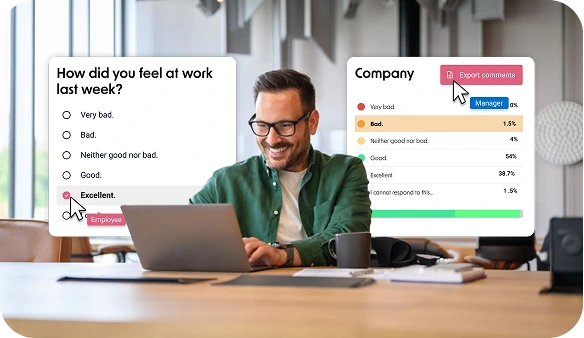
Engagement surveys and insights help HR teams understand how people actually feel, not just how they perform. The platform includes engagement and pulse surveys that regularly measure motivation, alignment, manager effectiveness, and overall engagement.
Results are visualized in dashboards that highlight trends across teams, roles, and time periods. This gives HR teams early signals when engagement drops or when specific groups of employees need attention. Because surveys run continuously, insights feel current rather than outdated by the time results are reviewed.
The real value comes from connecting engagement data to action. Managers can see where their teams are struggling and follow up with targeted conversations or changes. For organizations focused on employee engagement and long-term performance, this creates a clearer link between sentiment, behavior, and outcomes.
Goal and OKR Tracking
Goal and OKR tracking connect day-to-day work with broader priorities. Teams can set individual and team goals or OKRs and track progress over time, so employees understand how their work contributes to larger objectives.
These goals aren’t isolated from performance conversations. They show up alongside weekly check-ins, making it easier for managers to tie feedback and coaching directly to outcomes. When progress stalls or priorities shift, it’s visible early rather than surfacing at the end of a review cycle.
For HR and leadership, this adds structure without overcomplicating planning. Goals stay connected to performance management and engagement instead of living in a separate system. This works best for organizations that want alignment and accountability without turning goal tracking into heavy administration.
Feedback and Recognition Tools
Feedback and recognition tools in 15Five are built to make input and appreciation part of everyday work. Employees can give continuous feedback at any time, whether it’s quick input, coaching notes, or a more structured peer review. This keeps feedback from being tied only to formal reviews.
Recognition is handled through simple, visible tools like high fives and peer recognition. These call out positive behavior publicly and reinforce what the organization values, without needing a formal reward system. Recognition stays lightweight but consistent.
Over time, this creates a clearer record of both performance and contribution. For managers, it adds context to performance reviews. For HR teams, it supports a healthier feedback culture where recognition and input happen regularly, not just when something goes wrong.
One-on-One Meeting Support
One-on-one meeting support helps managers and team members run more focused, consistent conversations. The platform provides shared agendas, talking points, and notes so both sides know what will be discussed before the meeting starts.
These one-on-ones connect directly to weekly check ins, goals, and ongoing feedback, which keeps conversations grounded in real work and recent context. Managers don’t have to rely on memory or scattered notes, and employees feel their updates are actually being used.
For HR teams, this improves manager effectiveness without forcing rigid scripts. One-on-ones become a regular coaching tool rather than a status update, supporting development, alignment, and trust over time.
HR Outcomes Dashboard and Analytics
The HR Outcomes Dashboard and analytics give HR teams a consolidated view of performance, engagement, and feedback trends across the organization. Instead of pulling data from multiple tools, HR leaders can see how employee engagement, performance, and manager activity connect in one place.
The dashboards surface patterns over time, not just snapshots. You can track changes in engagement survey results, review completion, feedback activity, and manager effectiveness, making it easier to spot risks early or confirm what’s working. This is especially useful for strategic HR leaders who need evidence, not anecdotes.
For HR teams, the value is clarity. Analytics turns daily activities like check-ins and feedback into actionable insights that support decision-making, planning, and conversations with leadership. It’s not about complex data science. It’s about making ongoing people data understandable and actionable.
15Five Pricing
15Five uses a modular, per-user pricing model. You pay based on what you actually use, but costs scale as you layer features. All plans are billed annually, which matters when budgeting.
- Engage starts at $4 per user per month and focuses on employee engagement. This tier covers engagement survey, pulse surveys, heat maps, benchmarking, and action planning. It’s essentially the listening layer.
- Perform is the core performance management plan at $11 per user per month and is marked as the most popular. This is where performance reviews, continuous feedback, OKRs, review cycle setup, manager review, peer review, and career paths live.
- Total Platform costs $16 per user per month and combines Engage and Perform with added focus on manager effectiveness. You get the HR Outcomes Dashboard, manager indicators, and access to training microlearnings.
There are also add-ons that increase the total cost.
- Manager Products start around $49 per month and focus on coaching.
- Kona AI adds AI-driven coaching and meeting support.
- Compensation is priced separately and connects pay with employee performance.
These are not plug-and-play extras. They’re sales-led and require demos.
Honest take: pricing is transparent on the surface, but total cost can climb quickly as you move toward a full continuous performance management setup.
For a small business, Engage or Perform may feel reasonable. For larger organizations, 15Five becomes a strategic investment rather than a lightweight tool. It delivers value if you actually use the features. If adoption is low, it gets expensive fast.
15Five Integrations
Integrations cover the essentials for performance and engagement workflows: HR data sync, identity, collaboration, and calendars.
They’re not as broad as full HR suites that connect every module (compensation, recruiting, learning) out of the box, but they handle the areas that matter most for performance management, check-ins, and conversation workflows. In practice, the value depends on how tightly your existing systems sync and how much you need data flowing in both directions.
- HR systems: 15Five connects with core HR systems, so employee records like hire date, title, department, and manager structure stay in sync. This reduces manual updates and helps HR keep performance and engagement data tied to the right people.
- Single sign-on (SSO) providers: Common SSO tools (e.g., Okta, Azure AD) authenticate users without separate 15Five passwords. This makes login easier for employees and more secure for IT.
- Workplace platforms: Integrations with collaboration tools like Slack and Microsoft Teams allow notifications and feedback prompts to happen where people already work. That keeps continuous feedback and weekly check-ins top of mind without forcing everyone into another app.
- Calendar systems: Connecting to Google Calendar and Outlook makes scheduling and tracking one-on-one meetings smoother. Summaries, reminders, and agendas can show up side by side with your regular work calendar.
- Performance & goal tools: Some integrations pull data from goal or project platforms into 15Five’s OKR and goal tracking. This gives context for performance and progress without duplicating effort.
- Reporting & analytics export: Integrations with BI tools let HR teams export engagement, review, and activity data for deeper analysis outside of 15Five dashboards.
15Five Reviews
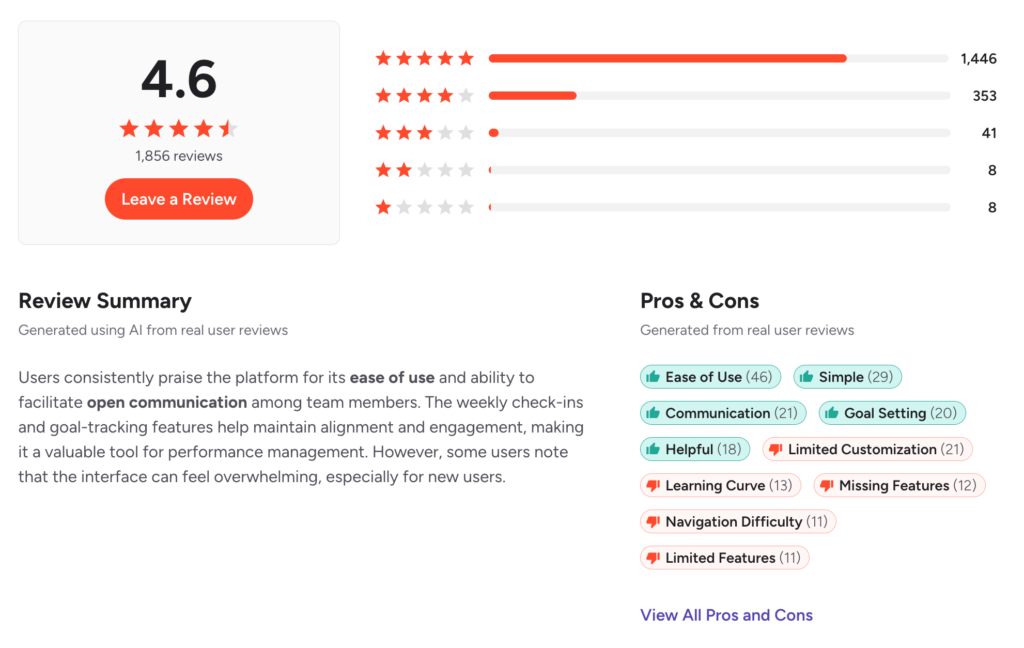
On review sites, 15Five scores strongly overall. On G2, it’s rated 4.6/5 based on 1,856 reviews. On Capterra, it’s rated 4.7/5 based on 892 reviews.
What users like:
- Ease of use and fast rollout, especially for regular routines like check-ins.
- The weekly check-ins model helps maintain alignment and keeps conversations going between formal reviews.
- Goal tracking and OKR visibility are frequently cited as practical for staying focused.
- Recognition (including High Fives) is often mentioned as an easy morale booster when teams actually use it.
What users dislike:
- Limited customization comes up a lot, especially for organizations with nuanced structures, terminology, or non-standard workflows.
- A learning curve and occasional navigation complexity, particularly as the platform expands beyond check-ins into more “suite-like” functionality.
- Survey repetition over time and engagement mechanics that can feel “samey” if you don’t actively refresh your approach.
- Mobile experience and billing rigidity are common practical complaints in Capterra-style feedback.
15Five tends to get high marks when teams commit to its rhythm: check-ins, manager follow-through, and ongoing feedback. Reviews get more mixed when buyers expect deep customization, want a lighter interface, rely heavily on mobile, or need flexible billing terms.
15Five Alternatives
As you can see from this 15Five review, I’m talking about a strong platform that, for many teams, does exactly what it promises. It brings structure to performance management, improves manager effectiveness, and makes ongoing feedback easier to run at scale. But that doesn’t mean it’s the right choice for every organization.
Depending on your size, budget, culture, or what you’re actually trying to fix, other tools may be a better fit. Some teams need deeper insight into employee engagement and experience, more flexible engagement diagnostics, or a lighter system that puts employee voice first. One of the strongest alternatives in that space is HeartCount.
HeartCount
15Five is strong at performance management and manager workflows, but it has structural limits:
- Engagement depth is shallow: Engagement surveys exist, but they are standardized, trend-oriented, and often repetitive. Custom survey logic, nuanced segmentation, and context-rich diagnostics are limited. Over time, engagement data becomes broad but not precise.
- Employee voice is manager-centric: Feedback flows primarily through manager structures. Anonymous employee-initiated communication exists but is not a core strength. Psychological safety depends heavily on a manager’s maturity.
- Insights are retrospective, not diagnostic: Dashboards show what is happening, not why, at a granular level. HR still has to infer root causes from signals.
- Customization hits a ceiling: Review types, questions, labels, and workflows can be configured, but only within a fixed framework. Organizations with non-standard structures feel friction.
- Performance first, experience second: The platform is optimized for performance, manager effectiveness, and review cycles. Employee experience is supported, but not deeply explored.
HeartCount fills the experience intelligence gap underneath performance.
- Deep, configurable engagement diagnostics: HeartCount supports custom surveys, advanced survey reports, and automated pulse check surveys that go far beyond templated engagement models. You can measure exactly what matters to your organization, not what a framework assumes.
- True employee voice, independent of managers: Anonymous feedback, direct messages, and open commentary are first-class features. Employees can speak without routing everything through a manager relationship.
- Root-cause visibility: HeartCount is built to explain why engagement shifts happen. Labels, segmentation, historical comparisons, and detailed reporting make patterns obvious without interpretation gymnastics.
- Operational clarity for HR: Manuals, FAQs, and role-based permissions show that HeartCount is designed for day-to-day HR operations, not just leadership narratives. HR controls the system, not the other way around.
- Experience before performance: HeartCount treats employee experience management as the foundation. Performance conversations make more sense once experience data is clear and trusted.
They are not direct substitutes. 15Five is a performance system, while HeartCount is an experience intelligence system.
When performance starts slipping in 15Five, HC explains the cause.
Other 15Five Alternatives
While HeartCount stands out as one of the strongest options, it’s not the only platform worth considering. Depending on your needs, priorities, and how you run HR today, there are several other alternatives you may want to explore:
- Lattice
- Culture Amp
- Leapsome
- Engagedly
- TINYpulse
- HiBob
- BambooHR
Does 15Five Actually Fit Your Organization?
15Five works best in organizations that are ready to commit to regular check-ins, structured performance reviews, goal tracking, and ongoing feedback. If managers are engaged and HR has the capacity to run the system properly, 15Five delivers clarity, structure, and long-term value.
That said, it’s not lightweight. Setup, configuration, and adoption take time, and the platform assumes a certain level of process maturity. If your main challenge is understanding how employees actually feel day to day, or if you need fast, unfiltered insight into engagement and experience, 15Five can feel heavy before it feels helpful.
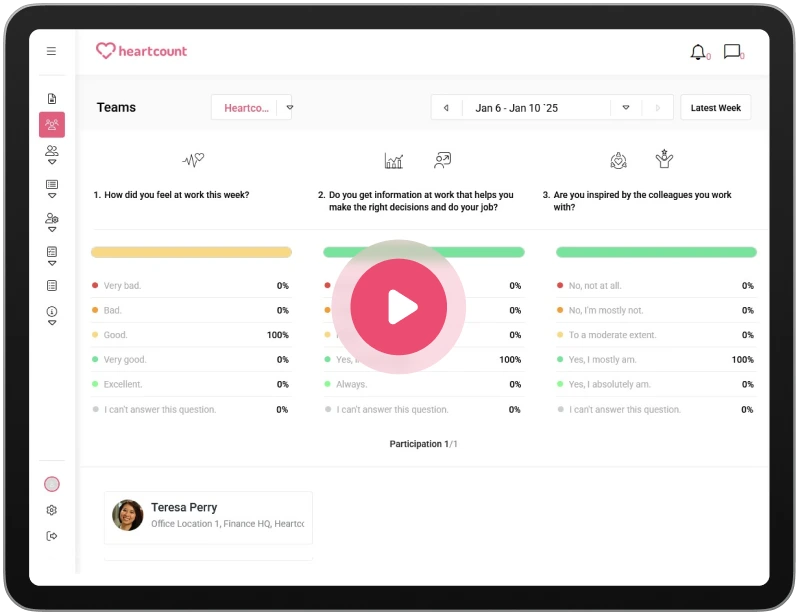
This is where HeartCount shines. It focuses on employee engagement and experience first. You get frequent pulse surveys, honest feedback, clear signals, and early warnings without complex workflows or dependence on managers. It’s built for speed, clarity, and action.
If your priority is understanding how people actually experience your organization, not just how they perform in reviews, HeartCount is a natural next step. It gives you early, honest signals you can act on quickly, without adding another heavy system. It’s easy to launch and free for small teams.