

Employee Engagement Strategies: 14 Proven Ways to Build a More Engaged Team




-
1.Why Employee Engagement Strategies Fail Without a System
-
2.The 3-Phase Employee Engagement Strategy Framework
-
3.Phase 1: Measure First
-
4.Phase 2: Act on What the Data Shows
-
5.Phase 3: Close the Loop
-
6.How to Develop an Employee Engagement Strategy Step by Step
-
7.Build an Employee Engagement Strategy That Actually Sticks
-
8.FAQs




Global employee engagement fell to 20% in 2025, the lowest level since 2020, according to Gallup’s 2026 State of the Global Workplace report. Every percentage point of disengagement represents roughly 21 million workers. At scale, that adds up to an estimated $10 trillion in lost productivity annually.
Most HR teams are aware of the problem. The harder question is what to do about it — specifically, systematically, in a way that doesn’t reset to zero every six months.
This guide lays out 14 employee engagement strategies organized into a three-phase framework: Measure, Act, and Close the Loop. Each phase builds on the previous one.
You can run pulse surveys and collect trend data. You can recognize contributions and invest in growth. But none of it compounds if you don’t close the loop with your people — showing them that their feedback actually made a difference. That final step is where most engagement programs quietly fail.
| For the foundational theory behind why engagement matters, see our employee engagement model. This guide focuses on practical implementation. |
Why Employee Engagement Strategies Fail Without a System
Most organizations don’t have an engagement strategy. They have engagement activities — a recognition program here, an annual survey there, a few team lunches. These things aren’t bad, but they don’t compound because they’re not connected to each other or to data.
The pattern is familiar: a survey goes out, results come back, leadership schedules a meeting, action items get assigned, six months pass, nothing visibly changes, and participation drops in the next survey. Repeat.
The business cost of this cycle is high. Gallup’s ongoing Q12 research shows that highly engaged teams are 23% more profitable and 18% more productive than their low-engagement counterparts.
Deloitte research similarly finds that employees at high-engagement organizations show 57% greater discretionary effort — the Corporate Leadership Council’s term for the difference between doing the minimum and genuinely contributing.
| The ROI case for engagement is well-documented. For a full breakdown, see The ROI of Employee Engagement. |
A system fixes the cycle. When measurement informs action, action gets tracked over time, and employees see visible results from their input, engagement compounds. That’s what the three-phase framework in this guide is designed to deliver.
The 3-Phase Employee Engagement Strategy Framework
The 14 strategies in this guide are grouped into three phases:
- Phase 1: Measure First — Understand what’s actually driving engagement in your organization before taking any action.
- Phase 2: Act on What the Data Shows — Address the real drivers with targeted, evidence-based approaches.
- Phase 3: Close the Loop — Track progress, integrate engagement into performance conversations, and show employees what changed as a result of their input.
Phase 1: Measure First
Before deciding which engagement initiatives to prioritize, you need to know what’s actually broken. Without data, you’re guessing. And in a 200-person organization, guessing means deploying a company-wide program to solve a problem that only one department has.
Strategy 1: Run Regular Pulse Surveys
Annual engagement surveys have one fundamental limitation: by the time results arrive, the conditions that created them have often already changed. An employee who was struggling in March looks fine in December’s data, because they left in September.
Pulse surveys fix this. Short, frequent check-ins, typically 3–5 questions, weekly or biweekly, give HR teams a rolling picture of sentiment across the organization. They’re quick enough that participation stays high, and frequent enough to catch disengagement before it becomes turnover.
Vega IT, a software development company, moved from quarterly surveys to weekly pulse check-ins. Over four years, employee turnover dropped by 7%, and during the same period, the company sustained annual profit growth exceeding 30%.
The connection isn’t coincidental: when you know who’s struggling before they’ve mentally checked out, you can act in time.
| For survey question ideas, see Employee Engagement Survey Questions. |
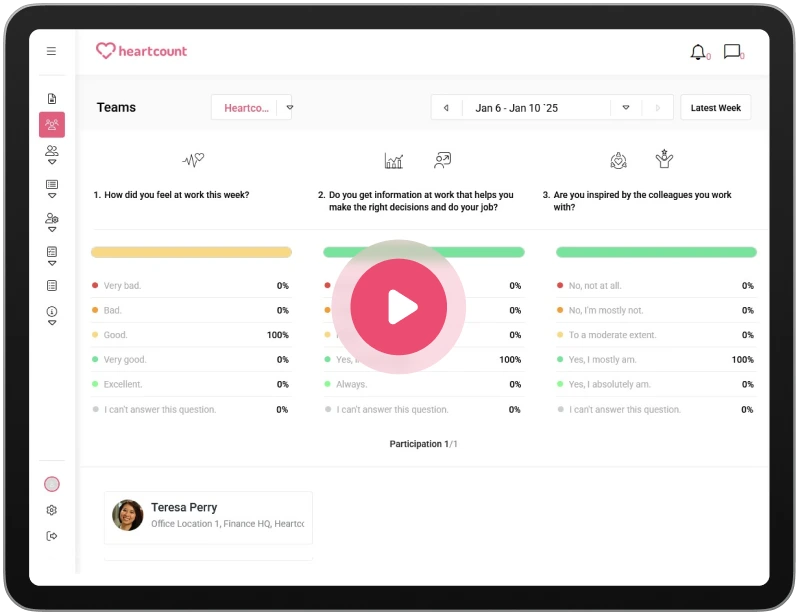
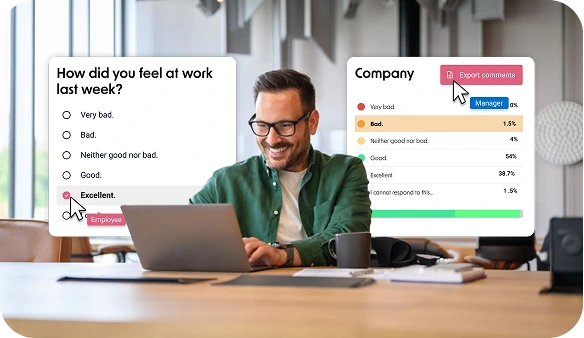
HeartCount runs pulse surveys on an automated weekly or biweekly cadence. Employees complete them in under a minute. HR teams see results segmented by team, department, and engagement driver without manually aggregating spreadsheets.
Strategy 2: Analyze Engagement Drivers
Knowing that engagement is low isn’t enough. You need to know why it’s low, and the answer is almost never the same across organizations.
Engagement has multiple drivers: relationship with management, growth opportunities, recognition, psychological safety, job clarity, workload, and team dynamics. A drop in your overall engagement score could mean any of them.
Driver analysis, looking at which factors correlate most strongly with your engagement index, tells you where to focus.
HeartCount’s AI Insights module analyzes weekly pulse data across eight engagement categories and surfaces the specific drivers pulling scores down. Instead of manually reviewing 40 survey questions, HR managers see a prioritized view of what’s actually moving the needle, and for which teams.
Strategy 3: Segment by Team, Role, and Tenure
Company-wide averages are misleading. An overall engagement score of 72% can mask your engineering team’s 85% and customer support’s 55%. Without segmentation, you’d never know, and you’d deploy the wrong intervention for the wrong group.
Segment your engagement data by:
- Team and department
- Manager
- Role type (individual contributor, manager, frontline, remote)
- Tenure (new hires, 6–18 months, 3+ years)
- Work model (remote, hybrid, on-site)
Tenure segmentation is particularly valuable. Gallup data consistently show a dip in engagement around the 1–2-year mark, when onboarding energy has faded, but the employee hasn’t found their growth path. Catching that dip early with targeted 1:1s prevents a slow, invisible slide into disengagement.
HeartCount’s Employees’ Overview provides segmented engagement data across all these dimensions in real time, without additional configuration.
Strategy 4: Share Findings with Managers
Data sitting in an HR dashboard doesn’t change anything. Engagement moves when managers understand what’s happening in their teams and have the context to act on it.
Build a regular rhythm of sharing team-specific engagement summaries with managers, a concise view they can bring into their next 1:1s. The goal is to make managers feel equipped, not evaluated.
When a manager sees that two team members have scored low on the relationship with management metric for three consecutive weeks, they can have a conversation before it results in a resignation. That’s the operational value of real-time data.
Phase 2: Act on What the Data Shows
Once you know which drivers are pulling engagement down, the strategies in this phase give you targeted approaches to address them. Don’t deploy all seven at once; prioritize based on your driver analysis from Phase 1.
Strategy 5: Build Psychological Safety
In 2012, Google launched Project Aristotle to understand what made high-performing teams successful. After studying 180 teams and 250+ variables, it found that the key factor was psychological safety: employees felt comfortable speaking up, admitting mistakes, and sharing ideas without fear. The finding has since been replicated across industries and company sizes.
In HR terms, psychological safety is the difference between a team that flags problems early and one that hides them until they explode.
Practical steps:
- Managers respond to concerns with curiosity, not defensiveness
- Mistakes are discussed openly as learning events, not used as performance ammunition
- Anonymous feedback channels are available so employees can speak honestly without risk
HeartCount‘s Anonymous Comments in the Communication Module give employees a confidential channel to share real concerns, which is a practical foundation for psychological safety in teams where trust is still being established.
Strategy 6: Enable Meaningful Work
People stay engaged when their work feels significant. Not every task is intrinsically motivating, but every role can be connected to an outcome that matters.
Make that connection explicit. This means more than a mission statement on the wall. It means managers regularly explain how their team’s output feeds into something larger, and call out specific contributions when results are delivered.
Role clarity is a related driver. Gallup’s meta-analysis across 112,312 teams found that knowing what’s expected of you is the single strongest predictor of engagement, and role clarity has been declining globally since 2020. Teams that combine purpose-driven communication with clear expectations consistently outperform those that have neither.
Strategy 7: Recognize Contributions Consistently
Recognition is one of the highest-leverage, lowest-cost engagement levers available — and it’s massively underused.
Research analyzing data from 25,285 employees published in PLOS ONE found that regular recognition increases engagement, and frequency matters more than reward size. Employees recognized weekly are much more engaged than those recognized monthly, while monthly recognition has a modest advantage over no recognition at all.
A specific, genuine thank-you delivered soon after an achievement has more impact than a formal annual award. Recognition should come from managers, peers, and colleagues across teams. When appreciation becomes a regular part of daily work, it strengthens engagement and connection to the job.
HeartCount’s Kudos Cards enable peer-to-peer recognition directly within the platform.
| For a deeper look at how recognition drives retention, see What Is Employee Recognition. |
Strategy 8: Invest in Growth and Development
According to LinkedIn’s 2024 Workplace Learning Report, 94% of employees say they’d stay longer at a company that invests in their development. And yet the same research shows that only 15% of employees say their manager helped them build a career plan in the last 6 months, a figure that dropped another 5% in the 2025 edition.
Growth doesn’t mean promoting everyone. It means every person on your team has a clear answer to: What am I learning here, and where does this lead?
- Individual development plans are reviewed quarterly, not annually
- Stretch assignments that build skills outside the current role
- Internal mobility options communicated proactively
- Mentoring programs connecting junior and senior employees across departments
HeartCount’s Advanced Survey Reports track growth and development as a separate engagement category, surfacing which teams are falling behind on development conversations before the data shows up as turnover.
Strategy 9: Improve Manager-Employee Communication
According to Gallup’s State of the American Manager, managers account for at least 70% of the variance in team-level engagement. And the 2026 data makes this even more urgent: manager engagement globally fell from 27% to 22% in a single year, the steepest single-year drop Gallup has ever recorded for this group.
Disengaged managers underperform, but more importantly, they actively suppress the engagement of everyone below them. An HR team can deploy the best recognition program in the industry, but if the direct manager dismisses it or fails to participate, it won’t move the needle.
Improving manager-employee communication means:
- Regular 1:1s with a structured format, not just project status updates
- Managers trained to give specific, behavioral feedback rather than vague praise
- Team-level engagement data shared directly with managers so they can see their own impact
When managers are equipped with their team’s engagement data, they shift from guessing to responding. That operational shift is what makes engagement strategies stick at the team level.
Strategy 10: Foster Connection in Hybrid and Remote Teams
A Gallup study found that employees prefer hybrid or fully remote arrangements. That preference isn’t going away, which means engagement strategies need to work across distributed teams, not only in the office.
The core challenge with hybrid teams is proximity bias, the tendency for in-office employees to receive more recognition, more career opportunities, and more manager attention simply because they’re physically visible. Remote employees who feel invisible disengage faster than those who feel connected.
Strategies that improve engagement in remote and hybrid teams include:
- Clear communication practices that work across time zones
- Digital recognition programs that include all employees, regardless of location
- Mobile-friendly pulse surveys that make participation easy for remote and frontline staff
- Regular virtual touchpoints that help people stay connected without forcing team-building activities
For more on remote employee engagement strategies, see the FAQ section below.
Strategy 11: Create Channels for Anonymous Feedback
Employees know things HR and leadership don’t. They see the manager who takes credit for their team’s work. They know why 3 people in the same department quit in 6 months. They notice when a policy is hurting morale before any survey captures it.
Most of that knowledge never surfaces because the cost of speaking up feels higher than the cost of staying quiet.
Anonymous feedback channels change that equation. When employees can share concerns without attaching their names, participation rates go up, and signal quality improves. HR teams get access to the real picture, not the sanitized version that surfaces in direct conversations.
The gap between what employees know and what leadership hears is a structural problem, and anonymous channels are one practical way to close it. The channel only works if feedback visibly leads to action. More on that in Strategy 14.
Phase 3: Close the Loop
This is the phase most engagement programs skip, and the reason most of them plateau. Measuring and acting create momentum. Closing the loop sustains it by showing employees that their input actually makes a difference.
Strategy 12: Build Continuous Performance Conversations
Annual performance reviews often do little to improve engagement. They happen too infrequently, focus heavily on past performance, and can feel more like evaluations than conversations.
Many organizations now use regular manager-employee check-ins instead. Adobe’s Check-In model is a well-known example that replaces annual reviews with ongoing discussions about progress, goals, and career growth. The approach helped reduce voluntary turnover and became a model for modern performance management.
The principle is simple: make feedback an ongoing conversation rather than a once-a-year event. Regular one-on-ones should cover how employees feel about their work, not just what they’re working on.
When performance discussions become a normal part of work, employees are more likely to feel supported, engaged, and invested in their growth.
Strategy 13: Track Engagement Over Time
A single engagement score tells you almost nothing. Trend data tells you a great deal.
Tracking engagement over time shows whether your initiatives are working and where the next problem is forming. More importantly, it gives HR teams something concrete to bring to leadership: “Our engineering team’s engagement has risen 8 points over 12 weeks since we introduced biweekly 1:1s. Customer support has dropped 5 points — here’s why.”
Employees with low intent to stay often leave within 3 to 6 months after that signal appears in survey data. Trend tracking turns what would be a missed signal into an actionable early warning.
HeartCount tracks engagement trends across all survey dimensions and displays them in a visual dashboard, with historical comparison, team-level breakdowns, and automated alerts when scores shift significantly week over week.
Strategy 14: Communicate Actions Taken to Employees
This is the single most underused strategy in engagement program design, and the one with the highest return per effort invested.
When employees see that a survey they completed in October led to a concrete change in November, they learn that their input matters. Participation in the next survey goes up. Trust in the process goes up. And engagement compounds over time.
When nothing visibly changes after a survey, the opposite happens. Employees conclude the process is performative. Participation drops. The organization gets the signal it deserves: silence.
According to a 2026 GSIC report, nearly 4 in 10 organizations struggle to show that employee feedback leads to action. That gap is both a trust problem and a missed opportunity.
The “You said, we listened” communication doesn’t need to be elaborate. A monthly internal update that says “Based on your feedback in Q3, here’s what we’re changing” is enough. Specificity matters more than format.
| For a deeper look at building effective feedback loops, see Employee Feedback Loop. |
How to Develop an Employee Engagement Strategy Step by Step
Developing an employee engagement strategy doesn’t require a six-month planning process. It requires five decisions made in the right order.
- Step 1: Baseline your current engagement. Before any initiative, run a pulse survey to establish where engagement stands by team, driver, and segment. You can’t improve what you haven’t measured.
- Step 2: Identify your top two or three engagement drivers. Driver analysis will show where the problem is. Focus there first, not on the most visible or easiest-to-deploy program.
- Step 3: Build an action plan with named owners and timelines. Vague commitments don’t move engagement. Each initiative needs an owner, a start date, a definition of success, and a review date.
- Step 4: Communicate the plan to employees. Tell your people what you found in the data and what you’re doing about it. This step alone moves engagement scores before a single initiative launches.
- Step 5: Measure, report, and iterate quarterly. Engagement strategy is not a project with an end date. It’s an ongoing cycle. Review driver data quarterly, report results to leadership with business context, and adjust based on what’s working.
| For a combined view of engagement and retention within the same framework, see Employee Engagement and Retention Strategies. |
Build an Employee Engagement Strategy That Actually Sticks
Ready to stop guessing and start seeing what’s actually driving engagement in your teams? HeartCount runs automated pulse surveys, segments data by team and driver, surfaces AI-generated insights, and tracks trends over time — so HR teams can move from data to action in hours, not weeks. Explore HeartCount.
FAQs
What are the most effective employee engagement strategies?
The most effective employee engagement strategies focus on the factors that have the biggest impact on employees’ day-to-day experience. These often include manager support, regular recognition, opportunities for growth, and a workplace where people feel comfortable sharing ideas and concerns.
How do you measure the success of an employee engagement strategy?
Look beyond the overall engagement score. Track changes in engagement over time, participation rates, and scores for key drivers such as recognition, communication, and career development. Monitor business metrics like turnover and absenteeism to see whether engagement improvements are having a broader impact.
What is the difference between engagement strategies and engagement activities?
Engagement activities are one-time events, such as team lunches, celebrations, or wellness initiatives. Engagement strategies are ongoing efforts that improve employees’ day-to-day work experience, including regular feedback, manager training, recognition programs, and career development opportunities.
How often should you review your employee engagement strategy?
Most organizations should review engagement data monthly and assess their overall strategy every quarter. This makes it easier to spot problems early, evaluate progress, and adjust initiatives before engagement issues begin affecting performance or retention.
What employee engagement strategies work best for remote teams?
Remote teams respond well to regular one-on-one meetings, frequent recognition, clear communication, and opportunities to share feedback. Mobile-friendly pulse surveys and updates that show how employee feedback is being acted on can also help remote employees feel connected and included.