

15 Employee Engagement Ideas and Activities That Actually Work in 2026








A new hire joins full of energy, asks good questions, and volunteers for extra work. Three months later, they barely speak up in meetings and reply to messages a day late. This shift happens in almost every company, and it rarely comes down to the person. The reason is usually how engaged they feel.
Real engagement comes from small, repeated actions throughout the year: how someone is welcomed, how their feedback is used, how their wins are noticed.
Below are 15 employee engagement ideas and activities you can start using this week.
15 employee engagement ideas and activities for 2026
These ideas cover the everyday moments that shape how engaged people feel, from someone’s first week to how recognition and feedback show up over time. Each one includes a short explanation of why it matters and a practical way to put it into action.
You do not need to roll out all 15 at once. Start with whichever feels most relevant to your team right now.
1. Make new hires feel welcome from day one
How someone is treated in their first weeks shapes how long they stay and how hard they work later on. A short welcome note from the team, a clear walkthrough of company values, and a buddy who can answer small questions all make a real difference.
Pair this with structured onboarding survey questions so you catch confusion or friction early, before it turns into disengagement.
How to do it: Send a short welcome message from the team before the new hire’s first day. Walk them through company values and how their role fits into the bigger picture during week one. Assign a buddy who is not their manager, someone they feel comfortable asking small questions. Check in again at the 30- and 60-day marks, not only on day one.
2. Set clear expectations early
Confusion about a role is one of the fastest ways to lose someone before they have even settled in. Deloitte’s 2026 Global Human Capital Trends report found that a third of employees experienced 15 or more major changes at work in the past year, and only 27% felt their organization handled those changes well.
Regular one-on-one conversations give managers a simple way to keep expectations clear even as priorities shift around them.
How to do it: Write down what success looks like for the role in the first 90 days, not just a list of tasks. Walk through it together in the first one-on-one instead of sending it over email. Revisit it every few weeks, since priorities shift faster than job descriptions do.
3. Bring employees into decisions that affect them
People commit more fully to decisions they helped shape. Share the reasoning behind a change before it happens rather than after, and build small cross-department groups so different perspectives reach leadership directly. This is the foundation of a real culture of collaboration, where ideas move in both directions instead of only downward.
How to do it: Before rolling out a change, share the problem you are trying to solve and ask for input from the people it affects. Set up a small, rotating group across departments to get an early look at upcoming decisions. Close the loop publicly afterward and explain what was decided and why, even when you did not follow every suggestion.
4. Build a steady feedback loop
A single annual survey cannot catch a problem while it is still small. A proper feedback loop closes the gap between hearing from employees and acting on their feedback.
SHRM’s 2026 State of the Workplace research found that 91% of employees who believe their organization handles workplace needs well report being satisfied with their jobs, compared to 44% among those who do not.
The gap usually comes down to what happens after the feedback is collected.
How to do it: Replace the once-a-year survey with short monthly or quarterly pulse checks. Share results with the team within a week, not months later. Pick one or two action items per cycle, follow through on them, then report back on what actually changed.
5. Celebrate wins as they happen
Recognition loses most of its value if it shows up weeks late. A quick mention in a team channel, a handwritten note, or a two-minute shoutout at the start of a meeting are forms of recognition that often land better than a single annual awards dinner.
How to do it: Open team meetings with two minutes of peer recognition. Use a shared channel where anyone, not only managers, can call out good work. Match the size of the gesture to the size of the win, a quick shoutout for daily effort, and something more visible for bigger milestones.
6. Protect work-life balance
Employees who never switch off eventually stop performing at their best. Set clear norms around after-hours messages, encourage people to actually use their vacation days, and watch for the early signs of burnout on your team before someone quietly starts job hunting.
How to do it: Set written norms for after-hours messages, for example, no expectation to reply outside working hours unless something is urgent. Keep an eye on who is not using their vacation days and check in with them directly. Train managers to notice early warning signs in their team instead of waiting for someone to say they are struggling.
7. Let employees help shape their own rewards
A reward only motivates someone if it is something they actually want. Ask your team what matters most to them through a short survey, then offer a short list of real options instead of guessing on their behalf.
How to do it: Run a short survey asking what kind of recognition people actually want: extra time off, a gift card, public praise, or more flexibility. Offer a small set of real choices rather than a single fixed reward for everyone. Revisit the list every six months, since preferences tend to change.
8. Invest in long-term growth
People tend to stay where they can picture a future for themselves. Mentorship, internal mobility, and real access to training all signal that the company is thinking about someone’s career, beyond their current task list.
SHRM’s 2025 Employee Benefits Survey found that 65% of employers now rank professional and career development benefits as very or extremely important, a clear sign that this has become a baseline expectation in many companies.
How to do it: Set up a simple mentorship pairing program, even informal pairs who meet once a month are enough to start. Budget a fixed amount per employee per year for courses or certifications. Put together a basic growth and development path for each role so people can see what comes next.
9. Build connection through shared activities
Team building does not require a big budget or an in-person office. A handful of well-run virtual team-building activities can build more genuine connections than an expensive offsite that nobody remembers a month later.
How to do it: Pick activities tied to the team’s actual interests rather than a generic icebreaker everyone has done before. Keep them short; 30 to 45 minutes is usually enough for a virtual session. Rotate who plans them so the same one or two people are not always doing the extra work.
10. Create real belonging
Belonging shows up when people feel safe sharing an unpopular idea in a meeting, when they get credited for their own results, and when they are included long before any holiday party invitation goes out. Building a genuine culture of belonging takes ongoing attention to who gets heard and who gets left out of the conversation.
How to do it: Notice who speaks the least in meetings and create direct space for them to contribute. Make sure credit for results goes to the people who actually did the work, not just the most senior person in the room. Support small interest-based groups even when they are not tied to a formal company initiative.
11. Give people the right tools
Clunky systems quietly drain engagement every single day. When people spend more time fighting their tools than doing their actual work, frustration builds quickly and later shows up as disengagement.
How to do it: Ask employees once a quarter what tool or process wastes the most of their time. Pilot new tools with a small group before rolling them out to the whole company. Cut tools nobody actually uses, since adding more software is not the same as solving the underlying problem.
12. Offer real flexibility
Most employees now expect a real degree of flexibility as a basic part of the job. The same SHRM 2025 Employee Benefits Survey found that 68% of employers still rank flexible working benefits as very or extremely important, even after a small dip from the year before.
Give people genuine control over when and where they work, whenever the role allows, and clearly explain which roles cannot offer that and why.
How to do it: Define which roles can offer flexible hours or remote work, and be transparent about why other roles cannot. Let people choose their own core hours where possible instead of a fixed 9 to 5. Review the policy with managers regularly so it does not quietly become stricter over time.
13. Run stay interviews before people quit
Exit interviews explain why someone has already left. Stay interviews ask the more useful question while there is still time to act, simply asking people what would make them want to stay another year. The answers are often smaller and easier to fix than most leaders expect.
How to do it: Ask a small set of open questions: what makes you want to stay, what might make you leave, what would you change if you could. Run them with employees who are doing well, not only with those who seem at risk of leaving. Look for patterns across multiple interviews rather than acting on one person’s preference alone.
14. Support employee resource groups
Employee resource groups (ERGs) give people with shared backgrounds, identities, or interests a structured way to connect with one another and be heard by leadership. A women in leadership group, a parents network, or a group built around a shared cultural background are all common examples, and most start small before growing into something more formal.
They tend to work best when employees propose and lead them, rather than when HR assigns leadership from the top, with the company providing a small budget and a direct line to decision-makers.
How to do it: Let employees propose and lead groups rather than assigning leadership from the top. Give each group a small budget and visible support from leadership. Connect group leaders with HR regularly so feedback actually reaches the people who can act on it.
15. Make giving back part of the culture
A team volunteering afternoon or a company-wide charity drive gives people a shared purpose beyond their daily to-do lists. It costs little to organize and tends to stick in people’s memories long after the event, especially when employees get a say in choosing the cause.
How to do it: Offer a few cause options instead of picking one for the whole company. Give employees paid time to volunteer rather than asking them to use their personal time. Share photos or a short recap afterward so the effort feels recognized, not just completed.
Use the right tools to make engagement stick
Reading through a list like this once will not change much on its own. Teams that see real results treat these ideas as an ongoing habit rather than a one-time project, and they use data to see which ones are actually working for their people.
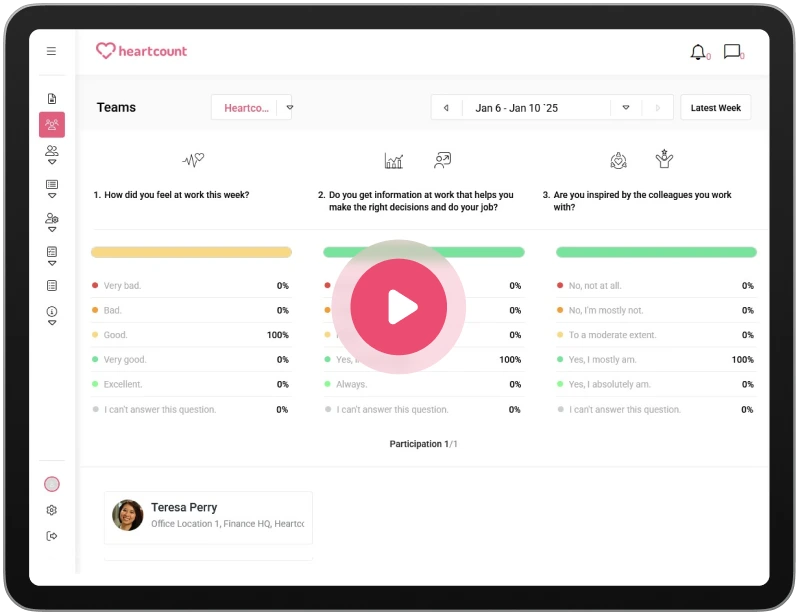
HeartCount helps with exactly that part. Weekly pulse checks show how people are feeling before it turns into a resignation letter, the Praise feature makes recognition visible across teams, and AI-powered alerts flag employees at risk of disengaging early enough to act.
Start now and see insights in 24 hours. Plans are available for every team size.
Employee Engagement Ideas FAQs
What are good employee engagement ideas for small companies?
Small teams get the most out of low-cost, high-frequency actions like quick recognition shoutouts, regular one-on-one check-ins, and flexible scheduling. Consistency matters more than budget.
What are the best employee engagement ideas for remote or hybrid teams?
Short virtual team-building activities, async recognition channels, and clear communication norms tend to work best for distributed teams.
How often should companies run employee engagement activities?
Treat engagement as an ongoing habit rather than a single event. Mix daily or weekly actions like recognition with quarterly check-ins, such as pulse surveys or stay interviews.
How do you know if your employee engagement ideas are actually working?
Track simple signals like pulse survey scores, participation rates, and turnover, not just whether an activity took place. If those numbers do not move over a few months, revisit which ideas you are actually using.
What is the difference between employee engagement ideas and employee engagement strategies?
Ideas are specific, hands-on activities like recognition shout-outs or team-building. Employee engagement strategies are the broader systems that ensure those activities remain consistent.