

Warning Signs of Unhappy Employees: How To Spot Them Early (and What To Do About Them)








Most employees don’t walk into their manager’s office and say they’re unhappy. They don’t send an email, they don’t raise their hand in a team meeting, and they rarely say it directly until the day they hand in their resignation. By that point, the damage is already done. The team has felt the ripple effects for weeks or months, productivity has declined, and the employer is about to spend significant time and money replacing someone who could have been retained.
The signs of unhappy employees are almost always visible long before someone decides to quit. They show up in the way a person carries themselves in meetings, in how they respond to new tasks, and in how often they’re actually present, physically and mentally.
Happy employees behave very differently from unsatisfied employees, and once you know what to look for, the contrast is hard to miss. A happy employee brings energy, initiative, and investment to their work. An unhappy one gradually withdraws all three.
In this guide, I’ll cover warning signs that tell you an employee is struggling before the situation becomes irreversible. It’s organized into early-stage and late-stage signals because the right response depends heavily on how far the disengagement has already gone.

The Cost of Ignoring Unhappy Employees
“The biggest cost of ignoring unhappy employees isn’t the moment they resign; it’s everything that happens before. Gallup’s research shows disengaged employees cost organizations around 18% of their annual salary in lost productivity alone, and that’s before you factor in the impact on team morale, error rates, and the colleagues quietly absorbing the slack.”
Tamara Balog, Head of Customer Success, HeartCount
Every employer has a responsibility to understand what drives unhappiness at work for two reasons: it affects individual well-being and has business consequences.
Unhappy employees are far less productive than their engaged counterparts. Research from Gallup consistently shows that disengaged employees cost organizations through declining productivity, increased sick days, and higher turnover.
Replacing a single employee typically costs between 50% and 200% of their annual salary, including recruitment, onboarding, and the time it takes for someone new to reach full productivity. Employee retention suffers most when dissatisfied employees and unhappy staff go unnoticed for too long.
Beyond the financial cost, unhappy employees affect the people around them. Low team morale is contagious. When one staff member is visibly disengaged or checked out, it shifts the atmosphere for everyone. Colleagues pick up the slack, feel the tension, and sometimes start questioning their own job satisfaction.
In customer-facing roles, the consequences extend even further. Declining employee engagement often shows up as an increase in customer complaints, as disengaged workers stop going the extra mile for the people they serve.
Happy employees, by contrast, drive performance, strengthen workplace culture, and actively contribute to a positive work environment. The earlier an employer identifies and addresses unhappiness, the lower the cost in money, team morale, work quality, and the effort required to fix it.
Early-Stage Warning Signs of Unhappy Employees
Early-stage signs are subtle. There are changes in behavior that are easy to rationalize or overlook — a quieter week, a few missed deadlines, someone who seems a little off. On their own, none of these signals is conclusive. But when you notice several of them in the same person over two to four weeks, they deserve your attention.
1. Clock-Watching and Minimal Time Investment
An employee who was once absorbed in their work starts paying close attention to the clock. They arrive at the exact start time, take their full lunch break to the minute, take frequent breaks throughout the day, and begin packing up noticeably before the end of the day. They’re not breaking any rules; they’re simply making it clear that work is something to get through, not something they’re invested in.
This is one of the earliest and most reliable warning signs of disengagement. The employee hasn’t yet stopped doing their job, but their relationship with it has fundamentally changed. They’re fulfilling the contract, not the role.
In remote or hybrid teams, this shows up as logging off immediately at the end of the working day, not being available for anything outside strict hours, and a notable absence in team channels during the day.
What to do: Have a low-pressure one-on-one conversation. Frame it as a check-in, not a performance issue. Ask open questions about how they’re finding their workload, what they’re working on, and what they’re enjoying. The goal is to open a channel before the disengagement deepens.
2. Doing the Bare Minimum
“The early warning sign HR and managers most often miss is the quiet fade. The employee stops contributing ideas, stops pushing back, stops participating beyond the bare minimum. There’s no confrontation or complaint. Just a gradual withdrawal of energy and investment that’s easy to rationalize away until it’s too late to reverse.”
Tamara Balog, Head of Customer Success, HeartCount
A previously high-performing employee who starts delivering work that technically meets expectations but lacks the quality, initiative, or care they used to bring is a clear concern.
This pattern, sometimes called “quiet quitting,” means the employee is still present and completing tasks, but has mentally withdrawn from any investment in the outcome. They stop going beyond what’s asked, stop volunteering ideas, and do what’s on the list and nothing more. Work quality drops noticeably even when output volume stays the same.
In remote settings, this often appears as responses that are shorter than usual, participation in meetings limited to what’s directly asked, and deliverables that are correct but lack depth or thoughtfulness.
What to do: Acknowledge their recent work specifically, and find out if there’s something about their current tasks that isn’t working for them. Sometimes this pattern emerges when someone feels their contributions aren’t recognized, or when they’ve been stuck in tasks that no longer challenge them.
3. Withdrawal from Team Interaction
Unhappy employees tend to pull back from their colleagues. They stop joining informal conversations, skip optional team events, contribute less in group settings, and generally become more isolated in their day-to-day work. This is particularly noticeable in staff members who were previously social and engaged with the team.
The withdrawal often starts with small things: not joining a group lunch, being quieter in meetings, or responding to messages with shorter answers than usual. Over time, if nothing changes, the distance grows, and workplace culture starts to suffer as a result.
In remote teams, this manifests as cameras staying off during video calls, minimal participation in team chat channels, and a general absence from the informal communication that holds a distributed team together.
What to do: Don’t push social participation, but find a natural reason to connect one-on-one. Informal check-ins, even five minutes over coffee or a short call, give the employee a low-stakes way to open up if something is bothering them.
4. Reduced Initiative and Participation
An engaged employee contributes ideas, flags problems before they escalate, asks questions, and takes ownership of their work beyond the minimum scope.
When an unsatisfied employee stops raising their hand in meetings, suggesting improvements, and caring about outcomes beyond their immediate tasks, it signals they no longer feel invested in the work or the team.
What matters here is the change. Someone who used to contribute actively and has now gone quiet is sending a meaningful signal, and it tends to be consistent rather than tied to any single meeting or project.
What to do: In your next one-on-one, deliberately create space for their input. Ask for their opinion on something specific, or ask what they think could be improved in a current project. Sometimes employees disengage because they’ve felt ignored or dismissed in the past, and a genuine invitation to contribute can start to shift that dynamic.
5. Procrastination and Missed Deadlines
An employee who used to be reliable with deadlines starts letting things slip. Tasks get handed in late, work piles up, and follow-through on commitments becomes inconsistent. Procrastination at this level is usually a symptom of disengagement rather than a skill or capacity problem. The work feels meaningless or unpleasant, and starting it requires more effort than it used to.
This sign matters because it tends to compound. Missed deadlines create downstream problems for the team, which create friction and deepen the employee’s dissatisfaction and sense that things aren’t working.
What to do: Explore whether the employee’s current workload is contributing to the problem. Sometimes restructuring responsibilities or clarifying priorities early is enough to reverse this pattern before it escalates.
Late-Stage Warning Signs of Unhappy Employees
Late-stage signs are harder to ignore and more urgent to address. By this point, the unhappy employee has typically been struggling for a significant period of time, and the disengagement has hardened into consistent behavior. These signs often indicate that the employee is either actively considering leaving or has already made the decision internally.
6. Increased Sick Days and Absenteeism
A noticeable increase in sick days, unexplained absences, late arrivals, and early departures is one of the clearest late-stage indicators of an unhappy worker. When work feels like something to be avoided, people find ways to avoid it.
Often, the stress and emotional drain of employee unhappiness genuinely manifests as physical symptoms, fatigue, and a lowered threshold for taking a sick day.
The pattern to watch for is the change from an employee’s baseline. Someone who rarely took a sick day and now does so regularly, or someone who was always punctual and now arrives late several times a week, is showing you something important about their relationship with their work environment.
What to do: Address absenteeism early and directly, but with empathy rather than accusation. The conversation should start with genuine concern for the employee’s well-being, not a warning about attendance. Understanding the cause is far more important than responding to the symptom.
7. Negative Attitude and Constant Complaints
The concern here is when a negative attitude becomes a defining characteristic of how an employee shows up at work. They complain consistently about tasks, colleagues, processes, and company decisions. They’re cynical in meetings, dismissive of new initiatives, and seem to find fault with most things they encounter at work.
Every workplace has difficult days; the signal is persistence and breadth across weeks, not occasional venting after a hard deadline.
This kind of sustained negativity is both a sign of deep employee dissatisfaction and a real risk to team morale. It’s contagious, and if left unaddressed, it can significantly damage workplace culture.
What to do: Take a private, non-confrontational approach. Acknowledge that they seem frustrated and create space for them to explain what’s driving it. Sometimes this behavior stems from a specific unresolved issue: a conflict with a coworker, a decision they felt was unfair, or a sense that their contributions aren’t valued. Getting to the root cause is the only path to a real resolution.
8. Declining Performance and Work Quality
When an employee’s performance drops meaningfully, as shown by consistently missing deadlines, degrading work quality, increasing errors, and targets not being met, it’s a serious sign that something has gone wrong.
At this stage, the employee may no longer be meeting even the basic expectations of their role, which is a step beyond the early-stage pattern of just doing the minimum. Declining productivity at this level is difficult to hide and impossible to ignore.
Poor performance compounds. The employee is aware that their work isn’t meeting expectations, which increases stress and reduces confidence, which further affects their output and overall employee experience.
What to do: A performance conversation is necessary at this stage, but it should be paired with a genuine effort to understand what has changed. Addressing the root cause, whether that’s unhappiness, burnout, a personal situation, or a role mismatch, is what determines whether performance actually improves.
9. Burnout and Mental Health Struggles
“Whether a burned-out employee can reengage depends on how far the disengagement has gone. For some, rest, a different manager, more autonomy, a clearer path forward can genuinely turn things around. For others, the negative emotional residue toward that workplace has already hardened, and even real improvements won’t be enough to change the outcome.”
Tamara Balog, Head of Customer Success, HeartCount
Burnout is a state of chronic physical and emotional exhaustion that develops when workplace stress is sustained over a long period without adequate recovery. It shows through:
- Persistent fatigue
- Emotional detachment
- Difficulty concentrating
- Reduced ability to handle normal workload
- Increased irritability
An employee showing burnout symptoms is someone who has been unhappy or overwhelmed for a significant amount of time. In some cases, burnout develops alongside more serious mental health issues that require professional support.
Burnout doesn’t resolve itself. Without meaningful intervention, it deepens and typically ends in resignation or prolonged absence, both of which are significant blows to employee retention.
In remote settings, burnout is harder to spot because the employee isn’t physically visible. Signs to watch for include consistently slow responses, a noticeable drop in communication quality, and an inability to maintain output consistently over time.
What to do: Burnout requires more than a conversation. It typically requires concrete changes, such as workload reduction, time off, adjusted responsibilities, and, in some cases, access to professional mental health support. It’s also a signal to review whether the employee’s work-life balance and overall working conditions are sustainable in the longer term.
10. Chronic Stress and Physical Strain
Chronic workplace stress leaves visible traces. A deeply unhappy employee may appear consistently tired, report physical symptoms such as headaches or muscle tension, and show noticeably lower energy than before. They may regularly feel overwhelmed and struggle to decompress even outside working hours, a clear sign that work-life balance has broken down entirely.
Stress at this level affects sleep, concentration, and physical health, creating a cycle that’s genuinely difficult to break without intervention. Left unaddressed, it often develops into full burnout or leads to extended health-related absences.
What to do: Approach this with care and genuine concern for the person. This is a conversation about the employee’s well-being first, and their work second. Asking directly whether they’re doing okay and meaning it often matters more at this stage than any formal process.
11. Conflict with Colleagues and Attitude Change
When an employee who previously had good working relationships with their coworkers suddenly becomes short-tempered, conflict-prone, or difficult to work with, it’s almost always a sign that something significant has shifted internally.
This can show up as friction in meetings, passive-aggressive communication, spreading negativity among the team, or simply a coldness toward colleagues that wasn’t there before.
This sign is particularly disruptive because it creates tension for everyone around the unhappy staff member and can damage team morale and workplace culture over time.
What to do: Don’t wait for formal complaints before acting. A direct, private conversation about what you’ve noticed is the right move. Keep the tone observational and focus on understanding what’s behind the behavior change.
12. Customer Complaints Linked to a Specific Employee
In customer-facing roles, a pattern of customer complaints tied to a specific staff member is a late-stage warning sign that employers sometimes overlook. A disgruntled employee who has disengaged from their work no longer goes the extra mile for customers. Interactions become shorter, less helpful, and sometimes openly negative. Customers notice, and they complain.
When complaints about the same employee start to accumulate, it’s rarely about a single bad interaction. It reflects a sustained change in how that person approaches their work and the people they serve, and it points directly to deeper employee dissatisfaction that needs to be addressed.
What to do: Address the pattern directly with the employee, but approach the conversation as an exploration rather than a reprimand. Consistent customer complaints are often the visible surface of a deeper problem with job satisfaction or employee engagement that needs to be uncovered.
13. Signs of Actively Looking for Another Job
By the time an employee is actively searching for another role, they have typically already made an internal decision. The signals can be subtle:
- Updating their LinkedIn profile
- Mentioning other companies or opportunities more often
- Showing less engagement in planning conversations about the future
- Noticeably lower investment in projects that won’t deliver results for several months
The window for retention at this stage is narrow but not always closed. Some dissatisfied employees who have started looking can be retained if the underlying issues are addressed directly and credibly. Others have already decided, and the most constructive response is to manage a respectful and professional transition.
What to do: If you suspect this is happening, have an honest conversation. Ask directly how they’re feeling about their role and whether there’s anything that would make it work better for them. At this stage, an employee can tell the difference between a real commitment to change and an attempt to buy time.
What to Do When You Spot Signs of Unhappy Employees
Recognizing the signs is only the first step. What you do with that information determines whether the situation improves or escalates.
- Start with a genuine conversation. The first response to any warning sign should be a private, informal conversation: not a formal meeting, not a performance review, just a sincere check-in. Ask how the person is doing, what they’re finding challenging, and what they enjoy about their work. The goal is to understand, not to diagnose or fix immediately.
- Address the root cause, not the symptom. Clock-watching is a symptom. Sick days are a symptom. The root cause might be a conflict with a coworker, a feeling of being undervalued, an unsustainable workload, a poor work-life balance, a lack of growth opportunities, or something entirely personal. Until you understand the root cause, any response will be superficial and temporary.
- Act on what you learn. Employees who raise concerns and see nothing change become more disengaged, not less. Even small, visible actions in response to feedback signal that the company takes their concerns seriously and genuinely cares about the employee experience.
- Follow up. A single conversation isn’t enough. Check in again in a week or two. Ask whether things have improved. Make the ongoing concern for their well-being visible and consistent.
- Know when to escalate. Some situations require HR involvement, additional support, or a more formal process. When an unhappy employee’s dissatisfaction is affecting the rest of the team, or when the root cause is beyond a manager’s ability to address, involving HR is the right move.
How to Catch Signs of Unhappy Employees Early
“Disengagement doesn’t arrive suddenly. It builds through small, consistent shifts that are easy to miss in isolation. Changes in how quickly someone responds, a drop in peer recognition, a shift in the tone of open comments, a quiet decline in eNPS scores. Individually, none of these signals is conclusive. Together, tracked over time, they form a pattern that’s visible weeks before it shows up in performance data or attrition.”
Tamara Balog, Head of Customer Success, HeartCount
The challenge with all of these warning signs is that they require consistent observation, which has natural limits.
An employer overseeing a large team, or leading a distributed workforce, can’t always see the subtle early-stage shifts in employee engagement that indicate a problem is developing. By the time the signs are obvious enough to be unmissable, the situation is often already at a late stage.
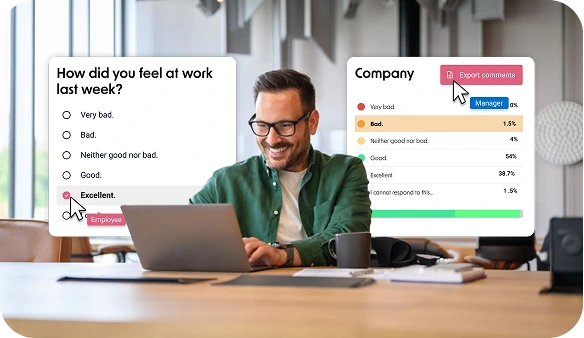
Pulse surveys are one of the most effective tools HR managers have for catching employee unhappiness before it becomes visible in behavior.
When employees are asked regularly and anonymously how they’re feeling about their work, their relationships with colleagues, their workload, and their sense of purpose, they share things they would never say directly. The data gives managers early visibility into problems that wouldn’t otherwise surface until they become serious threats to employee retention and team morale.
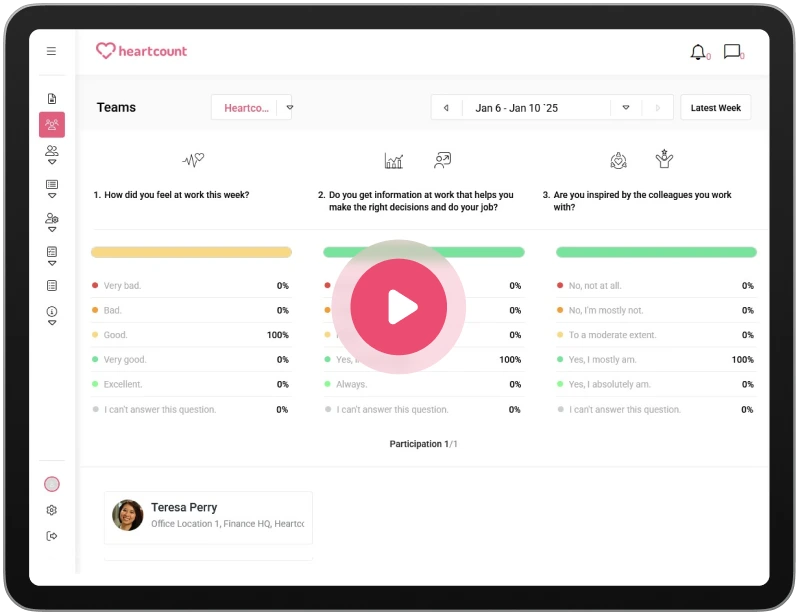
HeartCount is built specifically for this purpose. Weekly pulse surveys give managers a real-time view of how their teams are feeling across the dimensions that matter most for employee wellbeing and engagement.
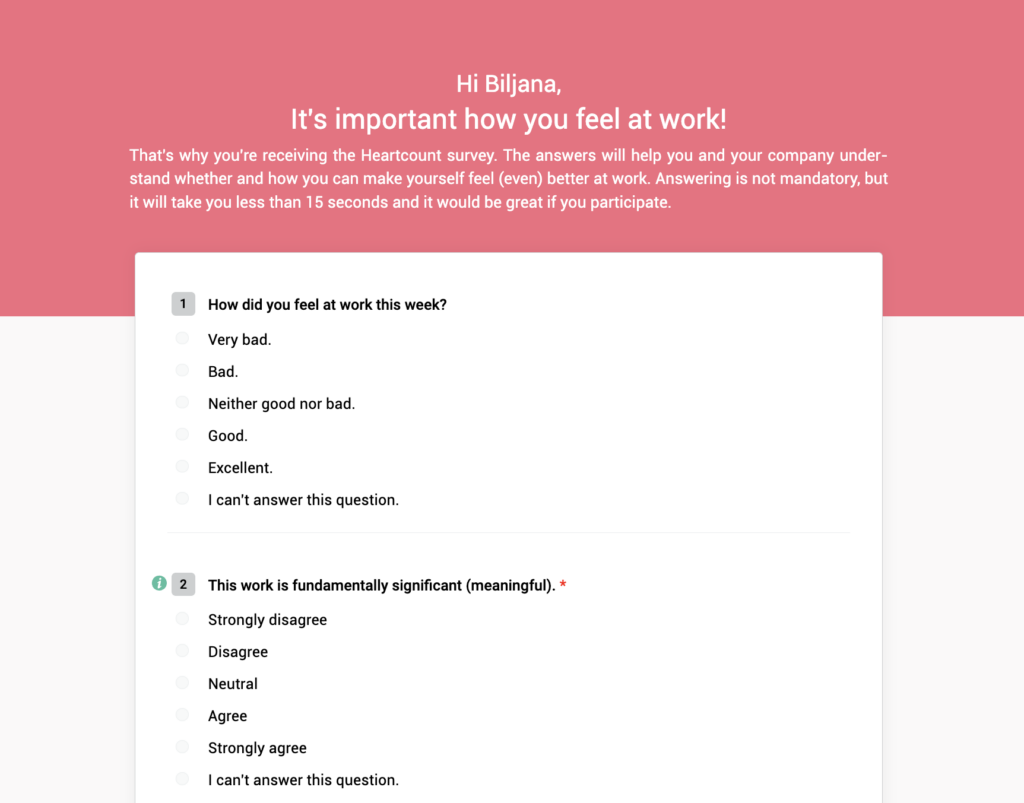
That way, you can track employees’ satisfaction and well-being, which is the basis for improvements.
The platform surfaces patterns over time, so instead of trying to read individual behavior signals across a busy week, managers get a clear and consistent picture of where team morale is strong and where it needs attention.
Employees can also use HeartCount to send private messages to management or HR, anonymously or under their own name, which creates a direct channel for concerns that wouldn’t otherwise be raised.
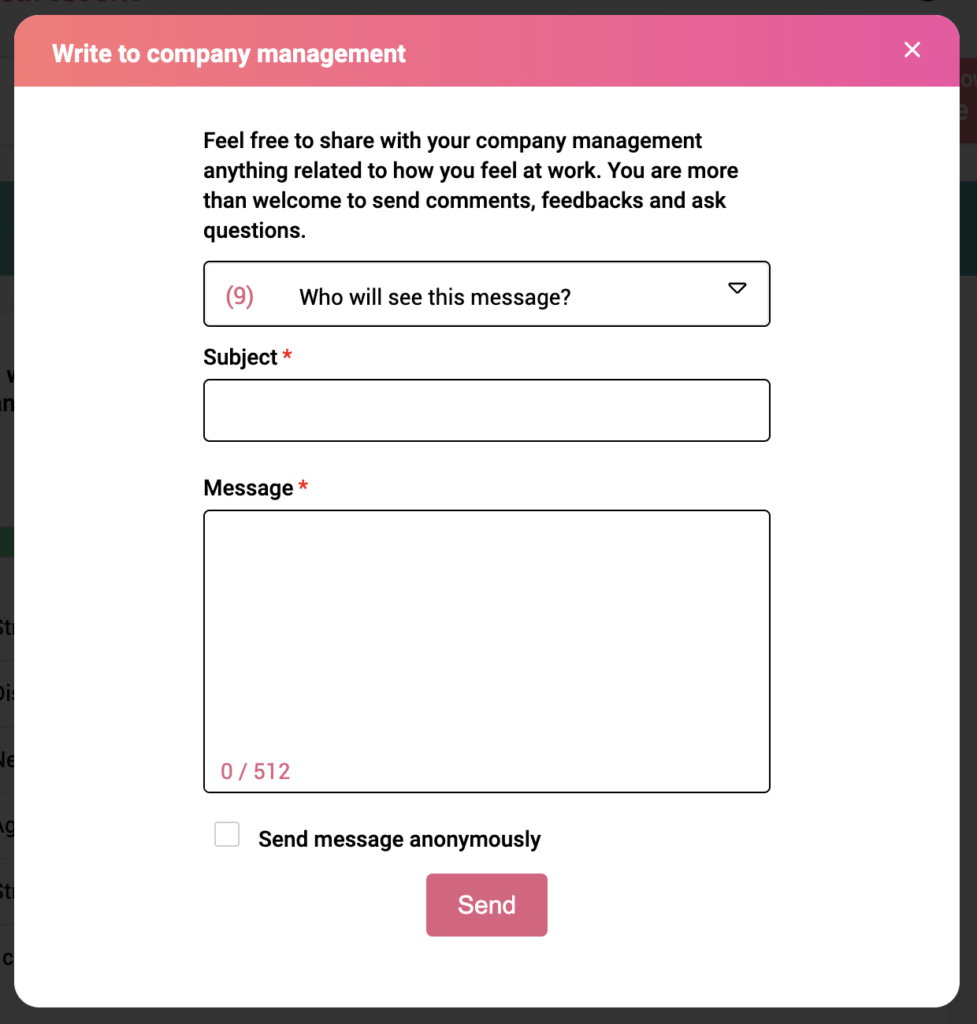
What’s more, with HeartCount, employees can write a comment directly to the HR department to request a meeting to discuss their concerns.

By actively creating channels for employees to share honest feedback, you take the first step toward building a happier, more engaged team.
FAQs
How can I tell the difference between a temporarily stressed employee and a genuinely unhappy employee?
Duration and breadth are the two key factors.
- Temporary stress usually has a clear cause (a difficult project, a tight deadline, a personal situation) and it resolves once that cause passes.
- Genuine unhappiness and job dissatisfaction show up across multiple areas at once: attitude, performance, engagement, and interactions with coworkers. When you’re seeing warning signs consistently over three to four weeks, that points to something deeper than a difficult period.
Should I address warning signs directly with the employee, or wait to see if things improve on their own?
Address them early. Waiting rarely leads to improvement and almost always worsens the situation. A simple, low-pressure check-in conversation costs very little and can significantly improve employee satisfaction and retention. The longer you wait, the harder the conversation becomes and the fewer options you have for a real resolution.
What if an unhappy employee denies being dissatisfied when I raise my concerns?
Some employees aren’t comfortable being honest with their manager about how they’re feeling, particularly if they don’t fully trust that the conversation will stay confidential or lead to anything positive.
Focus on the specific behaviors you’ve observed, express genuine concern, and leave the door open for them to come back when they’re ready. Continuing to check in informally over time builds the trust that makes honest conversation possible.
Can unhappy employees become re-engaged?
Yes, and it happens regularly, but only when the root cause of their unhappiness is genuinely addressed. Employees who feel unheard, undervalued, or stuck in roles that no longer fit them can become happy, highly engaged employees again once those issues are resolved.
The critical factors are acting quickly before the disengagement becomes entrenched, following through on commitments, and maintaining ongoing communication about the employee experience.
What is the difference between an unhappy employee and a disengaged employee?
An unhappy employee is experiencing negative emotions about their work, workplace culture, or work environment, such as dissatisfaction, frustration, or a sense that something isn’t right. Disengaged employees have moved a step further: they’ve stopped investing emotionally and practically in their work.
How do pulse surveys help managers identify unhappy employees?
Pulse surveys give managers access to employee sentiment data that wouldn’t otherwise be visible. Because they’re short, regular, and anonymous, employees are far more likely to share how they actually feel about their job satisfaction, workload, and work environment than they would be in a direct conversation with their manager.