

Employee attitude: What is it and how it affects workplace culture




-
1.What is employee attitude, and why does it matter
-
2.How to recognize an employee with a bad attitude
-
3.Characteristics of a positive employee attitude
-
4.What does a positive attitude at work actually look like?
-
5.Attitude examples: positive vs. negative in real workplace scenarios
-
6.Factors influencing employee attitudes
-
7.Dealing with an employee's negative attitude
-
8.Don't overlook employees with a positive attitude
-
9.How to create a positive attitude in the workplace
-
10.Employee attitude: Take charge of it
-
11.Employee Attitude FAQs




Employee attitude is the single biggest driver of workplace culture. It shapes employee performance, team dynamics, and organizational commitment more than any system or process ever could.
Employee attitude is contagious. A bad one can infect an entire workplace.
New hires arrive full of enthusiasm, ready to make a positive impact. However, an employee with a bad attitude can quickly dampen that spirit with constant negativity. They distort the workplace atmosphere, focusing on the negative while overshadowing what’s going well.
A negative work environment is demotivating and leads to reduced employee productivity and increased turnover. Moreover, a toxic coworker can create a hostile subculture within your organizational culture, making it difficult for new hires to integrate and feel welcomed.
Harsh truth: bad attitudes cost money. And the above are just some of the consequences. Let’s talk about it.
What is employee attitude, and why does it matter
Employee attitude is a worker’s overall mental disposition toward their job, employer, and workplace, and it directly determines their job satisfaction, organizational commitment, and day-to-day behavior at work.
Employee attitude refers to the mental state or disposition an individual brings to work. It includes their feelings, beliefs, and values about their job, colleagues, and the organization as a whole. This mindset can be positive, negative, or neutral, and significantly influences their behavior and employee performance.
Employee attitude is the foundation of organizational success.
As Simon Sinek, a business leadership author, states: “You don’t hire for skills, you hire for attitude. You can always teach skills.” A positive employee attitude creates a productive, collaborative, and innovative work environment. Conversely, a negative attitude can erode organizational culture and lead to high turnover.
Attitude impacts every important aspect of employee engagement:
- Employee productivity: Employees with a positive attitude are more motivated, engaged, and focused. They are more efficient, make fewer errors, and go the extra mile. Conversely, negative attitudes lead to procrastination, absenteeism, and decreased output, all of which directly hurt employee performance.
- Employee morale: A positive work attitude lifts the atmosphere and creates a supportive, enjoyable work environment. Negative attitudes dampen morale, leading to dissatisfaction and burnout, and dissatisfied employees rarely stay.
- Teamwork: Positive attitudes facilitate collaboration, trust, and open communication. Employees with a good attitude are more likely to be team players and contribute to healthy team dynamics. Negative attitudes create friction, hinder cooperation, and generate conflicts that an HR manager then has to resolve.
Some common indicators that an employee is struggling with their workplace attitude include:
- Decreased employee productivity and quality of work
- Increased absenteeism and tardiness
- Negative body language and poor communication
- Complaining and blaming others
- Lack of enthusiasm and low employee morale
- Difficulty getting along with colleagues
- Resistance to change and new processes
How to recognize an employee with a bad attitude
Recognizing a bad attitude early requires a combination of structured employee feedback tools, direct observation, and consistent manager check-ins, because employees with poor attitudes often mask their feelings until the damage is already done.
Identifying employees with a negative attitude can be challenging because they often conceal their true feelings. However, several techniques can help you uncover potential issues before they spread across your workplace culture.
Regular pulse checks
Pulse check surveys are the fastest way to detect a declining work attitude across your team. They surface problems in days, not months.
Pulse checks are short, frequent surveys that help you gauge employee sentiment in real time. By regularly checking in with employees, you can identify emerging attitude problems or declining morale before they escalate into broader disengagement.
Consistent low ratings on job satisfaction, work environment, or management questions point to a negative workplace attitude. An uptick in complaints or criticisms about the company, workload, or colleagues signals growing dissatisfaction that deserves attention from an HR manager or team lead.
Custom surveys
Custom employee satisfaction surveys allow employers to go deeper than standard pulse checks by targeting specific sources of friction in the workplace.
Tailored questionnaires designed around job stress, workload, colleague relationships, or management style reveal negative sentiments that generic surveys miss. Qualitative data from open-ended questions provides valuable insights into employees’ frustrations and the root causes of poor attitude.
Employee Net Promoter Score (eNPS)
eNPS is a reliable indicator of employee satisfaction and organizational commitment. A low score often predicts attitude problems before they become visible.
eNPS measures how likely employees are to recommend the company as a great place to work. A consistently low score suggests employees feel disconnected from the organization, a key precursor to negative workplace attitudes and, eventually, turnover.
Stay interviews
Stay interviews are one of the most effective tools an HR manager has for identifying attitude risks. They reveal what’s quietly eroding job satisfaction before an employee disengages entirely.
Stay interviews uncover the factors that drive employee retention but also serve as early warning systems for potential turnover.
Employees often share candid feedback about aspects of their work environment that negatively affect their outlook, such as limited growth opportunities, poor work-life balance, or strained relationships with colleagues or management.
Performance reviews
A sudden drop in job performance is frequently a behavioral signal, not just a skills gap, and it often reflects a deeper attitude problem.
While primarily focused on results, performance reviews can also surface insights into employee attitudes and motivation. A decline in performance metrics may indicate that an employee has disengaged or developed a negative attitude toward their role.
Observation
Direct observation of specific behavior in everyday work situations remains one of the most telling indicators of workplace attitude.
What to watch for:
- Negative body language: Crossed arms, eye-rolling, or avoiding interaction can indicate a negative attitude toward colleagues or management.
- Decreased engagement: Reduced participation in team activities or a consistent lack of enthusiasm are warning signs.
- Increased conflict: Frequent disagreements or arguments with coworkers signal a hostile or confrontational attitude that affects team dynamics.
Peer feedback
Peer feedback captures how an employee’s attitude and behavior impact those around them; that’s something managers often can’t see directly.
If peers describe a colleague as withdrawn, dismissive, or difficult to collaborate with, it often points to an underlying attitude problem. This kind of employee feedback is invaluable precisely because it reflects the day-to-day lived experience of the team.
Social media monitoring
Public social media activity can occasionally signal broader dissatisfaction, but this method must be approached within clear legal and ethical boundaries.
Tracking employees’ public-facing social media can provide context about their sentiment. However, you should consider only public posts, and always review local employment law before doing so; regulations vary significantly by country.
Public complaints or declining engagement with company content can indicate underlying issues, but this method should only ever supplement, never replace, more direct feedback channels.
Note: Combine these methods to get a full picture of employee attitudes across your organization. Using multiple sources together allows you to distinguish individual attitude problems from broader cultural signals.
Characteristics of a positive employee attitude
A positive employee attitude is defined by consistent, observable behaviors, and these behaviors directly shape the work environment for everyone around them.
Employees with a positive work attitude are invaluable to any organization. They contribute to a healthy work environment, drive employee performance, and strengthen organizational culture from the inside out. Here are the defining characteristics:
- Optimism: They treat challenges as opportunities for growth rather than threats.
- Resilience: They bounce back quickly from setbacks and failures without dwelling on them.
- Enthusiasm: They bring genuinely contagious energy to the workplace.
- Passion: They are invested in their role and take pride in the quality of their work.
- Support: They actively help colleagues succeed and contribute to team dynamics.
- Open-mindedness: They welcome input, feedback, and ideas from others.
- Proactivity: They identify problems before they escalate and seek solutions.
- Ownership: They take responsibility for their behavior and outcomes, good or bad.
- Adaptability: They embrace organizational change and new ways of working.
- Willingness to learn: They seek new skills and knowledge without being asked.
- Dedication: They are committed to their role and to the organization’s goals.
- Reliability: Their employer and teammates can depend on them consistently.
- Clear communication: They express ideas and concerns directly and constructively.
- Active listening: They pay genuine attention to others and act on what they hear.
Employees who demonstrate these characteristics create a positive ripple effect throughout the organization. Their good attitude raises the baseline for everyone around them.
What does a positive attitude at work actually look like?
A positive attitude at work doesn’t involve being endlessly cheerful. It’s a pattern of specific behaviors: taking ownership, staying solution-focused, supporting teammates, and maintaining professional behavior even under pressure.
Understanding the definition of a positive work attitude is one thing; recognizing it in practice is another. Here are the most visible signs of a genuinely positive attitude at work:
- They reframe setbacks constructively
When a project hits a wall, a positive person asks, “What can we learn from this?” rather than looking for someone to blame. They move quickly from frustration to problem-solving, which keeps the whole team’s morale intact. - They build others up
Employees with a positive attitude actively acknowledge teammates’ contributions, share credit, and offer help without being asked. Their positive behavior raises the energy in a room rather than draining it. - They engage with change rather than resist it
When processes shift or strategies pivot, they ask clarifying questions and adapt. They may voice concerns, but they do it through proper channels and in a solution-oriented way, which is the hallmark of good organizational behavior. - They take initiative
Rather than waiting to be told, they identify gaps and fill them, whether that’s flagging a client issue before it escalates or volunteering for a stretch project. - They handle feedback without defensiveness
Constructive criticism is received with openness. They don’t treat employee feedback personally or shut down; they use it to improve their job performance. - They maintain professionalism under pressure
Even during demanding periods, they keep communication respectful, behavior consistent, and their focus on outcomes rather than grievances.
Attitude examples: positive vs. negative in real workplace scenarios
The clearest way to understand employee attitude is through concrete examples, because workplace attitude reveals itself not in big moments, but in hundreds of small daily behaviors.
Here are four scenarios showing how the same situation plays out differently depending on an employee’s attitude:
Scenario 1: A project deadline is moved up unexpectedly
Positive work attitude: “That’s tight, but let’s figure out what we can reprioritize to make it work. I’ll block time this afternoon to map out a revised plan.”
Poor attitude: “This is typical; management never thinks about the impact on the team. I’m already at capacity. This is going to be a disaster.”
Scenario 2: A colleague receives public recognition
Good attitude: Congratulates the colleague sincerely, asks what approach they took, and uses the moment as motivation for their own work.
Negative employee behavior: Dismisses the recognition (“they only got noticed because of who they know”), or becomes quietly withdrawn and disengaged.
Scenario 3: A new process is introduced
Positive behavior: Asks questions to understand the rationale, raises concerns constructively in a team meeting, and then commits to the new approach.
Attitude problem: Complains to other coworkers in side conversations, finds workarounds to avoid the new system, or subtly undermines adoption. This is classic difficult employee behavior.
Scenario 4: Receiving critical feedback during a review
Desired behavior: Listens actively, asks clarifying questions, and follows up with a concrete development plan. Treats it as useful employee feedback.
Negative attitude: Becomes defensive or disputes the feedback, then becomes disengaged from their work or the team following the conversation.
These examples illustrate that workplace attitude is a pattern of behavior that plays out across dozens of small moments every day. Managers and HR managers who know what to look for can intervene earlier and far more effectively.
Factors influencing employee attitudes
Employee attitudes are shaped by the work environment, leadership behavior, job satisfaction, organizational culture, and whether employees feel genuinely valued by their employer.
Understanding these factors is the foundation of any meaningful effort to improve workplace culture.
1. Work environment
The physical and psychological work environment directly affects employee attitude. A safe, comfortable, and well-resourced workspace fosters positive behavior, while a chaotic or unsafe one breeds frustration.
A well-equipped and thoughtfully designed workspace boosts employee morale, productivity, and creativity. A noisy, cramped, or hazardous environment creates chronic stress and dissatisfaction that manifest as a poor work attitude over time.
2. Leadership and management style
Leadership behavior is the single most powerful factor in shaping employee attitudes. Managers who model a positive work attitude create organizations where a good attitude becomes the norm.
Leaders’ and managers’ behavior sets the standard for the entire organization.
Supportive, transparent leaders who foster trust and open communication create a positive work environment where employees feel psychologically safe. Micromanaging or authoritarian leadership, by contrast, actively drives negative attitudes and erodes organizational commitment.
3. Job satisfaction
Employees with high job satisfaction consistently demonstrate better work attitudes, because how an employee feels about their work determines how much effort and care they put into it.
Factors like the nature of the work itself, meaningful challenges, opportunities for growth, and recognition from the employer all contribute to job satisfaction.
Employees who feel their work matters and their contributions are seen are far more likely to bring a positive attitude to work every day.
4. Compensation and benefits
Fair compensation and a strong benefits package, including an employee assistance program, signal to workers that the employer values them, which reinforces positive employee attitudes.
Financial security and well-being are foundational to a positive work attitude. However, even competitive pay cannot fully compensate for poor job satisfaction, unhealthy team dynamics, or a lack of work-life balance. Compensation matters, but it’s one piece of a larger picture.
5. Work-life balance
Poor work-life balance is one of the most common and underestimated drivers of negative employee attitude. When workers are consistently overwhelmed, dissatisfaction builds until it becomes visible.
When employees feel overwhelmed by work and have little time for personal commitments, their job satisfaction declines along with their attitude. If this persists, satisfied employees become disengaged ones.
Organizations that support work-life balance through flexible hours, remote work options, and wellness programs consistently cultivate more positive employee attitudes.
6. Organizational culture
Organizational culture is the environment in which employee attitudes either thrive or deteriorate. A constructive culture reinforces positive behavior, while a toxic one normalizes a poor attitude.
A healthy organizational culture creates a sense of belonging and shared purpose.
Open communication, genuine teamwork, and shared goals contribute to a positive workplace culture. Conversely, an organization with toxic organizational behavior, characterized by blame, exclusion, or poor leadership, will see negative attitudes become entrenched over time.
7. Career development opportunities
Employees who see a clear growth path within their organization show stronger organizational commitment and more positive work attitudes; stagnation breeds resentment.
Providing training, mentorship, and clear career trajectories helps employees feel valued and invested in the organization’s success. Lack of development opportunities leads to boredom and frustration, which are among the most common causes of a declining work attitude.
8. Recognition and reward systems
Regular recognition of employee contributions is one of the most cost-effective ways to sustain positive employee attitudes and strong employee morale.
Public recognition, performance bonuses, and meaningful incentives reinforce desired behavior and make employees feel seen.
However, recognition must be fair and consistent. Perceived favoritism or arbitrary rewards can have the opposite effect, creating resentment and negative attitudes.
9. Job security
Job security is foundational to employee satisfaction and positive workplace attitude. When workers fear for their roles, anxiety replaces engagement.
Economic uncertainty and fear of job loss create chronic stress that negatively impacts both employee performance and attitude.
Employers who communicate clearly about the organization’s financial health and take visible steps to support job security help maintain the psychological conditions for a positive work environment.
10. Peer relationships
The quality of peer relationships is one of the strongest predictors of employee morale. Positive team dynamics create a work environment where good attitudes are self-reinforcing.
Supportive and collaborative colleague relationships are a major driver of job satisfaction.
When employees genuinely like and trust the people they work with, their positive attitude strengthens naturally. Conversely, workplace conflict and poor team dynamics create chronic stress that degrades both attitude and employee performance over time.
Dealing with an employee’s negative attitude
Addressing a negative employee attitude requires a structured, empathetic approach. Ignoring it or hoping it resolves itself is one of the costliest mistakes an employer or HR manager can make.
A negative employee can cast a long shadow over an entire team, impacting employee morale, productivity, and overall job satisfaction.
According to Gallup’s research, 59% of employees are disengaged in their roles; a phenomenon often called “quiet quitting.” A further 18% are “loud quitting,” meaning they are actively disengaged and openly expressing their dissatisfaction.
Coaching a difficult employee with a negative attitude
Coaching a difficult employee is most effective when it focuses on specific behavior rather than personality, and when the manager approaches the conversation as a partner, not a disciplinarian.
Here is a structured approach:
- Understand the root cause
Before addressing the negative attitude, investigate the underlying reasons. Is it job dissatisfaction? A poor work environment? Work-life balance issues? Strained peer relationships? Identifying the root cause allows you to personalize your approach and actually solve the problem rather than just manage the symptom. - Schedule a private conversation
Initiate a one-on-one meeting in a safe, non-confrontational setting. The employee needs to feel they can express their concerns openly, and you need to listen without judgment before offering employee feedback. - Provide constructive feedback on specific behavior
Focus on concrete, observable behavior rather than the employee’s character or personality. Explain the impact of specific behavior on the team, on employee morale, and on the work environment. Balance the feedback: acknowledge positives, not just problems. - Collaborate on solutions
Work together to define what the desired behavior looks like going forward. Set clear expectations, agree on a personal development plan, or explore stress management options. Collaboration gives the employee ownership over the process. - Set SMART goals
Break down the improvement process into manageable steps with Specific, Measurable, Achievable, Relevant, and Time-bound targets. This makes progress visible and keeps the employee focused. - Follow up consistently
Regular check-ins to monitor progress and provide ongoing support are essential. Recognize and celebrate positive changes to reinforce desired behavior; positive feedback shapes behavior just as powerfully as corrective feedback. - Consider an employee assistance program
If the issues are complex or deeply personal, an employee assistance program (EAP) can provide professional support that goes beyond what a manager can offer. EAPs are a valuable, underused resource for addressing the personal drivers of negative workplace attitude.
Organizational change and building a positive work environment
Organizational change is one of the most common triggers for negative employee attitudes. Transparent communication and employee involvement are the most effective countermeasures.
- Communicate transparently
Organizations that handle change poorly see only 41% of employees engaged during transitions. Clear, honest communication about reasons, impacts, and timelines builds trust and reduces the anxiety that fuels negative attitudes. - Involve employees in decision-making
Giving employees a voice in decisions that affect them improves both organizational commitment and morale. It demonstrates that the employer values their perspective, which is foundational to employee satisfaction. - Offer flexibility
Remote work, flextime, or compressed workweeks improve work-life balance and employee satisfaction. In 2026, 65% of candidates consider fully remote work their ideal setup. Around 34% favor a hybrid model, while just 1% prefer working entirely from the office. - Nurture inclusion
A positive workplace culture requires that every employee feels respected, regardless of their role or background. Prioritizing diversity, equity, and inclusion reinforces the organizational behavior norms that support positive attitudes. - Invest in well-being programs
Stress management resources, mental health support, and physical wellness initiatives directly address the personal drivers of poor work attitude and help sustain a positive work environment over time.
Don’t overlook employees with a positive attitude
Employees with a consistently positive attitude are among the most valuable workers in any organization, and neglecting them in favor of managing difficult employees is a common and costly oversight.
“People and their behaviors are what deliver results to your organization. Not systems, not processes, not computers, not machines,” states Mark Hortsman, co-founder of the world’s most-downloaded business podcast.
This is precisely why you must nurture the employees who contribute most – the ones who bring a positive work attitude every day. Their enthusiasm boosts employee morale, strengthens team dynamics, and drives innovation.
Satisfied employees with a positive attitude tend to be more resilient, creative, and collaborative, and their behavior sets a standard that influences the whole team.
Here is how to protect and develop these workers:
- Keep communication open
Create a culture where employees feel genuinely safe to share ideas, concerns, and employee feedback. Regular check-ins and open-door policies build the trust that sustains positive workplace culture. - Protect their work-life balance
Employees who feel balanced in their personal and professional lives are far more likely to maintain a positive attitude over the long term, and far less likely to burn out quietly. - Recognize their contributions
Simple, consistent recognition of good behavior and strong work reinforces positive workplace attitude and demonstrates to the whole organization what desired behavior looks like. - Invest in their growth
Satisfied employees will keep a positive attitude only if they continue to grow. Training, mentorship, and involvement in meaningful decisions signal to workers that their employer is invested in their future. - Foster peer support
Collaborative team dynamics don’t happen by accident. Actively encourage teamwork and peer support. When a positive person feels part of a cohesive team, their attitude strengthens further, becoming a shared resource.
Limit negative influences
Protect your best employees from the drain of chronic negativity, whether from difficult colleagues, toxic processes, or an organizational culture that rewards complaint over contribution.
How to create a positive attitude in the workplace
Creating a positive attitude in the workplace requires deliberate, consistent action from leadership, because workplace culture is not something that happens to an organization; it is something the employer and managers actively build.
1. Lead by example
The most powerful influence on employee attitude is the behavior of their direct manager. Leaders who model a positive work attitude give their teams permission to do the same.
Managers who remain optimistic under pressure, praise effort, and show genuine appreciation for contributions set the behavioral standard for the whole team.
As John C. Maxwell, leadership expert and author, puts it: “People may hear your words, but they feel your attitude.” And they don’t just feel it; they adopt it.
2. Encourage open communication
Psychological safety, the sense that it’s safe to speak up, is the foundation of a positive workplace attitude; without it, even satisfied employees disengage over time.
Regular team meetings, one-on-ones, and an open-door policy give employees structured and informal opportunities to raise concerns before they become attitude problems.
A team that holds a weekly “Wins and Challenges” meeting, for example, normalizes honest dialogue and builds the organizational trust that sustains a positive work environment.
3. Collect regular feedback
Regular employee feedback collection is what separates organizations that maintain positive workplace culture from those that only notice attitude problems when it’s too late.
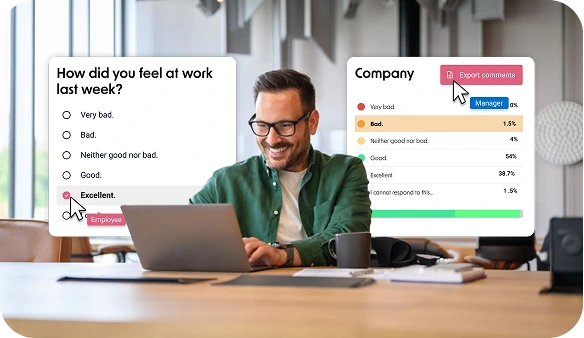
When employees see that their feedback leads to real changes, their job satisfaction and organizational commitment both rise. Regular feedback also helps employers catch emerging attitude problems before they spread. HeartCount makes this process continuous and low-friction.
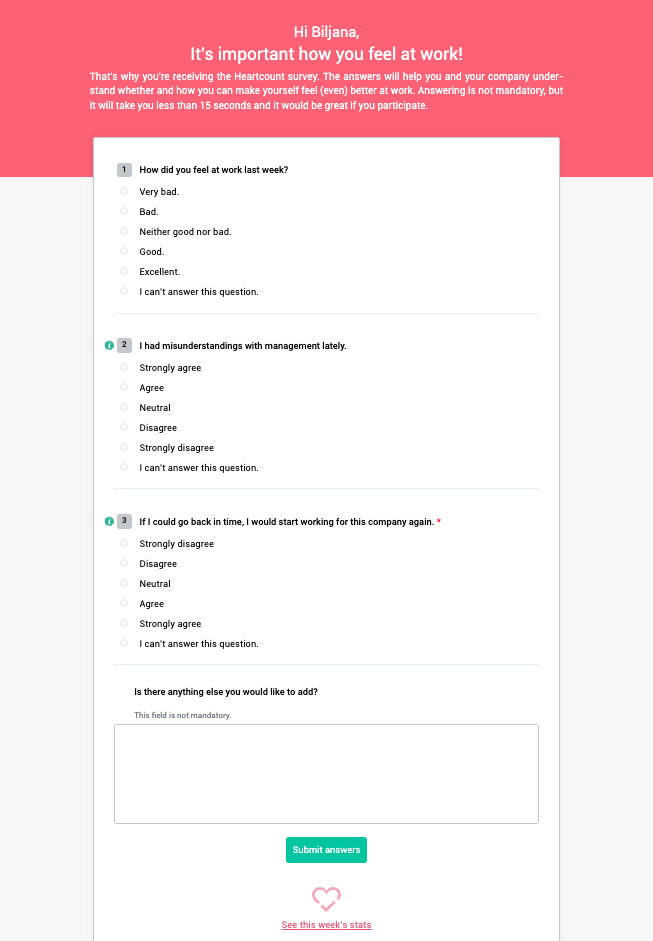
Its weekly pulse checks let managers track employee sentiment in real time, while custom surveys allow targeted collection of employee feedback on specific issues such as workload, management style, team dynamics, or work environment.
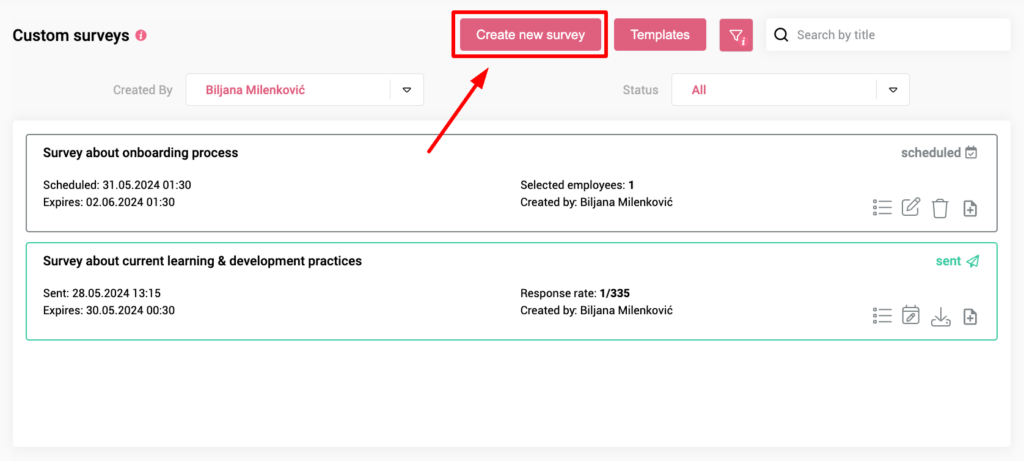
Companies that use HeartCount can demonstrate a genuine commitment to listening, which on its own drives more positive workplace attitudes.
4. Appreciation and recognition
Consistent recognition of positive behavior is one of the highest-ROI investments an employer can make in workplace attitude and employee morale.
Implementing structured recognition, such as an “Employee of the Month” program in which workers nominate colleagues for positive contributions, creates a culture in which a good attitude is publicly valued and reinforced.
HeartCount’s platform includes a peer recognition feature that allows employees to directly and publicly recognize others within the organization. This ensures recognition is timely, visible, and tied to specific behavior, amplifying the culture of appreciation that sustains strong workplace attitude over time.
5. Promote work-life balance
Work-life balance is a direct lever on employee attitude, employee satisfaction, and long-term employee retention.
Offering flexible working hours, remote options, and mental health days ensures that workers return to their roles refreshed and with their positive attitude intact.
Organizations that treat work-life balance as a genuine priority see measurable improvements in employee morale and employee satisfaction.
6. Create opportunities for professional growth
Employees who are growing professionally bring a more positive attitude to work; stagnation is the enemy of organizational commitment.
Workshops, online courses, and mentoring programs give employees a sense of forward momentum that translates directly into a better work attitude. When workers see a clear path within the organization, their job satisfaction rises, and their behavior at work reflects it.
7. Organize team-building activities and social events
Team-building activities are one of the most effective ways to strengthen team dynamics and normalize positive behavior across the workforce.
- Team-building exercises such as collaborative problem-solving, workshops, and outdoor challenges develop the trust and communication habits that sustain a positive work environment.
- Social events like casual gatherings, holiday parties, and team outings reduce stress, build relationships, and foster a sense of belonging that underpins good employee morale.
Employee attitude: Take charge of it
Employee attitude is not fixed; it is shaped by the work environment, leadership behavior, and the systems an employer puts in place to listen, recognize, and develop their people.
Bad attitudes drag down employee morale, hinder employee productivity, and damage organizational culture. Conversely, a positive work attitude boosts teamwork, innovation, and employee retention.
Identifying poor workplace attitudes early and understanding their root causes makes the difference between a thriving organization and one that cycles through workers without ever building real commitment.
HeartCount is here to support you in this mission. It helps you gauge employee sentiment through regular pulse checks, collect structured employee feedback, and take actionable steps to create a more positive and engaged workforce, before attitude problems become culture problems.
Ready to see how HeartCount can make a difference?
Employee Attitude FAQs
What is employee attitude, and why does it matter?
Employee attitude is a worker’s overall disposition toward their job, employer, and workplace. It matters because it directly shapes employee performance, team dynamics, organizational culture, and employee retention.
It encompasses the feelings, beliefs, and values an employee brings to work every day. A positive work attitude creates a collaborative, high-performance environment. A poor attitude, left unaddressed, erodes employee morale, damages organizational culture, and ultimately drives turnover.
What is the difference between employee attitude and employee morale?
Employee attitude is individual; it describes one worker’s disposition toward their role and workplace. Employee morale is collective; it describes the overall mood and outlook of a team or organization.
A single employee with a persistently negative attitude can significantly drag down collective morale. Conversely, a group of workers with consistently positive attitudes can sustain high morale even during difficult periods. HR managers need to track both, because the solutions are different.
What causes a negative attitude in the workplace?
Negative workplace attitudes are almost always symptoms of underlying problems, like poor job satisfaction, limited growth, weak management, unfair treatment, excessive workload, or a toxic organizational culture.
Personal factors outside of work can also play a role. Understanding the root cause is essential before attempting to change the behavior. Treating the symptom without addressing the cause rarely produces lasting change in work attitude.
How does a negative attitude affect the workplace?
A negative employee attitude doesn’t stay contained. It lowers employee morale, disrupts team dynamics, reduces employee productivity, and can shift the organizational culture if left unaddressed.
Actively disengaged employees cost organizations through higher absenteeism, lower output, and increased turnover. A single worker with a persistently poor attitude can also influence the behavior of otherwise positive colleagues, making rapid intervention essential.
Can a negative employee attitude be changed?
Yes, in most cases, a negative workplace attitude can be changed, provided the root cause is addressed, and the employer provides genuine support alongside clear behavioral expectations.
Attitude change is most sustainable when the work environment that produced the negative attitude is improved alongside the coaching conversation. A difficult employee who receives empathetic, structured support, including access to an employee assistance program where needed, will often respond positively.
What does a positive attitude at work look like?
A positive attitude at work is demonstrated through specific, consistent behaviors: taking ownership, communicating openly, supporting colleagues, adapting to change, and maintaining professional behavior under pressure.
Positive attitude is defined by how an employee approaches challenges and interacts with their team day after day. This kind of positive behavior can be modeled, recognized, and developed in any work environment with the right leadership.
How can managers measure employee attitudes?
HR managers and team leaders can measure employee attitudes through a combination of pulse check surveys, eNPS, custom employee satisfaction surveys, stay interviews, performance data, and direct observation of workplace behavior.
Using several methods together gives the most accurate picture of both individual and collective workplace attitude. Tools like HeartCount make this process continuous and actionable — surfacing early signals of poor attitude before small problems become large ones.
What is an employee attitude survey?
An employee attitude survey is a structured tool used by employers to systematically measure how workers feel about their job, work environment, management, and organizational culture, turning subjective sentiment into actionable data.
When well-designed and consistently run, an employee attitude survey helps HR managers identify pockets of dissatisfaction, track changes in employee morale over time, and prioritize interventions. The key is ensuring employees trust that their honest feedback will be used constructively rather than ignored or used against them.