
15Five vs Workleap: Which Employee Engagement Platform Is Better?




-
1.TL;DR: 15Five vs Workleap
-
2.15Five vs Workleap: Employee Engagement Features Compared
-
3.15Five: Engagement Pros and Cons
-
4.Workleap: Engagement Pros and Cons
-
5.15Five vs Workleap Pricing
-
6.15Five vs Workleap: Shared Limitations
-
7.A Modern Alternative: HeartCount
-
8.Full Comparison: 15Five vs Workleap vs HeartCount
-
9.Decision Guide
-
10.Final Verdict




When people search for 15Five vs Workleap, they’re usually trying to answer one thing: which platform actually improves employee engagement without creating unnecessary complexity.
I’ve reviewed both, and while they overlap in many areas. The real decision comes down to how much performance management you need vs how deeply you want to focus on engagement.
15Five and Workleap combine engagement surveys, pulse surveys, and performance management into broader systems that track employee performance and performance reviews alongside continuous feedback.
That works well for some companies. But not every organization wants a heavy performance management tool layered on top of engagement surveys. Some teams, especially growing companies or those focused strictly on retention and culture, just want a modern employee engagement platform with strong analytics and AI-driven insight.
In this comparison, I’ll break down the key features, real pricing structure, and engagement depth of both platforms. Then I’ll introduce HeartCount as an engagement-first alternative and evaluate it fairly against 15Five and Workleap.

TL;DR: 15Five vs Workleap
Both 15Five and Workleap cover the fundamentals of employee engagement well. They offer engagement surveys, pulse surveys, continuous feedback, employee recognition, and solid analytics. The difference is how tightly engagement is connected to performance management.
- 15Five leans heavily into performance management software. Its engagement tools are strong, but they sit inside a broader system built around goals, performance reviews, and employee performance tracking.
- Workleap Officevibe is more engagement-centered and modular. It focuses first on employee sentiment and feedback, with options like Workleap Performance added separately if you need them.
15Five vs Workleap: Employee Engagement Features Compared
Before I dive into key features of these two platforms, I have to emphasize that I’m focusing strictly on employee engagement, not full performance management.
Both platforms qualify as mature employee engagement software, but they approach engagement differently. I’m looking at engagement surveys, pulse surveys, anonymous feedback, continuous feedback loops, analytics, and how each platform turns employee sentiment into actionable insight for organizations.
| Engagement Feature | 15Five | Workleap (Officevibe) |
| Pulse surveys | Yes | Yes |
| Engagement surveys | Yes | Yes |
| Anonymous feedback | Yes | Yes |
| Continuous feedback | Yes | Yes |
| Employee recognition | Yes (High Fives) | Yes (Good Vibes) |
| Employee sentiment tracking | Yes | Yes |
| AI analytics | Predictive impact model | AI summaries & risk reports |
| Microsoft Teams integration | Yes | Yes |
| Best for | Performance-driven orgs | Engagement-focused teams |
Pulse surveys
15Five delivers pulse surveys through its Engage module, designed to track employee engagement and employee sentiment on a recurring basis. The platform allows HR leaders to run weekly or quarterly engagement surveys built around validated engagement drivers. Pulse surveys are integrated into the broader performance management workflow, so engagement data connects directly to goals, performance reviews, and manager check-ins. The focus is on structured measurement tied to overall employee performance and organizational performance.
Workleap Officevibe centers its platform around lightweight, recurring pulse surveys. These short surveys are typically sent weekly and emphasize simplicity to maintain high participation. Workleap focuses heavily on anonymous feedback and continuous feedback loops, helping teams surface engagement issues early. The engagement survey experience is more modular and engagement-first, with analytics designed to give managers quick, actionable insight without requiring a full performance management tool.
Engagement surveys framework
15Five structures its engagement surveys around 17 research-backed engagement drivers. These drivers connect employee engagement directly to business performance, linking themes like growth, alignment, and manager effectiveness to measurable outcomes. The framework is built to integrate with performance management, so engagement data feeds into performance reviews, goal tracking, and broader employee performance conversations. I see it as structured and enterprise-ready, especially for organizations that want engagement tightly connected to leadership accountability.
Workleap Officevibe organizes its engagement surveys around 10 core engagement metrics rooted in workplace psychology models. The framework focuses on autonomy, recognition, relationships, and growth, making it easy for managers to understand what drives employee sentiment. It is more streamlined and engagement-focused, with survey themes clearly tied to workplace culture and day-to-day team dynamics rather than formal performance management processes.
Anonymous feedback
15Five allows employees to submit anonymous feedback within engagement surveys and certain feedback channels. Anonymity settings can be configured by the HR team, and responses are typically aggregated to protect individual identity. Because 15Five sits inside a broader performance management system, anonymous feedback is one component of a larger continuous feedback structure that includes named check-ins and performance reviews.
Workleap Officevibe places a stronger emphasis on anonymous feedback as a core engagement driver. Employees can share comments confidentially alongside pulse surveys, and managers are encouraged to respond publicly to close the feedback loop while preserving anonymity. This structure supports open employee sentiment sharing and strengthens workplace culture by making psychological safety part of the platform design rather than an optional feature.
Continuous feedback tools
15Five embeds continuous feedback directly into its weekly check-ins between employees and managers. These structured updates allow employees to share progress, roadblocks, and reflections in real time. Because the platform connects feedback to goals, OKRs, and performance reviews, conversations do not stay isolated. Continuous feedback becomes part of ongoing performance management, reinforcing accountability and visibility across organizations.
Workleap Officevibe supports continuous feedback through lightweight check-ins and survey comments rather than formal performance cycles. Managers can respond to engagement survey results and maintain ongoing dialogue without launching a full performance review process. When combined with Workleap Performance, feedback can expand into structured reviews, but the core engagement platform keeps feedback simple, conversational, and easier for small business teams to sustain consistently.
Employee sentiment tracking
15Five tracks employee sentiment through recurring engagement surveys and driver-based scoring models. Sentiment trends are visualized inside dashboards that connect engagement data to performance management metrics. Managers and HR leaders can segment results by team, tenure, or department to identify shifts in employee engagement over time. The focus is structured measurement tied to business performance and manager effectiveness.
Workleap monitors employee sentiment through weekly pulse surveys and continuous feedback inputs. Sentiment trends are displayed through simple visual analytics that highlight changes quickly, making it easier for managers to act before issues escalate. The system emphasizes clarity and speed, helping organizations translate engagement survey results into practical next steps without navigating complex performance management layers.
Employee recognition
15Five includes peer-to-peer employee recognition through its High Fives feature. Employees can publicly acknowledge colleagues for contributions aligned with company values. Recognition appears in a shared feed, and managers can amplify praise to increase visibility. Because the platform connects engagement with performance management, recognition can reinforce behaviors that later surface in performance reviews and broader employee performance discussions.
Workleap offers recognition through Good Vibes, lightweight appreciation messages tied to company values. Recognition is social and visible across the platform, helping reinforce workplace culture in everyday interactions. It sits closer to engagement and team morale rather than formal performance management, making it simple for organizations that want recognition without adding review complexity.
Engagement analytics
15Five provides structured engagement analytics through dashboards that map survey results to its engagement drivers. HR leaders can segment data by department, tenure, manager, or location to uncover patterns in employee engagement and employee sentiment. The platform also connects engagement data with performance management metrics, allowing organizations to see how feedback trends relate to employee performance and retention risk. The analytics layer is built for deeper reporting and executive visibility.
Workleap focuses on accessible, real-time engagement analytics. Survey results are displayed through heatmaps, trend lines, and clear summaries that help managers quickly interpret employee surveys. The system emphasizes actionable insight over complexity, surfacing key engagement changes and recommended next steps without requiring advanced reporting knowledge. It is designed for practical decision-making inside everyday team workflows.
AI-driven insight
15Five uses AI to analyze engagement survey data and highlight patterns that affect employee engagement and performance. Its predictive models identify which engagement drivers have the strongest impact on outcomes like retention and manager effectiveness. The platform can generate summaries, surface risk indicators, and assist with performance review preparation. AI is closely tied to its performance management architecture, supporting structured coaching and accountability.
Workleap applies AI to summarize survey feedback, detect engagement shifts, and flag potential turnover risk. The system translates employee feedback into clear themes and suggested actions, helping managers respond faster. Rather than embedding AI deeply into performance reviews, Workleap keeps the focus on engagement analytics and practical insight that improves employee experience without adding operational complexity.
15Five: Engagement Pros and Cons
15Five is strong, but it is built for structure.
Pros
- Engagement is tightly connected to performance management. Engagement data flows into goals, 1:1s, and performance reviews.
- Clear OKR alignment. Employees see how their work connects to company performance.
- Strong analytics dashboards. HR leaders get deep visibility into employee engagement trends.
- Good for larger organizations that already run structured performance cycles.
Cons
- It can feel heavy if you only want engagement surveys. The platform assumes you will use its performance features as well.
- Setup takes more time. There are more workflows, more configuration, and more moving parts.
- Pricing increases as you move into higher tiers of full performance management software.
- For small business teams focused only on employee sentiment and feedback, it may be more system than necessary.
Workleap: Engagement Pros and Cons
Workleap takes a lighter, more modular approach.
Pros
- Workleap Officevibe is engagement-first. Pulse surveys and anonymous feedback are easy to run and maintain.
- Simpler rollout. Teams can start quickly without building a full performance management structure.
- Modular flexibility. You can add Workleap Performance later if needed.
- Clear engagement analytics that turn survey data into practical insight for managers.
Cons
- Modules can stack up in cost over time. What starts affordable can become expensive as organizations grow.
- Engagement and performance live in separate modules, which can create workflow gaps.
- Less depth in performance tracking compared to platforms built primarily as performance management tools.
In short, Workleap is easier to start with for employee engagement, but long-term structure depends on how many modules you adopt.
15Five vs Workleap Pricing
If you’re comparing 15Five vs Workleap mainly for employee engagement, pricing depends on how much performance management you plan to use. Both platforms start at a similar entry point, but the total cost changes as you add features.
Pricing Overview
| Plan Level | 15Five | Workleap |
| Entry engagement tier | $4/user/month (Engage, billed annually) | $5/user/month (Officevibe, 10-user minimum) |
| Engagement + performance | $11–$16/user/month (Perform or Total Platform) | $8/user/month (Officevibe + Performance bundle) |
| Enterprise | Custom | Custom |
| Billing | Annual standard | Monthly or yearly (20% discount yearly) |
What This Means in Practice
15Five separates engagement and performance. The $4 Engage plan covers engagement and pulse surveys, benchmarking, and analytics. But once you need performance reviews, OKRs, or 360-degree feedback, you move into the $11 to $16 range quickly. For organizations that want employee engagement and structured performance management, pricing is transparent but higher.
Workleap takes a modular approach. Officevibe at $5 per user per month handles engagement surveys, anonymous feedback, recognition, and AI reporting. If you later add Workleap Performance, pricing increases. The bundle at $8 looks competitive, but as organizations scale or add compensation modules, the total cost rises.
Here’s the real trade-off: modular pricing offers flexibility, but growing organizations can see costs expand as features stack. Meanwhile, performance-heavy plans may include functionality that small business teams focused strictly on employee sentiment and engagement do not need.
15Five vs Workleap: Shared Limitations
If I look at 15Five vs Workleap strictly through an employee engagement lens, they share a few structural limitations. These are not flaws. They are design choices.
1. Structural Complexity
Both 15Five and Workleap combine engagement with performance management software. Engagement surveys, pulse surveys, goals, performance reviews, and manager workflows often live in interconnected systems.
That integration is powerful for structured organizations. But it also means:
- More configuration during setup
- More dashboards and workflows to manage
- More training required for managers
If your goal is simple employee engagement surveys and continuous feedback, the broader architecture can feel heavier than necessary. You are adopting a performance management tool even if engagement is your only priority.
2. Cost Escalation Over Time
Entry pricing looks reasonable for both platforms. 15Five starts at $4 per user per month for Engage. Workleap Officevibe starts at $5 per user per month with a minimum seat requirement.
The increase happens when organizations expand:
- Adding performance reviews
- Adding goal tracking
- Adding compensation modules
- Scaling headcount
Because both platforms monetize through tier upgrades or modular add-ons, total spend can grow faster than expected. For growing organizations, especially small business teams, long-term cost becomes an important consideration.
3. Performance-Heavy Architecture
Both platforms are designed around performance as a core driver. Engagement is deeply tied to:
- Performance reviews
- OKRs and goals
- Manager effectiveness tracking
- Structured evaluation cycles
That design works well in enterprises and performance-driven organizations. Engagement data feeds directly into accountability and employee performance discussions.
But if an organization wants lightweight employee engagement software focused only on employee sentiment, anonymous feedback, pulse surveys, and predictive analytics, the performance-first architecture may introduce unnecessary layers. You end up managing performance workflows even when your primary goal is improving workplace culture and retention.
This is the key distinction from an engagement-only perspective.

A Modern Alternative: HeartCount
If your goal is employee engagement without building a full performance management stack, HeartCount might be the right solution for you. The difference is structural. It is not engagement inside performance. It is engagement as the core system.
Focused on Engagement Only
HeartCount is built as a dedicated employee engagement platform. It does not try to be performance management software with engagement added on. The entire architecture revolves around employee sentiment, feedback, well-being, communication, and retention risk.
Everything inside the platform supports one goal: understanding how employees feel and acting before disengagement turns into turnover.
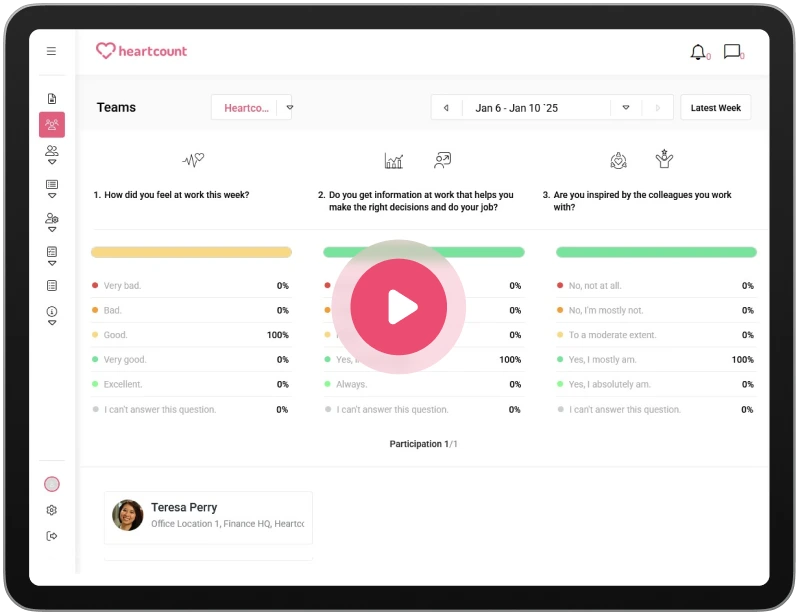
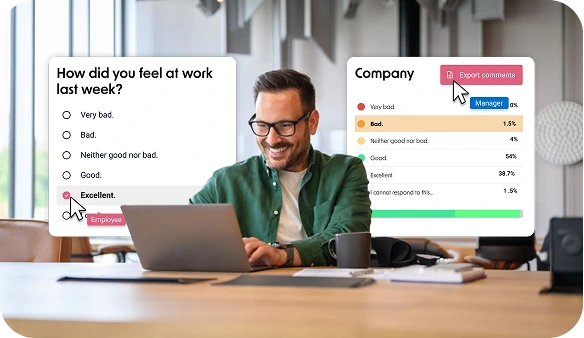
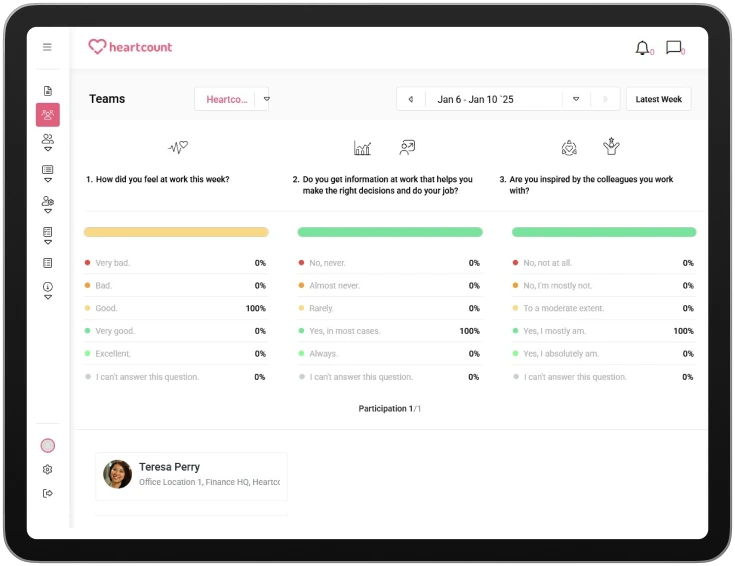
Weekly Pulse Surveys
HeartCount runs automated weekly pulse surveys using a scientifically validated model with 140 questions designed by in-house psychologists.
Each week, employees answer just three questions covering eight engagement categories, including job satisfaction, well-being, feedback and recognition, productivity, and relationship with management.
The system balances depth and simplicity:
- Only three questions per week
- Automated delivery and reminders
- eNPS measured periodically
- Results integrated into real-time reports
- Advanced survey reports
For employees, it is lightweight. For HR leaders, it produces statistically consistent engagement data over time.
Predictive Burnout and Churn Detection
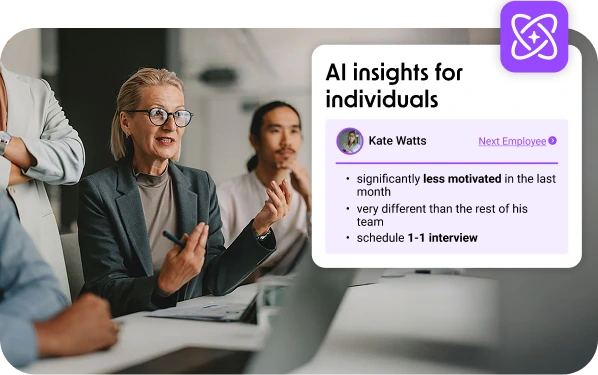
HeartCount does more than track survey averages. Its AI insight module analyzes response patterns over months and flags individual risk levels as low, medium, or high.
It detects early signals of:
- Emotional exhaustion
- Dissatisfaction
- Declining engagement
- Potential resignation risk
The analysis updates automatically after each pulse cycle.
This is predictive retention modeling, not just reporting dashboards. HR professionals can see which employees may need support before problems escalate.
Anonymous Feedback and Communication Module
Anonymous feedback is not an optional extra. It is embedded into how HeartCount works.
Employees can:
- Leave comments inside weekly surveys
- Send direct messages to HR or management
- Choose to send those messages anonymously
The communication module allows employees to select “Send anonymously,” meaning management can reply without seeing the identity.
This creates two important conditions:
- Psychological safety
- Ongoing dialogue
It is structured communication, not a passive suggestion box.
Peer Recognition Built Into Engagement
HeartCount also includes a peer recognition system that reinforces workplace culture.
Employees can publicly praise colleagues through a visible wall of praise. Recognition is transparent, social, and tied to engagement momentum.
Unlike surveys, recognition is not anonymous. It is intentionally visible to strengthen team culture and motivation.
This combination matters:
- Anonymous feedback for honesty
- Structured communication for dialogue
- Public recognition for morale
- AI analytics for retention risk
That is the engagement-first model.
In my view, this is where HeartCount differentiates itself most clearly. Engagement is not embedded in performance management. It is the core system, supported by pulse surveys, predictive analytics, a built-in communication module, and peer recognition mechanisms designed to improve employee experience and retention.
Strong AI and Analytics
HeartCount does more than display survey scores. It translates data into insight.
Real-Time Sentiment Tracking
Engagement reports provide weekly, monthly, and semi-annual breakdowns with percentage scores and exact numbers. You can track engagement, eNPS, autonomy, motivation, and emotional exhaustion over time.
Reports update automatically based on weekly employee activity.
Actionable Insight Suggestions
The AI insight module transforms survey data into practical recommendations for managers. It highlights themes that require attention and uncovers hidden issues that standard dashboards might miss.
That means HR professionals are not left interpreting heatmaps alone.
Predictive Retention Modeling
HeartCount tracks engagement levels over time within the Employee Overview dashboard. It keeps detailed records of well-being scores, praises, and survey responses per employee.
Combined with AI-driven risk scoring, this creates a retention monitoring layer that is deeper than standard engagement analytics.
Lower Complexity
This is where the practical advantage shows.
Faster Setup
HeartCount focuses on pulse surveys, custom surveys, recognition, reports, and employee overview. It does not require building performance review cycles, goal frameworks, or talent matrices first. That reduces onboarding time.
Fewer Modules
You do not need separate tools for engagement, recognition, and employee overview. They are part of one engagement-first platform.
Workleap splits engagement and performance into modules. 15Five embeds engagement inside performance. HeartCount removes that layer entirely.
Designed for Clarity
Dashboards are customizable by team and timeframe. Reports are available in real time and are exportable for deeper analysis.
For HR teams that want visibility without configuration overload, this matters.
More Accessible Pricing
HeartCount is structured as an engagement-first pricing model:
- Free plan: Up to 25 employees
- Business plan: $2.5 per employee per month (up to 500 employees)
- Enterprise: Custom pricing
That means a 100-person company pays $250 per month for full engagement features, including unlimited pulse surveys, employee recognition, AI insights, eNPS tracking, and individual risk flagging.
Compare that to engagement-only tiers:
- 15Five Engage: $4 per user per month (annual billing) → 100 employees = $400 per month
- Workleap Officevibe: $5 per user per month (10-user minimum) → 100 employees = $500 per month
So from a pure employee engagement perspective:
- HeartCount Business plan at $2.5 per employee is 37% cheaper than 15Five Engage
- It is 50% cheaper than Workleap Officevibe
- It avoids automatic escalation into performance management software tiers
For growing organizations and financial services teams focused on retention and employee satisfaction, this translates into:
- Lower recurring software cost
- No forced upgrade into review cycles or OKR tracking
- AI insights and risk detection included without premium add-ons
15Five and Workleap combine engagement with performance management. That works well in performance-heavy environments.
HeartCount isolates employee engagement and prices it accordingly. If your priority is retention, employee sentiment, and predictive engagement analytics rather than structured performance reviews, the cost structure aligns more directly with that goal.
Full Comparison: 15Five vs Workleap vs HeartCount
| Feature | 15Five | Workleap | HeartCount |
| Starting price (engagement only) | $4/user/month (Engage, billed annually) | $5/user/month (Officevibe, 10-user minimum) | Free (up to 25 employees) |
| Paid engagement tier | $4/user/month | $5/user/month | $2.5/employee/month (Business plan, up to 500 employees) |
| Full engagement + performance | $11–$16/user/month | $8/user/month (Officevibe + Performance bundle) | Not performance-focused |
| Engagement surveys | Yes | Yes | Yes |
| Weekly pulse surveys | Yes | Yes | Yes (unlimited in all plans) |
| Anonymous feedback | Yes | Yes | Yes |
| AI insights included in base plan | Limited in Engage | Included (shared AI usage) | Included even in Free tier |
| Individual risk detection | Available in higher tiers | Turnover risk reporting | Included (individual risk flagging) |
| Performance management | Full suite (Perform & Total Platform) | Separate module | Not core focus |
| Setup complexity | Medium–High | Medium | Low |
| Best for | Performance-driven organizations | Modular HR ecosystems | Engagement-first organizations |
After looking at the full comparison, the structural difference becomes clear.
15Five and Workleap both combine employee engagement with performance management. Engagement surveys, pulse surveys, feedback, and analytics sit alongside performance reviews, goal tracking, and structured evaluation cycles. For organizations that want engagement tightly connected to employee performance, that integrated model makes sense.
HeartCount takes a different path. It isolates employee engagement and builds the entire platform around sentiment tracking, anonymous feedback, predictive risk detection, and actionable insight. There is no performance management layer to configure or pay for.
That distinction is the core positioning. Integrated performance ecosystem versus engagement-first specialization.
Decision Guide
Choose 15Five if:
- You want employee engagement tightly connected to performance management.
- Structured performance reviews, 360 feedback, and OKRs are core to your system.
- You operate in a performance-driven organization with formal review cycles.
- You are comfortable with higher pricing tiers in exchange for an integrated performance management software suite.
15Five works best when engagement and employee performance are equally important.
Choose Workleap if:
- You prefer a modular approach to employee engagement and performance.
- You want to start with engagement surveys through Workleap Officevibe and add performance later.
- You value flexibility and lighter rollout for small business or growing organizations.
- You want engagement analytics and AI summaries without committing immediately to a full performance stack.
Workleap is strong when you want engagement first, with optional expansion.
Choose HeartCount if:
- Employee engagement is your primary focus, not performance management.
- You want weekly pulse surveys, anonymous feedback, and predictive retention insights at the core.
- You prefer lower complexity and faster implementation.
- You want strong AI-driven sentiment tracking and individual risk flagging without paying for performance modules.
- You are cost-sensitive and want a free or lower-cost entry point.
HeartCount fits organizations that want a dedicated employee engagement platform optimized for retention, clarity, and actionable insight.
Final Verdict
15Five and Workleap are solid platforms. They are mature, widely used, and well-built. If you need structured performance management tied closely to employee engagement, both can deliver. 15Five is stronger in fully integrated performance cycles. Workleap gives you modular flexibility.
But if what you really want is everything that comes with strong employee engagement, higher retention, clearer employee sentiment, predictive burnout detection, real-time feedback, and lower cost without performance complexity, then HeartCount is the cleaner fit.
You are not paying for review cycles you may not use.
You are not configuring layers of performance workflows.
You are focusing directly on engagement and retention.
If engagement is your priority, the next step is simple. Start a free plan or book a demo and see how it works with your team in real conditions.