

Employee Attrition: Why Are Your Best Employees Leaving and What Can You Do About It?




-
1.What Is Employee Attrition?
-
2.Employee Attrition vs. Turnover vs. Employee Retention
-
3.Types of Employee Attrition
-
4.Why Employee Attrition Matters: The Real Cost
-
5.How to Calculate Your Employee Attrition Rate
-
6.Attrition Rate by Industry: 2026 Benchmarks
-
7.What Is a Good Attrition Rate?
-
8.Top 10 Causes of High Employee Attrition
-
9.The Boomerang Employee: A Silver Lining of Attrition
-
10.How to Predict Attrition Before It Happens
-
11.Action Plan: Reduce Unwanted Attrition and Keep Top Talent
-
12.Final Words
-
13.FAQ: Employee Attrition




Every time a valuable employee walks out the door, they take more than their skills with them. They take institutional knowledge, client relationships, team morale, and an average of up to two times their annual salary in replacement costs.
Multiply that by the number of employees who quietly disengage and leave each year, and you start to understand why employee attrition is one of the most expensive problems most organizations never properly measure.
In this guide, I’ll explain everything you need to know about employee attrition — from calculating your attrition rate to predicting and preventing unwanted employee departures.
What Is Employee Attrition?
Employee attrition is the gradual reduction in your workforce that occurs when employees leave through voluntary resignation, retirement, or other departures, leaving their positions unfilled.
Unlike a layoff or restructuring, attrition is quiet. It happens one person at a time. But the cumulative effect on an organization can be enormous: shrinking teams, disappearing institutional knowledge, and weakened company culture.
HR professionals track employee attrition to understand long-term workforce trends, flag cultural problems, and plan for the future. It is one of the most telling metrics in talent management.
Employee Attrition vs. Turnover vs. Employee Retention
These three terms are often mixed up, but they measure very different things.
- Employee attrition happens when someone leaves, and the company does not refill the role, leading to a net reduction in headcount.
- Employee turnover includes all departures, including those in which the company actively hires a replacement. It is a broader measure of employee exits flowing in and out.
- Employee retention is the flip side. It measures how many employees stay over a given period. A high retention rate generally signals a healthy workplace culture, strong employee engagement, and good career development opportunities.
| Attrition | Turnover | Retention | |
| Role refilled? | No | Yes | N/A |
| Measures | Net headcount loss | All exits | Who stays |
| Key concern | Structural shrinkage | Hiring efficiency | Culture & engagement |
In short:
- Turnover is a replacement problem
- Attrition is a headcount problem
- Retention is the goal
Check out our guide on improving employee engagement and retention for more information on how these strategies work together.
Types of Employee Attrition
Not all attrition looks the same, and not all of it is bad. Understanding the type helps you choose the right response.
1. Voluntary Attrition
Voluntary attrition is when an employee chooses to leave, through voluntary resignation, career change, relocation, or finding a better opportunity elsewhere. It is the most common type and often the most preventable.
When high performers are responsible for the bulk of voluntary attrition, that is a red flag pointing to problems with leadership, company culture, work-life balance, or limited career advancement.
2. Involuntary Attrition
Involuntary attrition covers terminations, layoffs, and performance-based dismissals. It is employer-initiated.
Some level is expected and sometimes necessary, but high involuntary attrition through layoffs creates fear and uncertainty among remaining employees, potentially triggering a second wave of voluntary departures.
3. Retirement Attrition
When experienced, long-tenured employees retire, they take decades of institutional knowledge with them. Retirement attrition is predictable, which makes it one of the most manageable types if HR professionals plan for it through succession planning and structured knowledge transfer.
4. Internal Attrition
Internal attrition happens when employees move to a different role or department within the same organization. While it does not reduce overall headcount, it creates vacancies and talent gaps within specific teams.
Internal attrition can be a positive signal; it suggests the organization offers career development and mobility.
5. Early Attrition
Early attrition refers to employee departure within the first 90 days to one year of joining. It typically signals a mismatch between job expectations and reality, a poor onboarding experience, or a weak new hire integration process.
Early attrition is disproportionately expensive because the organization has invested in recruiting and onboarding with almost no return.
6. Healthy vs. Unhealthy Attrition
Some attrition is genuinely healthy — when underperformers leave, when teams restructure, or when departing employees are replaced by stronger talent.
Unhealthy attrition is when your best people, like engaged employees, specialists, and future leaders, are the ones walking out the door. This unwanted employee attrition is expensive, demoralizing, and often preventable.
Why Employee Attrition Matters: The Real Cost
High employee attrition is not just a headcount problem. It is a financial, cultural, and operational problem that compounds over time.
The Financial Hit
The numbers are sobering: Gallup estimates that voluntary turnover costs U.S. businesses roughly $1 trillion per year. Replacing a single employee typically costs between 0.5x and 2x their annual salary, depending on the role.
Deloitte’s research found that voluntary attrition increases by more than 30% during mergers and acquisitions, a period when retaining key employees is most critical to deal success.
According to Mercer’s 2025 U.S. Turnover Survey of 2,617 organizations, the average voluntary attrition rate sits at around 13%, down from a pandemic-era high of nearly 25%.
The Employee Engagement Crisis
High attrition and low employee engagement are two sides of the same coin.
Gallup’s State of the Global Workplace 2026 report found that global employee engagement fell to 20%, its lowest level since 2020. In 2024, disengagement cost the global economy an estimated $438 billion in lost productivity.
In the U.S., employee engagement hit a decade low in 2024, with only 31% of employees reporting feeling engaged, while 17% were actively disengaged.
Managers drive approximately 70% of the variance in team engagement. Yet manager engagement itself fell from 30% to 27% in 2024, with the sharpest drops among female managers (down 7 points) and managers under 35 (down 5 points).
The Hidden Cost: Culture and Morale
McKinsey found that 54% of employees who left said they didn’t feel valued by their organization, 52% felt undervalued by their manager, and 51% lacked a sense of belonging at work.
When employee exits become frequent, remaining employees notice. Trust erodes. Uncertainty spreads. Organizations that treat attrition as purely a hiring problem, rather than a culture and employee experience problem, are fighting the wrong battle.
How to Calculate Your Employee Attrition Rate
The Formula
Attrition Rate (%) = (Number of Employees Who Left ÷ Average Number of Employees) × 100
Where:
- Employees who left = total departures during the period (voluntary + involuntary, excluding internal transfers)
- Average number of employees = (headcount at start of period + headcount at end of period) ÷ 2
Example:
Your company starts the year with 200 employees and ends with 175. During that year, 25 employees left and were not replaced.
Average headcount = (200 + 175) ÷ 2 = 187.5
Attrition rate = (25 ÷ 187.5) × 100 = 13.3%
Employee Retention Rate Formula
Retention Rate (%) = ((Employees at End of Period – New Hires During Period) ÷ Employees at Start of Period) × 100
How Often Should You Track It?
Most HR professionals calculate attrition quarterly and annually. Quarterly tracking helps catch emerging issues, like an onboarding failure or a manager problem, before they scale. Annual calculations give you the bigger picture for strategic workforce planning and benchmarking.
Attrition Rate by Industry: 2026 Benchmarks
As of April 2026, the labor market has shifted from the “Great Resignation” of previous years toward a period of cautious stability, though significant turnover persists in frontline and operational roles.
While 2025 was defined by workers prioritizing security, 2026 has seen a slight uptick in “selective attrition” as employees move toward roles that offer better AI integration and work-life balance.
The following table provides benchmarks based on early-2026 reporting:
| Industry | Avg. Attrition Rate (2026) | Trend vs. 2025 | Notes |
| Hospitality & Restaurants | 52% – 84% | Stable/Down | While lower than pandemic peaks, frontline turnover remains high due to burnout. |
| Retail & Wholesale | 28% – 63% | Increasing | High “involuntary” attrition as retail continues to automate checkout and logistics. |
| Professional & Business Services | 48% – 53% | Increasing | High movement in consulting and gig-based professional roles. |
| Healthcare | 38% – 43% | Increasing | Chronic staffing shortages and “aging population” demand drive high exit rates. |
| Manufacturing | 32% – 35% | Increasing | Up from 2025 as the sector faces a massive skills gap and competition for labor. |
| Technology | 16% – 22% | Stable | Engineering turnover remains low (~11%); higher churn in sales and marketing. |
| Government / Public Sector | 8.2% – 9.3% | Increasing | Historically stable, but seeing exits due to “return-to-office” mandates. |
| Financial Services | 9% – 11% | Stable | Remains one of the most resilient sectors for retention. |
Key 2026 Data Insights:
- The “recognition gap”: Organizations with strong recognition cultures are seeing 18% to 43% lower turnover than their peers. Employee engagement has dropped globally to roughly 20%, leading to an increase in quiet quitting.
- AI-driven restructuring: Involuntary attrition is rising in administrative and data-heavy roles. Approximately 43% of companies report plans to replace repetitive functions with AI tools by the end of 2026.
- India market trends: According to the Deloitte India Talent Outlook 2026, attrition in India has stabilized at 17.6%. Companies are focusing on “cost discipline,” with salary increments hovering around 9.1% to balance retention with productivity.
- The gig shift: Retention is becoming more difficult as workers move toward the “Gig Economy.” By the end of 2026, over 70 million Americans are expected to be involved in freelance work, prioritizing autonomy over traditional full-time employment.
- Healthcare crisis: The U.S. healthcare sector is projected to face a shortage of 64,000 nurses by 2030, keeping attrition rates artificially high as staff “job hop” for significant sign-on bonuses and better ratios.
Note on methodology: These figures include “Total Separations” (both voluntary quits and involuntary layoffs). Voluntary “Quits” typically account for 60%–75% of these totals, depending on the stability of the economy in the specific month.
What Is a Good Attrition Rate?
For most organizations, an annual attrition rate between 10–15% is considered manageable. Rates below 10% are excellent; anything consistently above 20% demands urgent attention, especially when it involves high performers or key departments.
But the right benchmark depends on:
- Your industry
- Your company stage — early-stage companies often see lower attrition despite limited pay, because of mission alignment and equity ownership
- Your role mix — frontline and entry-level roles will always see higher turnover than senior or specialist positions
The more important question is not just how much attrition you have, but who is leaving and why.
Top 10 Causes of High Employee Attrition
Understanding why employees leave is the first step to fixing it. These are the most common and most impactful drivers of high attrition:
1. Lack of Career Growth and Development
This is consistently the number one driver of voluntary attrition. McKinsey identifies a lack of career advancement as the leading reason employees quit.
LinkedIn’s Workplace Learning Report found that 94% of employees would stay longer if their employer invested in their career development. Yet fewer than 26% of workers report being highly satisfied with their promotion opportunities. That gap is where attrition begins.
How to fix it: Build clear progression paths, offer structured learning programs, and run regular pulse surveys to understand how supported employees feel. Internal mobility extends average tenure by 41%.
2. Poor Management and Leadership
People don’t leave companies, they leave managers. Poor management is one of the most reliable predictors of high employee attrition.
Micromanagement, unclear expectations, failure to give meaningful employee feedback, and a lack of psychological safety all erode trust. Gallup’s research shows that managers account for roughly 70% of the variance in their team’s employee engagement.
How to fix it: Invest in management training and coaching. Teach managers how to give meaningful feedback, have difficult conversations, and create a culture where employee feedback is welcomed.
3. Compensation and Benefits Gaps
While pay alone rarely drives attrition, consistently below-market compensation is a deal-breaker, especially when combined with other frustrations. Only 30% of U.S. workers report being highly satisfied with their pay. A Deloitte survey found that 80% of employees consider mental health support a key factor in their decision to stay with their current employer.
How to fix it: Benchmark compensation regularly. Review your total rewards package, including flexibility, health support, and equity, not just base salary.
4. Burnout and Poor Work-Life Balance
Burnout is a leading cause of voluntary resignation. 82% of white-collar workers across North America, Europe, and Asia experienced some level of burnout. Workers suffering from burnout often quietly quit – disengage quietly before they resign.
How to fix it: Track workload patterns proactively. Use real-time employee surveys to identify burnout signals before they escalate to employee departure.
5. Toxic or Misaligned Company Culture
When employees don’t feel they belong or feel the organization’s values don’t match their own, they disengage and eventually leave.
Tolerance for toxic behavior, lack of inclusive practices, and poor workplace culture are silent drivers of high attrition, particularly among underrepresented groups.
How to fix it: Integrate DEI into everyday operations, not as a checkbox but as a genuine cultural commitment. Create feedback channels that surface cultural problems early.
6. Low Employee Engagement and Sense of Purpose
Global employee engagement is at just 20%. Actively disengaged employees are significantly more likely to seek new employment. Employees who feel their work lacks meaning or feel disconnected from the company’s mission disengage gradually before leaving.
How to fix it: Measure employee engagement regularly, not just annually. Act visibly on what you learn. Show employees how their work connects to something bigger.
7. Limited Flexibility
Rigid work arrangements are now a meaningful driver of voluntary attrition, particularly among younger workers. Fully remote employees report a 94.2% retention rate vs. 81.6% for fully on-site workers. Stanford research found that hybrid work reduces resignations by approximately 33%.
How to fix it: Use employee surveys to understand what flexibility means to your teams. Build hybrid models based on real preferences, not assumptions.
8. Lack of Recognition
High performers who feel invisible will start looking elsewhere. High-quality recognition programs reduce the risk of turnover within two years by 45%. Recognition is not a luxury, but a fundamental driver of employee satisfaction and workforce stability.
How to fix it: Build recognition into daily team practices, not just annual reviews. Make it timely, specific, and peer-to-peer, not just top-down.
9. Job Insecurity and Organizational Instability
Even when layoffs aren’t happening, rumors and uncertainty about a company’s future cause valuable employees to leave proactively. This kind of damage to employee morale can become self-fulfilling, driven by attrition due to fear.
How to fix it: Communicate transparently and consistently during times of change. Leaders who over-communicate stability during uncertainty retain more engaged employees than those who go quiet.
10. Poor Onboarding and Early-Stage Mismatch
Early attrition is disproportionately expensive. Research shows 61% of employees who left their roles did so within the first 12 months, and 54% of voluntary departures occur in the first six months. Often, the problem started in the hiring process: misaligned expectations, poor job descriptions, or prioritizing hiring speed over culture fit for new employees.
How to fix it: Revisit your onboarding program. Ask new employees for honest feedback at 30, 60, and 90 days. Treat the first year as an ongoing retention effort.
The Boomerang Employee: A Silver Lining of Attrition
Not every employee departure is permanent. A boomerang employee is someone who leaves an organization and later returns, often with new skills, fresh perspectives, and a stronger appreciation for the workplace they once left.
McKinsey research found that of employees who voluntarily left their jobs without another role lined up, 47% returned to the workforce, some back to their original employer. Boomerang employees can be a significant untapped talent pool, particularly in sectors experiencing skill shortages.
The key is to maintain positive alumni relationships, avoid burning bridges at offboarding, and create a welcoming path for rehires. Organizations that treat departing employees well often find them returning as stronger contributors or as ambassadors who refer quality new hires.
How to Predict Attrition Before It Happens
Most employee exits come with warning signs. The challenge is detecting them early enough to act.
Early Warning Signals
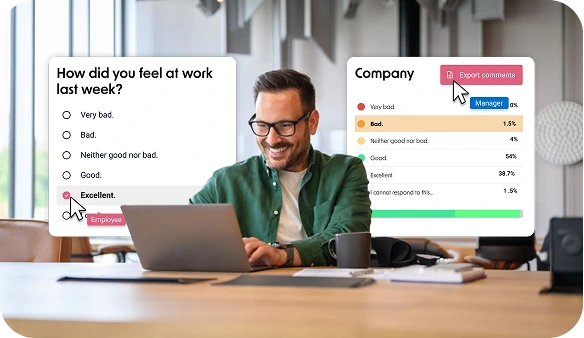
Weekly pulse surveys give HR professionals a real-time view of how employees are feeling — far more effectively than annual engagement surveys. Consistent dips in employee satisfaction scores, declining trust in management, or recurring themes in employee feedback are early signals of disengagement that precede employee departure.
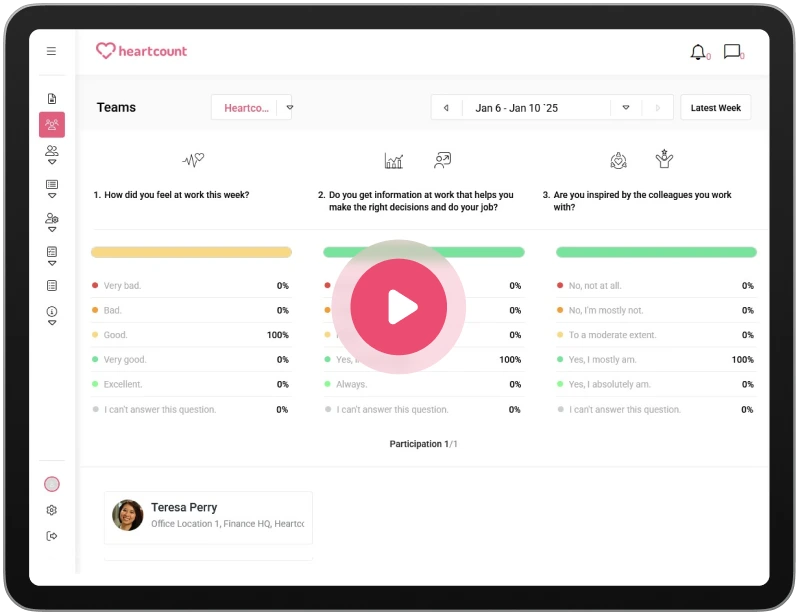
HeartCount automates this process entirely. Its 30-second weekly pulse checks are built on psychologist-designed questions, sent automatically to every employee, and designed to capture how people are actually feeling week to week, not just how they felt at last year’s annual survey.
The results feed directly into real-time dashboards where HR professionals and managers can see engagement trends, well-being scores, and team-level patterns at a glance.
Research by MIT Sloan found that organizations that regularly gather and act on employee feedback experience 14% lower turnover rates than those that don’t.
AI-Powered Attrition Prediction
Modern people analytics platforms now use machine learning to identify employees at risk of leaving before they resign. These tools analyze patterns across engagement scores, tenure, manager relationships, and participation trends to surface early warnings that would be invisible in a spreadsheet.
HeartCount’s AI Insights feature does exactly this. After each weekly pulse survey, the platform automatically analyses up to 24 responses across a rolling six-month window to detect subtle shifts in sentiment and emotional engagement.
When it identifies a pattern consistent with burnout, disengagement, or churn risk, it flags the employee, and critically, it explains why: which specific factors (a dip in motivation scores, a sustained drop in well-being, or a shift in how someone rates their relationship with their manager) drove the alert. Managers then receive tailored, actionable recommendations, including specific conversation prompts, so they know exactly what to say and when.
This is a meaningfully different approach from traditional engagement surveys, which tell you that something is wrong after the fact. HeartCount surfaces the risk while there is still time to act on it.
A Visier study found that organizations using people analytics saw a 17% reduction in manager turnover within two years, with overall resignations dropping by 3.5% through data-driven, team-level retention strategies.
The Listen → Diagnose → Act Framework
The most effective organizations don’t just collect data; they close the loop:
- Listen continuously through automated weekly pulse surveys, exit interviews with departing employees, and HeartCount’s custom survey tool, which lets HR teams build tailored surveys for specific moments, such as onboarding check-ins, stay interviews, or post-restructuring feedback.
- Diagnose patterns using HeartCount’s Employees’ Overview to compare engagement trends across teams, spot high-risk departments, and review individual engagement histories without manual data crunching.
- Act visibly by coaching managers with AI-generated recommendations, addressing cultural issues surfaced through the Communication Module, and using the Employee Recognition feature to re-engage employees who are drifting before they disengage completely.
Employees quickly lose trust if their feedback disappears into a void. The act of closing the feedback loop is itself a retention strategy that signals that voices matter and that leadership is listening.
Action Plan: Reduce Unwanted Attrition and Keep Top Talent
Follow these steps to retain your valuable employees:
1. Build Real Career Growth Pathways
Create visible, achievable progression paths. Invest in learning programs, cross-functional projects, and mentoring. Ask employees in regular surveys how well-supported they feel in their career advancement. Internal mobility programs that help employees move across teams extend tenure significantly while building a more adaptable workforce.
2. Equip Managers with the Right Data and Skills
Managers are your primary retention lever and your biggest attrition risk when they fail. Give team leads real-time data on engagement and risk indicators so they can have meaningful conversations before employees start to disengage. Make manager development ongoing, not a one-time training event.
3. Design a Flexible, Inclusive Workplace Culture
Flexibility is now a basic expectation, not a perk. So is psychological safety. Build a workplace culture where employees feel safe raising concerns, disagreeing, and being themselves. Embed DEI into performance frameworks, promotion decisions, and daily practices. A culture that only exists in slide decks retains no one.
4. Run Effective Exit Interviews and Act on Them
Exit interviews with departing employees are a goldmine for understanding what is really driving attrition. But they only create value if the insights are tracked, analyzed for patterns, and fed back into policy. Create a structured exit-interview process, identify recurring themes, and share findings with leadership.
5. Close the Feedback Loop
Collecting employee surveys is the start, not the finish. The organizations with the lowest unwanted attrition don’t just gather input; they act on it transparently, share what changed, and continue the conversation. That visible responsiveness builds the trust that keeps employees.
Final Words
Employee attrition rarely happens overnight. It builds quietly through ignored feedback, missed recognition, and small frustrations that compound until a valuable employee decides enough is enough. The good news is that most unwanted attrition is preventable, provided you catch the signals early and act on them.
The organizations that retain their best people are not necessarily the ones with the biggest budgets. They are the ones that listen consistently, equip their managers with the right data, and make employees feel genuinely seen and valued.
If you are ready to move from reactive hiring to proactive retention, HeartCount gives you the tools to do it, from automated weekly pulse surveys and AI-powered churn risk alerts to real-time dashboards and manager recommendations.
Start for free today and see your first insights within a week.
FAQ: Employee Attrition
What is employee attrition?
Employee attrition is the gradual reduction in workforce size that occurs when employees leave an organization, through resignation, retirement, or other departures, and their roles are not refilled. It differs from employee turnover, where exits are followed by replacement hires.
How do you calculate employee attrition rate?
Use this formula: Attrition Rate (%) = (Number of Exits ÷ Average Number of Employees) × 100. Average headcount = (start of period headcount + end of period headcount) ÷ 2.
What is a good attrition rate?
For most organizations, 10–15% annually is considered stable. The ideal benchmark varies significantly by industry: retail and hospitality see much higher rates, while government and insurance tend to be lower. What matters most is understanding who is leaving and why.
Is a high attrition rate always bad?
Not always. Some attrition is expected and even beneficial, for example, when underperformers exit, when teams restructure, or when natural retirements allow fresh talent to enter. The concern is high attrition among engaged employees and high performers, which signals systemic problems with culture, management, or growth opportunities.
What is the difference between attrition and turnover?
Turnover includes all exits, typically followed by backfilling. Attrition specifically refers to exits where roles are not refilled, resulting in a net reduction in headcount. In practice, many organizations use these terms interchangeably, but the distinction matters for workforce planning.
What causes high employee attrition?
The most common drivers are a lack of career growth, poor management, below-market compensation, burnout, weak workplace culture, and low employee engagement. Employees rarely leave for a single reason; it’s usually a combination of factors that build over time.
Can attrition be predicted?
Yes. Modern people analytics tools and regular employee surveys can identify early warning signals: declining engagement, reduced participation, and shifting sentiment patterns that predict employee departure weeks or months before a resignation is submitted. Acting on these signals early is the most effective form of employee retention strategy.