

Heartcount vs Lattice: Which Is Better for Employee Engagement in 2026







When I talk to HR leaders about engagement tools, Heartcount and Lattice come up in the same sentence more often than you’d expect. Both promise better engagement, clearer employee feedback, and healthier teams. Both talk about pulse surveys, insights, and helping managers act before problems turn into attrition. From the outside, they can look like direct alternatives.
The reason people compare them is simple. They’re trying to answer the same question: how do I understand what my team is feeling and do something useful with that information? The difference is in how far each tool goes and how much structure it asks for in return.
This article isn’t about declaring a universal winner. I’m looking at these two tools as a buyer who wants clarity. My goal is to help you decide which tool fits your company size, HR maturity, and growth stage, not which platform has more features on paper.
TL;DR
Heartcount and Lattice solve different problems under the same “engagement” label. Heartcount is built for fast, continuous employee feedback and clear follow-up, with minimal setup and transparent pricing. Lattice is a broader people management platform that combines engagement with performance reviews, goals, and development, but requires more time, budget, and HR ownership.
If you want speed, focus, and low friction around engagement, Heartcount fits better. If you want an all-in-one HR system and have the maturity to run it, Lattice makes sense.
Heartcount vs Lattice at a Glance
Heartcount is an employee engagement and feedback tool that helps understand how people feel at work in real time. It is a simple, fast way to run pulse surveys, track employee sentiment, and turn feedback into clear, actionable insights. It’s built for teams that want honest input, quick adoption, and engagement insights without the overhead of a full HR suite.
Lattice is a full people success platform that covers performance reviews, goals and OKRs, engagement surveys, feedback, career development, and compensation. It’s a strong option for larger HR teams that want everything in one system, but it’s broader, more complex, and heavier to implement if engagement and feedback are the main priorities.
Comparison Table
| Area | Heartcount | Lattice |
| Type of tool | Employee engagement and feedback platform | Full people management / HR platform |
| Primary focus | Continuous engagement, sentiment, and action | Performance, goals, development, plus engagement |
| Core features | Pulse surveys, comments, recognition, and AI insights | Performance reviews, OKRs, 1:1s, surveys, analytics |
| Best fit | Teams that want fast engagement insights and low friction | Organizations ready for structured HR processes |
| Pricing approach | Transparent, free tier + simple per-employee pricing starting at $2.5 per employee | Modular pricing, add-ons, and annual contracts, starting at $11 per employee |
| Time to value | Fast, after the first scheduled pulse survey (weekly cadence) | Slower, requires setup and configuration |
| Integrations | Slack, Teams, HRIS basics for engagement | Broad HR tech ecosystem (Workday, BambooHR, etc.) |
| Overall feel | Focused, lightweight, action-oriented | Powerful, comprehensive, enterprise-ready |
Deep Dive into Features
Before I get into the individual features, I want to be clear about how I’m approaching this comparison. I’m not lining up feature checklists or counting modules. I’m looking at how each tool actually works in real HR teams, what problems it solves first, and how much effort it takes to get value.
Heartcount and Lattice overlap in some areas, but they’re built with different priorities in mind. That difference becomes evident once you break the tools down by how they handle feedback, insights, communication, and day-to-day use.
1. Pulse Surveys & Employee Feedback
This is where the difference between the two tools shows up very clearly.
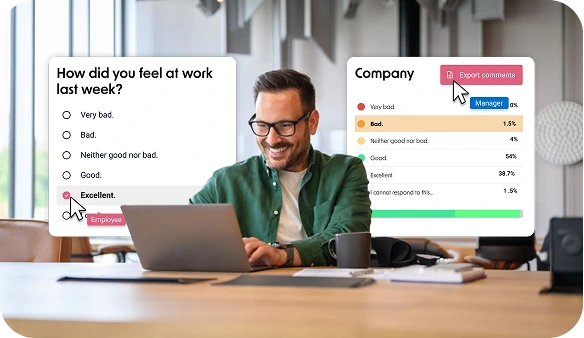
With Heartcount, pulse check surveys are the foundation of the product, not an add-on. Surveys run weekly, questions rotate, and the format stays short and predictable, which helps maintain strong response rates over time.
In addition to weekly pulse checks, Heartcount also supports engagement survey templates, eNPS measurement, and automated scheduling, allowing teams to run both continuous and structured engagement programs within the same platform.
Anonymity is configurable rather than fixed, which allows organizations to balance honest feedback with transparency and individual-level insight.
What I find especially valuable is that feedback doesn’t end at a score or chart. Employees can leave comments, HR or managers can respond directly, and that creates a real two-way feedback loop instead of one-way data collection.
In practice, Heartcount focuses on:
- Weekly pulse surveys with rotating questions
- Built-in anonymity that supports honest feedback
- Comments tied directly to survey answers
- Two-way communication and clear follow-up options
Lattice also supports pulse surveys, but they sit within a much broader people success platform. Lattice offers engagement survey templates, eNPS surveys, and automated scheduling, which work well for organizations running structured engagement programs.
Pulse surveys are flexible, but often used alongside performance reviews, goals, and other HR workflows, rather than as a continuous weekly habit.
With Lattice, the approach typically includes:
- Pulse and eNPS surveys that use predefined templates
- Automation and scheduling across survey cycles
- Strong reporting and aggregation of survey results
- Engagement as one input among many HR processes
Bottom line: If your priority is continuous employee feedback that feels lightweight, safe, and easy to act on, Heartcount feels more focused. If you want engagement surveys as part of a larger, more formal HR system, Lattice fits that model better.
2. Analytics, Insights & AI Signals
Both tools offer strong analytics, but they’re built for different kinds of decisions.
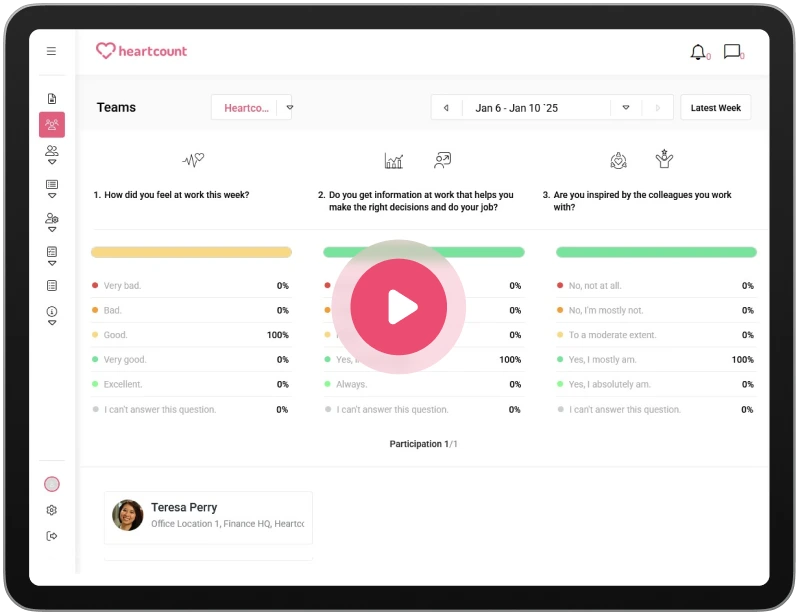
With Heartcount, analytics are designed to surface problems early, not just explain them after the fact. The platform provides rich dashboards, segmentation, and historical trend analysis that allow teams to track sentiment, participation, and behavior over time.
Insights update in real time, so shifts are visible as they happen rather than after a quarterly reporting cycle.
What differentiates Heartcount is how these insights are framed. Analytics are organized around engagement risk and disengagement signals, not just descriptive reporting.
AI adds an additional layer by combining sentiment, response consistency, skipped surveys, comments, and peer recognition into clear risk signals (low, medium, high). This helps HR teams prioritize attention and act early, before disengagement escalates into attrition.
Heartcount’s analytics focus on:
- Real-time dashboards and trend visualizations
- Employee sentiment tracking over time
- Early warning signals for disengagement and risk
- AI insights based on behavior patterns and response dynamics
Lattice goes deeper into traditional analytics and reporting. It offers rich dashboards, advanced segmentation, and benchmarking against historical data or peer groups. This works well for HR leaders who need detailed reports, presentations, and structured analysis across performance, engagement, and goals. Lattice’s AI is more summary-driven, helping explain results, highlight themes in survey comments, and suggest next steps.
Lattice’s analytics typically include:
- In-depth reports across engagement, performance, and goals
- Benchmarking and segmentation by team or demographic
- Exportable dashboards and presentation-ready reports
- AI-generated summaries and recommendations
Bottom line: If you need fast, actionable insight into how people are feeling right now, Heartcount keeps analytics focused and operational. If your priority is deep analysis, benchmarking, and formal reporting across multiple HR dimensions, Lattice offers more depth in that area.
3. Communication & Follow-up Workflows
With Heartcount, communication is tightly connected to feedback. When someone leaves a comment, it doesn’t disappear into a report. HR or managers can reply directly, continue the conversation, and track it in one place. Follow-ups are not a separate workflow you have to remember to trigger later. They live next to the feedback itself, which makes acting on issues much more practical. The whole flow is built around closing the loop, not just collecting data.
In day-to-day use, Heartcount supports:
- Comments and replies directly tied to survey responses
- Internal communication threads around specific feedback
- Follow-ups that stay connected to the original context
- Clear action paths linked to real employee input
Lattice approaches communication differently. It offers multiple tools for interaction, such as feedback exchanges, public praise, and structured 1:1 meetings. These features work well, especially for performance conversations and manager-led check-ins. However, communication spans different modules. Feedback lives in one place, praise in another, 1:1s in another, and engagement surveys in yet another. That’s not a flaw, but it does add complexity.
In Lattice, communication typically happens through:
- Continuous feedback tools and peer recognition
- Structured 1:1 meetings with agendas and notes
- Praise and visibility through company feeds or Slack
- Engagement follow-up handled alongside other HR workflows
Bottom line: Heartcount is not a performance management tool, and it doesn’t try to be one. Instead, it’s operationally stronger at turning employee feedback into visible action. If engagement is your main priority and you want fast, focused follow-up, Heartcount feels more direct. If communication is part of a broader performance and development system, Lattice fits that structure better.
4. Integrations & Ecosystem
With Heartcount, integrations are designed to support engagement without adding complexity. It connects with the tools teams already use every day, such as Slack and Microsoft Teams, and offers HRIS integrations that are enough to keep employee data in sync. For an engagement-first use case, this is usually all that’s needed. Data flows in, feedback flows out, and HR doesn’t have to manage a heavy integration setup just to run surveys and track sentiment.
Heartcount’s integration approach focuses on:
- Slack and Microsoft Teams for survey delivery and easy communication
- HRIS integrations to keep employee data aligned
- Minimal setup that supports fast deployment
- A focused ecosystem built around engagement workflows
Lattice is part of a much broader HR tech ecosystem. It integrates deeply with platforms like Workday and BambooHR and fits well into complex enterprise stacks. This is valuable for organizations running many interconnected HR systems, but it also comes with more configuration, dependencies, and ongoing maintenance.
Lattice’s ecosystem typically includes:
- Deep integrations with enterprise HRIS platforms
- A wide network of HR, payroll, and performance tools
- Strong alignment with large, multi-system environments
Bottom line: The trade-off is clear. Lattice offers breadth and depth for complex HR environments. Heartcount offers focus. If engagement is the priority, Heartcount’s lighter ecosystem reduces overhead and keeps the tool easy to manage, while still integrating where it matters most.
5. Time-to-value & Ongoing Ownership
Heartcount is built to deliver value fast. Once I add employees, the platform is fully set up and ready, with the first pulse check automatically delivered on the next scheduled weekly cycle. There’s no heavy setup, no long configuration phase, and no dependency on perfectly defined processes. Value appears early and continues to compound with minimal ongoing effort.
Over time, ownership stays light:
- Minimal admin work
- No complex cycles to manage
- Engagement insights stay close to daily reality, not quarterly rituals
Lattice works differently. The value curve is longer. You usually need:
- Onboarding and configuration
- Alignment on processes like reviews, goals, and cycles
- Ongoing HR ownership to keep everything running well
When that investment is there, Lattice pays off. But the time-to-value is slower, and ownership grows as more modules and workflows are added.
Bottom line: Heartcount gives fast, continuous value with low ongoing effort. Lattice rewards long-term investment, but only if the organization is ready to support the platform operationally.
6. Ease of Use & Adoption
Ease of use is where many tools look similar on paper but feel very different in practice.
With Heartcount, getting started is fast. Setup is simple, the interface is clear, and once employees are added, the platform is ready for the first pulse survey on the next scheduled weekly cycle. There’s minimal configuration required, which lowers the barrier for both HR teams and managers.
Employees don’t need training to participate, and HR doesn’t need weeks of planning before meaningful data starts to accumulate. That speed matters, especially when addressing engagement issues early.
In everyday use, Heartcount stands out for:
- Fast setup with minimal configuration
- Low learning curve for HR, managers, and employees
- First pulse survey delivered on the first scheduled weekly cycle
- Insights that are easy to understand and act on
Lattice takes more effort to roll out. Because it covers performance, goals, engagement, development, and more, there’s more to configure upfront. HR teams usually go through structured onboarding, define processes, and align stakeholders before the platform reaches full value. For organizations with mature HR processes, that investment makes sense.
With Lattice, adoption typically involves:
- More configuration across multiple modules
- Formal onboarding and rollout planning
- Higher expectations from HR and managers
- Longer time to reach full value
Bottom line: If your goal is to get fast, honest feedback, spot engagement issues early, and act without adding complexity, Heartcount is the more practical choice. It removes friction, shortens the path from insight to action, and works even when HR resources are limited. Lattice makes sense when you’re ready to manage performance, goals, and development in one large system, but for teams that want clarity and momentum around engagement, Heartcount delivers value faster.
Pricing & the Cost of Ownership
Heartcount is transparent and lightweight by design. Pricing is public, easy to understand, and aligned with an engagement-first use case.
- Free tier up to 25 employees
- $2.5 per employee/month for growing teams, with a clear feature set
- No required demo, no forced bundles, no surprise add-ons
- Setup is self-serve, with low admin overhead
- You pay only for what you actively use for engagement
That makes Heartcount accessible to small teams, startups, and HR teams that want predictable costs and fast rollout. Ownership stays simple because there’s no pressure to expand into unused modules just to justify the platform.
Lattice follows a modular, enterprise-style pricing model. Pricing is partly public, but real costs emerge as you add components.
- Base pricing starts around $11 per seat/month for core modules
- Engagement, Grow, and Compensation are paid add-ons ($4 to $6 per seat)
- Annual contracts and minimum spend apply
- Implementation, onboarding, and ongoing admin ownership are expected
Lattice pricing makes sense if you want performance reviews, goals, development, and compensation in one system. But for teams focused mainly on engagement, the total cost and operational weight can grow quickly.
Bottom line: Heartcount offers low-risk entry, clear pricing, and minimal ownership cost. Lattice is an investment platform. It delivers breadth, but you pay for that breadth in both budget and operational effort.
Lattice vs Heartcount: Which Is Better for SMBs, Mid-market, and Enterprise Teams?
This is usually where the decision becomes clear.
- Small businesses (SMBs): Heartcount is the better fit. SMBs need visibility into engagement fast, without heavy setup or long-term contracts. Heartcount’s free tier, simple onboarding, and focus on continuous feedback make it easier to get a real signal without adding HR overhead.
- Mid-market teams: This depends on priority. If engagement, sentiment, and acting on feedback are the main pain points, Heartcount fits better. If the company is formalizing performance reviews, goals, and manager processes at the same time, Lattice can make sense, assuming there’s enough HR capacity to run it well.
- Enterprise organizations: Lattice is usually the stronger choice because of its breadth, performance tooling, and enterprise ecosystem. The exception is when engagement speed is the primary issue. In those cases, teams sometimes prefer a focused engagement layer like Heartcount rather than rolling everything into a large HR suite.
When to Choose Heartcount Over Lattice?
This is where the decision usually becomes obvious.
Heartcount is a better fit if:
- I want fast, frequent employee feedback without rolling out a full HR suite
- Engagement surveys, sentiment tracking, and follow-up actions are the main priorities
- You need a value in days, not months
- The HR team is small or stretched and can’t own a complex system
- You want transparent pricing, low commitment, and minimal setup
- You care more about acting on feedback than documenting performance cycles
- You want managers and employees to actually use the tool, not just comply with it
Lattice is a better fit if:
- You want performance reviews, goals, development, and engagement in one platform
- Your organization already has strong HR processes and maturity
- You’re ready to invest time in configuration, onboarding, and ongoing ownership
- Performance management and OKRs matter as much as engagement
- You need enterprise-grade analytics, benchmarking, and deep reporting
- Budget and contract flexibility are less of a concern
Heartcount vs Lattice: Final Verdict
Heartcount and Lattice don’t compete on features as much as they compete on intent. One is built to surface engagement signals early and act on them fast. The other is built to manage people processes at scale.
If your primary goal is to understand how employees are feeling week by week and respond before issues escalate, Heartcount is the more practical choice. It stays focused, lightweight, and easy to own.
If your goal is to run performance, development, and engagement inside a single, structured system and you have the HR maturity to support it, Lattice is the stronger fit.