

Lattice vs Leapsome: Which Makes Engagement Easier to Track and Manage?








Lattice and Leapsome often get compared because they promise the same thing: better insight into how employees feel and how teams perform. On the surface, they look similar. Both offer surveys, analytics, feedback, and AI summaries.
The real difference only becomes clear once you ask a harder question. Not how well they measure engagement, but how quickly they help you notice something is wrong and do something about it.
That is where this comparison starts. I explored both platforms to see how each one behaves when engagement starts to shift, and decisions need to be made.

TL;DR
Lattice is a broad performance management platform built for structured HR work. It connects engagement, performance, goals, feedback, and compensation in one system. It works best for organizations with mature hr processes that want everything tied together, even if engagement is handled through scheduled cycles rather than continuous listening.
Leapsome is a flexible, modern people platform that blends engagement surveys, performance, learning, and HRIS features. It is easier to adapt and quicker to roll out, with strong AI summaries and a clean user interface. It suits growing teams that want connected insights across people topics, even if engagement is not the sole focus.
Lattice vs Leapsome: Key Features Comparison
When I compare Lattice and Leapsome feature by feature, I look at how each tool actually supports engagement in day-to-day work. This section breaks down what they do in practice, without hype, and where their approaches differ.
1. Engagement Measurement Approach
Lattice measures engagement through scheduled engagement surveys, including pulse surveys, eNPS, onboarding, and exit surveys. Surveys can run on a recurring schedule or as one-off campaigns, with results tracked over time using built-in analytics. Engagement is part of a larger performance management platform, which makes it easy to connect survey results to other hr processes like reviews and feedback.
Leapsome also uses pulse and recurring surveys to measure engagement, with a strong focus on flexibility. Teams can run frequent pulses or deeper surveys and track trends over time, supported by AI summaries and sentiment analysis. Engagement is a part of a broader system that includes performance management, learning, and goal setting, so feedback is naturally linked to wider people initiatives rather than treated as a standalone tool.
2. Trend Visibility and Historical Analysis
Lattice shows engagement trends through dashboards that track results across weeks, months, and quarters. HR teams can compare survey scores over time, filter by team or group, and spot changes in engagement levels after specific actions or initiatives. The focus is on clear visual summaries that help HR leaders understand how engagement is moving across the organization, even if the data often comes from scheduled survey cycles rather than continuous tracking.
Leapsome puts strong emphasis on historical trend tracking, with views that make it easy to follow changes over longer periods. Teams can look at engagement data across different time frames and use AI-powered summaries to highlight patterns and shifts. This makes it easier to turn past survey results into insight, especially when engagement data is reviewed alongside other metrics like goals, learning, and feedback.
3. Participation and Response Tracking
Lattice tracks participation and response rates for each engagement survey and shows how many employees were invited vs how many responded. HR teams can view response rates by team, department, or demographic group to understand where engagement is stronger or weaker. This helps them assess survey reach and reliability, though participation is mainly treated as a reporting metric rather than a behavioral signal.
Leapsome also clearly reports participation and response rates, with breakdowns by team and time period. It highlights trends in response behavior across survey cycles and uses analytics to flag changes in participation over time. Teams can understand how consistently employees are engaging with surveys as part of ongoing feedback efforts.
4. Risk Identification and Prioritization
Lattice identifies potential engagement risks through survey results, sentiment analysis, and trend changes over time. HR teams can see which teams or groups show declining scores and use AI-generated themes and recommendations to decide where to focus. The platform highlights patterns but leaves judgment and follow-up to HR professionals.
Leapsome approaches risk identification by combining engagement trends, survey comments, and AI summaries to surface areas that may need attention. It helps teams spot negative shifts early and understand what topics are driving them. It doesn’t label risk levels explicitly, but it gives context and actionable insights that HR and managers can use to plan next steps.
5. Feedback Comments and Follow-up
Lattice allows employees to leave comments with survey responses and share ongoing feedback outside of surveys. HR and managers can reply to comments, including anonymous ones, which helps close the loop. Follow-up often happens through action plans or manager conversations, which makes feedback part of a broader continuous process.
Leapsome also supports comments on surveys and enables two-way replies, even when feedback is anonymous. Conversations stay connected to the original response, which gives context over time. Follow-up is supported through AI summaries and suggested actions, so teams can turn comments into clearer next steps without adding a heavy process.
6. Communication Flow and Notifications
Lattice uses notifications to prompt users about surveys, feedback requests, reviews, and follow-ups. Notifications are typically sent by email and can also appear in Slack or Microsoft Teams, depending on integrations. The flow keeps HR teams and managers on track with scheduled activities, though it can feel busy in organizations using many features at once.
Leapsome also relies on email and Slack or Teams notifications to support surveys, feedback, and action items. Notifications are tied closely to ongoing cycles, such as recurring pulses or reviews, and are meant to guide users through each step. Communication is structured and predictable, so people know when input is needed without constantly checking the platform.
7. Roles, Permissions, and Data Visibility
Lattice offers detailed role and permission controls, so organizations can decide who can see what across surveys, feedback, and analytics. Admins can give managers access to team-level data while limiting visibility into individual responses, especially when anonymity is enabled. This flexibility works well for larger organization structures and complex HR processes, but it does require a clear setup.
Leapsome also provides granular permission settings, with clear separation between admin, HR, and manager roles. Data visibility can be adjusted so managers typically see aggregated team results, while sensitive or anonymous feedback stays protected. The system balances transparency with privacy, which makes it easier for teams to share insights without exposing individual employees.
8. Use of AI in Engagement Analysis
Lattice uses AI to analyze survey responses, especially open-text comments. It helps detect sentiment, surface common themes, and suggest follow-up actions for HR teams. AI also supports summaries and recommendations, giving HR professionals faster insights without replacing human decision-making.
Leapsome applies AI in a similar way, focusing on sentiment analysis and theme detection across engagement data. AI-generated summaries help teams quickly understand what is driving results and how patterns change over time. The goal is to reduce manual analysis and provide clear, actionable insight from survey feedback.
9. Recognition and Peer Feedback
Lattice includes built-in peer recognition through Praise and ongoing feedback tools. Employees can publicly recognize colleagues, often shared in Slack or Teams, which supports a culture of appreciation. Recognition, just like continuous feedback, 1:1s, and performance reviews, is a part of the wider system rather than a separate feature.
Leapsome also supports peer recognition and social feedback, allowing employees to share praise tied to company values or competencies. Recognition can be visible across the organization and integrated with Slack or Teams. It connects naturally with performance, learning, and employee growth, which reinforces positive behavior as part of everyday work.
10. Reporting and Exports
Lattice offers detailed reporting across engagement, feedback, and other people data, with dashboards designed for ongoing review. HR teams can export reports in CSV and PPT formats. Reporting is flexible and supports deeper analysis, especially for larger organization structures that rely on regular reporting cycles.
Leapsome provides clear reporting with visual summaries and trend views, supported by AI-generated highlights. Data can be exported in PDF and Excel, making it easy to share results with stakeholders. Reporting is designed to give quick, readable insight while still supporting deeper review when needed.
11. Setup Effort and Operational Complexity
Lattice requires more setup because it is a broad employee performance management platform. Teams need to configure surveys, permissions, cycles, and integrations, especially if they use multiple modules. For larger organizational structures and mature HR processes, this setup supports consistency, but it requires upfront planning and ongoing administrative involvement.
Leapsome is quicker to get started, with templates and guided setup for engagement and other features. Many teams can launch their first surveys relatively fast, then expand usage over time. While it still supports complex setups, the emphasis is on reducing friction so HR teams can start collecting data without heavy operational overhead.
Lattice vs Leapsome Pricing
Lattice uses transparent, modular pricing. The core Talent Management or Foundations packages start at $11 per seat per month, billed annually.
From there, teams can add modules like:
- Engagement: +$4/seat/month
- Grow: +$4/seat/month
- Compensation: +$6/seat/month
This structure makes it clear what you are paying for, but total pricing can add up as more modules are layered in.
Leapsome takes a quote-based, modular approach without publicly listing per-seat prices. Companies choose the modules they need, such as Reviews, Engagement surveys, Goals, Learning, or Leapsome HRIS, and pricing adjusts based on user volume and configuration.

Where Lattice and Leapsome Fall Short?
Both tools are excellent at measuring, analyzing, and explaining engagement.
They are less strong at early detection, clear prioritization, and closing the loop quickly without extra effort from HR teams.
Lattice:
- Engagement is event-based, not continuous
Engagement data mostly comes from scheduled pulses or survey cycles. That makes it harder to spot early shifts between cycles, especially if issues emerge quietly over time. - Signals stay descriptive, not prioritized
Lattice surfaces trends and themes well, but it does not clearly rank or classify risk. HR teams still need to interpret dashboards and decide what matters most. - Feedback follow-up depends on process discipline
Comments and replies exist, but turning feedback into action relies heavily on managers and HR following through outside the system. - Platform weight can slow response
Because engagement sits inside a large performance management system, actions often compete with reviews, goals, and cycles. This can delay fast intervention. - Participation behavior is underused
Response rates are visible, but skipped surveys or disengagement from the process itself are not treated as meaningful signals.
Leapsome:
- Strong insights, but less urgency
Leapsome explains why something is happening, but it is less explicit about who or what needs immediate attention. - AI summarizes, but does not triage
AI highlights themes and sentiment, yet it does not clearly separate low-risk from high-risk situations that require quick action. - Feedback conversations are present, but fragmented
Replies exist, but conversations can be spread across surveys, meetings, and modules, making it harder to maintain a single thread over time. - Engagement competes with many priorities
Engagement is one module among HRIS, learning, goals, and compensation. For teams focused purely on engagement health, it can feel diluted. - Participation trends are secondary
Like Lattice, Leapsome tracks response rates, but changes in participation over time are not treated as first-class engagement signals.
How HeartCount Addresses the Gaps?
Lattice and Leapsome are strong platforms, but they mostly treat engagement as something you check periodically, not something you monitor continuously.
They provide trends and insights, but they usually stop there. HR is still left to decide:
- What matters most
- Who needs attention first
- Whether silence or low participation is a warning sign
- How urgent a situation really is
HeartCount approaches engagement differently. It measures engagement every week using a consistent structure, observes not just answers but also participation behavior, and turns those patterns into early warning signals. It closes the loop inside the system through built-in communication, explicit risk levels, and contextual guidance, instead of relying on HR teams to manually connect signals across dashboards.
1. Engagement Is Continuous, Not Periodic
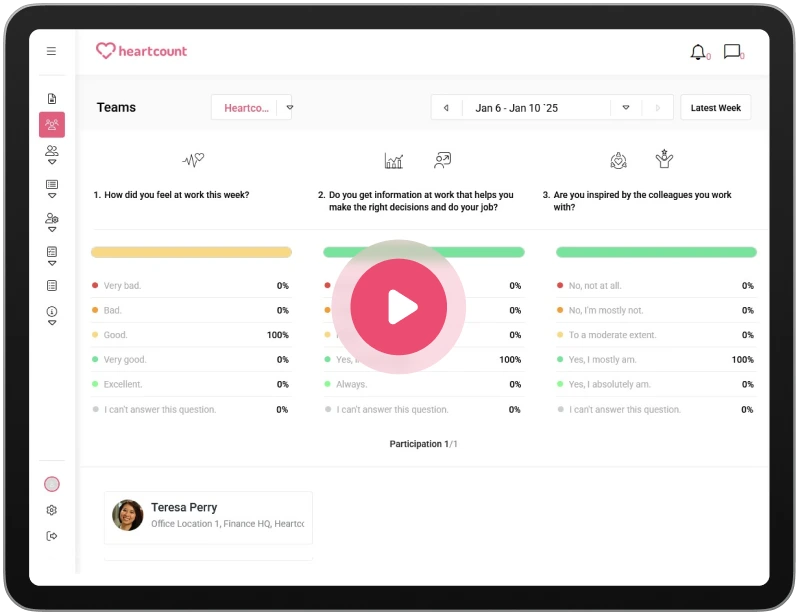
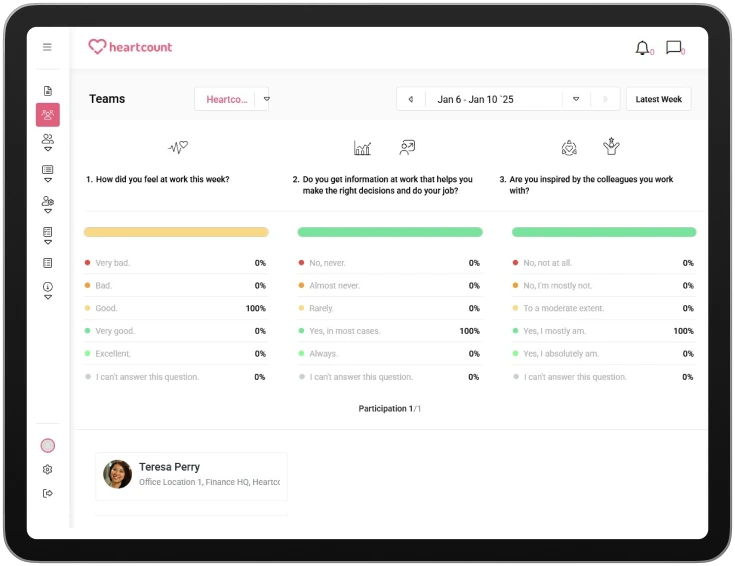
HeartCount runs automated weekly pulse checks with a consistent three-question format. One core well-being question is asked every week, while the other two rotate across engagement categories to capture a broader context without increasing survey fatigue. This makes small changes visible early, instead of surfacing problems weeks or months later.
Lattice and Leapsome primarily rely on scheduled survey cycles. If engagement shifts between those cycles, changes may remain invisible until the next planned check-in.
2. Participation Behavior Is Treated as a Signal
HeartCount tracks how people engage with the process itself:
- Skipping surveys
- Answering inconsistently
- Gradually stopping participation
These behaviors are interpreted as engagement signals, not just noise.
Lattice and Leapsome report response rates, but largely treat them as descriptive metrics rather than indicators of potential risk.
3. Risk Is Clearly Prioritized
HeartCount automatically surfaces a clear risk level for individuals and teams. Each person and team is classified as low, medium, or high risk, based on engagement trends, sentiment, participation behavior, and comments. HR immediately knows where attention is needed first, without manually interpreting charts or dashboards.
Lattice and Leapsome highlight themes and score movements, but they stop short of explicitly indicating urgency. HR teams still need to determine what requires immediate action versus what can wait.
4. Engagement Is the Core Focus
In Lattice and Leapsome, engagement sits alongside performance reviews, goals, learning, compensation, and HRIS functionality. That breadth is powerful, but it also means engagement competes for attention.
As a Lattice alternative, HeartCount is built almost entirely around engagement health, sentiment, and retention risk. The product is designed so that nothing distracts from those signals.
5. AI Supports Prioritization, Not Just Interpretation
HeartCount’s AI analyzes multiple engagement signals and how they evolve over time, including:
- Sentiment
- Trends across consecutive weeks
- Skipped or inconsistent participation
- Written comments and their themes
- Peer recognition
The model evaluates patterns, consistency, and change, not single responses, and increases confidence as more data is collected. This allows risk signals to become more reliable the longer the system is in use.
Lattice and Leapsome mainly use AI to summarize or explain data. HeartCount uses AI to triage and help decide what should be acted on first.
6. Feedback Remains Connected to the Original Signal
In HeartCount, feedback conversations stay tied to the engagement signal that triggered them. Employees leave comments, HR or managers respond, and the full context remains intact.
In Lattice and Leapsome, feedback can be distributed across surveys, meetings, reviews, and messages, which makes long-term follow-up and continuity harder.
7. Employees Can Be More Open by Default
HeartCount is designed so managers typically see aggregated results, not individual responses, unless the organization explicitly enables individual visibility. This lowers fear of retaliation and encourages honesty in organizations where trust is still forming.
This makes the tool easier to adopt in environments where trust is still developing, and employees may hesitate to be fully open.
8. Pricing Stays Engagement-Focused and Predictable
HeartCount uses transparent pricing that scales with company size, without bundling engagement into large, multi-module packages.
- Starter: $0 (up to 25 employees)
Includes unlimited pulse and custom surveys, AI insights, individual risk flags, comments, feedback replies, recognition, and core reporting. - Business: $2.50 per employee/month (up to 500 employees)
Adds advanced reporting, drill-downs, full historical data, multi-language support, stronger security, SSO, and optional SMS surveys. - Enterprise: Custom pricing
Includes benchmarks, dedicated customer success, custom integrations, platform customization, premium support, and training.
There are no mandatory add-ons. Teams can start free and upgrade only when scale or complexity requires it. Compared to Lattice and Leapsome, pricing remains predictable because it is centered on engagement rather than expanding as additional HR modules are added.
Lattice vs Leapsome vs HeartCount
| Pain Point | Lattice | Leapsome | HeartCount |
| Engagement gaps between surveys | Engagement measured in scheduled cycles; shifts between cycles may be missed | Cycle-based tracking, not continuous | Continuous weekly three-question pulse check survey with a fixed core question |
| Early warning signals | Trends shown, but no explicit urgency | AI explains patterns, not urgency | Automated low/medium/high risk signals |
| Low participation as a signal | Response rate reported, not interpreted | Reported, not behaviorally modeled | Participation behavior feeds risk scoring |
| Closing the feedback loop | Comments exist; follow-up depends on process discipline | Threads can be scattered across modules | Feedback stays tied to engagement signals |
| Making sense of data | Dashboards require manual prioritization | Templates help, but setup needed | AI prioritizes who needs attention now |
| Engagement dilution | One module among many HR workflows | Part of a broad people system | Engagement is the core product |
| Manager access to sensitive data | Configurable, but setup required | Configurable via permissions | Aggregated views by default |
| Fast, low-effort participation | Periodic pulse surveys | Periodic pulse surveys | Weekly 3-question format |
| Reporting for stakeholders | Flexible exports | Clear reporting | Reports include trends and risk context |
| Small-team setup | Requires initial configuration | Templates help, but setup is needed | Free tier with minimal setup |
| Behavior-based insight | Scores and themes | Sentiment and themes | Behavior patterns influence risk |
| Visibility into who needs action now | HR must interpret trends | HR must infer urgency | Clear risk ordering for people and teams |

Decision Guide: Lattice vs Leapsome vs HeartCount
Choose Lattice if:
- You want one big HR system that covers reviews, goals, feedback, and engagement.
- Engagement fits into scheduled cycles, not day-to-day monitoring.
- Your HR team is fine at analyzing dashboards and deciding priorities themselves.
Choose Leapsome if:
- You want engagement connected to learning, growth, and development.
- You like AI summaries that explain survey results.
- You review engagement together with goals, skills, and feedback.
Choose HeartCount if:
- Your main goal is early detection of disengagement and retention risk.
- You want engagement measured continuously, not in cycles.
- You care about how people participate, not just what they score.
- You want simple pricing and a fast time to value.
Final Words
So, Lattice vs Leapsome? Both are solid platforms for measuring and understanding engagement, especially when feedback is reviewed in planned cycles alongside other HR processes.
HeartCount takes a different approach. It is built for teams that want to see engagement shifts early, understand who needs attention first, and act without waiting for the next survey cycle.
If engagement is something you review periodically, Lattice or Leapsome can work well. If you want engagement monitored continuously with clear signals and fast follow-up, HeartCount is the better fit.