

Happiness at Work in Financial Sector Workplaces






More and more workplaces have realized that making their staff happy is great for company results. They’ve seen that when employees genuinely like their jobs, they are more productive, more motivated, more loyal, and more likely to go the extra mile for the customer.
Yes – having happy employees really is that great, and tons of studies prove it.
I see this increased focus on employee happiness in many industries, including in finance. I have personally worked with so many banks, pension companies, and insurance companies that have come to realize that happier employees lead to a better bottom line. That’s great!
In this white paper, I cover:
- Why happy employees are great for the bottom line in finance
- The biggest challenges in the industry
- Great examples from some of the happiest companies I know in the sector
- Specific tips and steps to make finance workplaces happier
Happy reading!
Challenges in Finance
Overall, workplaces in finance are facing systemic challenges to employee well-being. These are the biggest challenges that I have seen in my work in this sector.
1. Long Hours and High Workloads
Working long hours is not unusual in finance. Certain periods are simply more intense than others. Reporting cycles, regulatory deadlines, system changes, and market events. Anyone who has worked in the sector knows this rhythm.
The challenge starts when the high workload stops being the exception and slowly becomes the norm.
There is plenty of research showing that consistently working very long hours takes a toll over time. Not just on how people feel, but on how they think and perform. When people get tired, their focus drops. Decisions take longer. Mistakes become more likely. Creativity suffers.
This is not about people being less committed or less capable. It is about basic human limits.
What often gets overlooked is that long hours do not automatically lead to better results. In fact, a large body of management research shows the opposite. As fatigue increases, productivity per hour tends to go down, not up. People may be present for longer, but they are not necessarily working better.
Over time, sustained overload can also become costly for organizations. Higher absence, increased turnover, and loss of experience are common side effects when recovery is missing.
The most effective financial organizations I have worked with do not try to eliminate busy periods altogether. That would be unrealistic. Instead, they are intentional about how they manage their workload. They plan for peak periods, watch for signs of overload, and make sure intense phases are followed by time to recover.
The goal is not fewer demands, but sustainable performance. When people have the energy to think clearly and do their work well, both employees and the organization benefit.
2. Constant Change
Change is a normal part of work in finance. New rules, new systems, new products, new expectations. There is almost always something changing.
Change can come from many places:
- New products and services
- New laws and regulations
- New IT systems and tools
- Reorganizations
- New Safety and security requirements
- Changing customer expectations and demands
- New processes and workflows
Change itself is not a problem. It is often necessary.
It becomes harder when changes come one after another, without much time in between, or when people do not clearly understand why a change is happening.
I often hear employees say things like, “We just finished one big change, and now the next one is already starting.”
Change works best when people feel informed, supported, and involved. When that happens, employees are more open, more motivated, and more willing to make change work.
3. Management Quality
I once worked with a large bank that had noticed that engagement was lower in some teams.
When we looked into it, a clear pattern appeared. Year after year, the same teams mentioned challenges with their direct manager in employee surveys. The feedback was there, and it was consistent, but it took a long time before anything really changed.
This usually isn’t about bad intentions. In big, performance-driven organizations, strong specialists are often promoted into management roles. Leading people, however, is a different skill, and not everyone gets the training or support they need right away.
What we do know is that managers play a huge role in how people experience their work. When leadership works well, employees feel supported and motivated. When it doesn’t, stress goes up, and engagement goes down, even among people who care about their jobs.
That’s why management quality matters so much. Long-term results don’t come from numbers alone. They also come from how people are treated and supported every day.
Bottom Line: Focus on Financial Outcomes and Sense of Purpose
I once worked with a Danish insurance company that was doing very well financially. Profits were strong, but many employees felt that something was missing.
Over time, processes had been optimized so much that people felt they had less room to use their judgment, especially when helping customers in difficult situations. What had once made the job meaningful was becoming harder to do.
For many employees, meaning came from being able to really help customers when they needed it most. As the focus shifted more toward efficiency, that connection felt weaker.
We know that meaningful work matters. When people see how their work helps others, they are more engaged and better able to handle pressure. When that sense of purpose fades, motivation often drops.
In this case, the company adjusted its approach. They gave employees more autonomy and made the customer impact of their work more visible. This helped reduce pressure and supported strong results at the same time.
I’ve seen other organizations describe this balance very clearly. As one company put it:
Numbers and money follow. They do not lead.
Financial results still matter. The difference is understanding that they tend to follow when employees and customers come first.
Opportunities
Here’s the good news. While there are industry-wide challenges in finance, these workplaces also have some clear strengths when it comes to creating happy employees:
- They have the resources to act. Financial organizations generally have the scale and stability needed to invest in initiatives that improve how people experience their work.
- They employ highly skilled, well-trained people. Employees in finance are accustomed to learning, adapting, and working with complex topics, making them receptive to well-designed initiatives that improve working conditions.
- They have a lot to gain. In finance, even small improvements in employee happiness can lead to meaningful gains in performance, customer experience, and long-term results.
Let’s look at those.
Business Benefits of Happiness in Finance Sector
For companies in every industry, employee happiness is crucial for one simple reason: Happy companies make more money.
Happy employees are not simply in a better mood; they also do a much better job. Studies from psychology and neurology have shown that people who experience positive emotions experience a number of benefits at work. They:
- Are more productive and work faster and more efficiently
- Get sick less often and have much lower absenteeism rates
- Tend to be more creative and have more and better ideas
- Give much better service and make customers happy
- Stay at the company longer, saving huge efforts in recruiting new people
- Sell more when in sales roles
- Are more motivated and energetic
- Are more resilient in the face of setbacks
- Work better in teams
- Are more optimistic and engaged
And indeed, studies show that happy companies:
- Make more money
- Have happier and more loyal customers
- Have higher quality and less waste
- Have better safety records
- Have better sales
- Have higher stock prices
What’s not to like?
While some people think happiness is soft or fluffy, the truth is that it is one of the main drivers of business results, and any workplace that ignores it leaves money on the table, especially in finance workplaces that really stand to gain from it. Let’s look at why.
Specific Benefits in Finance
Employee happiness matters in every industry, but in finance, it has a particularly strong impact on long-term success. One of the clearest areas where this shows up is employee retention and talent attraction.
Reduced Employee Turnover and Attracting More Talent
When you invest time and money in hiring and training people, you want them to stay.
Employee happiness plays a big role here. When people enjoy their work and feel supported, they are far more likely to stick around. And when they do, they take valuable knowledge, experience, and relationships with them.
Happy workplaces also attract talent more easily. Employees who feel good about where they work naturally talk about it. They recommend the organization to friends and former colleagues, and that strengthens the employer brand in a very authentic way.
Some financial organizations are very clear about this link between happiness and retention. Jonas Juehl Thomsen, Regional Director at the Danish bank Arbejdernes Landsbank, explains it like this:
“We do not have a goal of retaining employees! Instead, we focus on creating happiness at work and thus make people want to stay.
In Arbejdernes Landsbank, we make an effort to make it fun to go to work!
This is a prerequisite for succeeding with our ambitions for employees, the customer experience, and, not least, strengthening the bank’s position.
For me, the most important success criterion is “Taking responsibility and doing the right thing”!
This requires that we do not just lend a helping hand as leaders, but that we also make an effort to make it easy to do the right thing for our employees.
When this succeeds, work makes sense.
And that makes people want to stay!
In Arbejdernes Landsbank, several years ago, we did away with meaningless target metric regimes. Instead, we focus on what effort we should make for each other and for the customers!
Why? Because it creates the right conditions for us to always put the customer at the center – and deliver the attentive and competent advice that customers should expect.
Close to 50% of new hires in the sector are gone after five years according to a recent survey.
In my view, this is not an employee problem. It is a management responsibility – which we have already taken to heart!
Let’s, once and for all, drop retention as a focus area, but instead focus on making it worth it to stay. This means that we automatically show up with positive energy and courage for the changes we need to succeed with.
It is no coincidence that customers have chosen us as the Danes’ preferred bank for 16 years in a row!
When employees are thriving, customers can feel it.”
That is just awesome! No performance metrics, just a focus on helping customers and coworkers. No direct focus on retention, just a focus on making employees happy.
Kudos, Jonas.
Better Customer Experience
A good customer experience is what keeps customers coming back.
And happy employees make a big difference here. When people enjoy their work, they are more attentive, more engaged, and more likely to notice small opportunities to help customers and act on them.
When employees feel good at work, they have more energy and focus. That naturally shows in how they interact with customers.
You can create all the service manuals and training programs you want, but what really brings them to life is how people feel at work. When employees care, good service follows.
That’s why investing in employee happiness makes so much sense. Research from customer-facing industries shows that when organizations invest in their people, it often pays off in better service and stronger business results.
Faster Learning and Pace of Change
Financial organizations operate in environments where change is frequent and often unavoidable. Regulation evolves, customer expectations shift, technology advances, and security requirements increase. As a result, teams are regularly asked to adapt to new ways of working.
Common drivers of change in the sector include:
- New laws and regulatory requirements
- New products and services
- Updated processes and workflows
- New IT systems and digital tools
- Organizational changes
- Enhanced safety and security standards
- Changing customer expectations
Change itself is not the problem. In fact, the ability to adapt quickly is a competitive advantage. The real challenge is how change feels to employees.
Change is harder when it comes in big waves, one after another, or when people don’t really understand why it’s happening. If the purpose isn’t clear, or if the link to customers and everyday work is missing, energy tends to drop.
That matters because change only works when employees are focused, motivated, and willing to learn. When people feel supported and confident, they are much more open to new ideas and more willing to help make changes work.
In organizations that handle change well, you often see the opposite reaction. Employees are curious rather than resistant. They trust leadership decisions and actively help turn new ideas into reality.
This is one of the reasons employee happiness matters so much in finance. When people feel valued and engaged, organizations can move faster, learn quicker, and adapt more easily to whatever comes next.
Good Examples
Over my 20+ years in the field of happiness at work, I have had the chance to work with many happy financial workplaces, including banks, insurance companies, and pension companies.
Here are some of my favorite and most inspiring examples.
SEB Pension
When Søren Lockwood was CEO of SEB Pension in Denmark, he realized something important: the best way to drive results was by focusing on employee happiness. He made it a clear strategic priority, and in 2015, he even won a national HR award.
People often asked him if he could prove that happiness leads to better business results. His answer was simple:
What about leaders who destroy happiness? Why don’t they have to prove that it doesn’t work?
At SEB Pension, this wasn’t just talk. Søren was personally involved, and happiness was approached both top-down and bottom-up.
They appointed a Chief Happiness Officer to keep things moving and set up a small employee happiness committee to suggest ideas from everyday work.
One small idea I loved was how they handled vacations. People used a simple Hawaiian lei to signal when they were about to leave and when they were away, making handovers smoother and avoiding interruptions.
They also paired managers up as buddies to learn from and support each other.
The result? Happier employees, strong financial results, and some of the highest customer satisfaction scores in the sector.
Middelfart Sparekasse
Middelfart Sparekasse is a Danish savings bank with around 300 employees, based in the town of Middelfart. Yes, the name often gets a smile, and it still does when I mention it in talks.
I’ve spoken at the bank several times, and every visit confirms the same thing: their culture is genuinely strong.
They’ve focused on employee happiness for decades. It’s not a side project or an HR initiative. It’s built into how they think, lead, and make decisions. Their philosophy is simple: treat customers so well that they stay and recommend the bank, treat employees so well that they look forward to coming to work, and make enough money to support both.
This approach has paid off. Middelfart Sparekasse has ranked at the top of Denmark’s Great Place to Work lists multiple times, and their culture has even been featured by CNN, which wrote about their success.
One thing I really like is their annual Culture Profile. It’s a detailed reflection on what the bank stands for, what happened during the year, and how they want to keep improving together.
NBK
I have had the chance to visit The National Bank of Kuwait several times in their very fancy skyscraper in Kuwait City, both to learn from them and to give talks to their top leadership and to their managers. And every time I’ve gone, I have been thoroughly impressed with their focus on employee happiness.
One area they especially focus on is training and development – giving every employee a chance to build their skills and competencies.
They arrange a ton of training sessions delivered by their own trainers or external speakers, and on my latest visit there, I saw one of their latest initiatives: The Network of Bright Knowledge program, where employees can offer training to each other in their areas of expertise.
This is a brilliant idea for three reasons:
- It’s a lot cheaper than bringing in external speakers and consultants
- It gives their employees a chance to shine by teaching something they know a lot about
- It gives employees a chance to connect and build relationships around topics they’re passionate about
The results have been stellar. In their most recent employee survey:
- 93% of employees say they’re proud to work at NBK
- 96% say they work beyond what is required to help it succeed
- 86% say that their work gives them a sense of personal accomplishment
- 92% say they fully support the Bank’s values
How to create a Happy Workplace in Finance
As I wrote previously, many workplaces in the sector have realized that happy employees lead to better profits. The problem is that too many of them try to improve employee experience by focusing mainly on external incentives such as raises, promotions, perks, and benefits.
Salaries obviously need to be fair and livable, but once they are fair, paying people more will not necessarily make them happier or more likely to stay with the organization.
Our model says that there are two things that make people happy at work: Results and relationships. Let’s look at those.
We all want to get results. We all want to make a difference, know that our work is important, get appreciation, and do work that we can be proud of.
One of our deepest psychological needs is the need to control our environment. If we’re placed in a situation where we have no control, where nothing we do matters, motivation and engagement decline. On the other hand, we love to make a difference. Accomplishment feels great. As Franklin D. Roosevelt put it:
“Happiness lies in the joy of achievement and the thrill of creative effort.”
We also need to feel valued as human beings and to have good connections with co-workers and managers, and even with customers, suppliers, shareholders, and the organization’s wider community.
Relationships at work matter so much because we spend a lot of time with people there. When you think about it, you’ll be spending more of your waking hours with them than with your friends and family.
So this is the foundation of happiness at work: Results and relationships – doing great work together with great people. This is what we must give our employees every single day.
Figuring out how to do this in practice is the crucial challenge. Here are some proven tips on how exactly to do this in financial workplaces.
Make Employee Happiness a Top Strategic Priority
The three great examples of happy finance workplaces I mentioned have one thing in common: They made employee happiness a top strategic priority, with the full attention of the organization, starting with the CEO.
They make sure that there are effective happiness initiatives at every level of the organization and that happiness is accurately measured and reported to them regularly.
As Drucker put it, culture eats strategy for breakfast, and any strategy that does not consider the impact on employee happiness and engagement is much more likely to fail.
Select and Train Managers for Happiness
Research is very clear: the main driver of employee happiness or unhappiness is the manager. That is why organizations need to ensure that managers have the personality, skills, and tools to support both performance and well-being.
As shown earlier, happiness at work is primarily driven by two factors: results and relationships. Employees thrive when they can make a difference in their work and when they feel genuinely cared for as people. These factors matter far more than perks or benefits.
This raises a key question: should managers focus on results or on people?
Research by James Zenger shows that managers who focus only on results, or only on relationships, are rarely seen as effective leaders. Managers who combine strong results focus with strong social skills are far more likely to be perceived as good managers. Yet very few managers naturally master both.
In practice, many organizations promote their strongest technical performers into management roles without sufficient preparation. Without proper training and development, this can negatively affect both employee experience and productivity.
In my view, organizations are more successful when they select managers with strong social skills and train them to deliver results. Developing empathy and relationship skills is often harder than developing performance focus.
Leadership is fundamentally about working with people. If someone does not genuinely enjoy working with others, they should not be in a leadership role.
It is also important to consider how managers are rewarded. When incentives focus only on results, relationship-building is often neglected. Balancing rewards between results and relationships encourages healthier leadership behavior over time.
The best financial organizations do not leave leadership quality to chance. They invest in structured training, coaching, and peer support. Examples include internal leadership academies and simple practices such as manager buddy systems, where leaders regularly support each other’s development.
Finally, organizations need to act when managers consistently fail to lead well. Not everyone is suited to a leadership role, and addressing this openly is essential for maintaining a healthy workplace.
More and more organizations are appointing Chief Happiness Officers, and for good reason. The role exists to drive concrete actions and initiatives that support employee happiness.
The CHO role follows the same logic as other executive functions. Just as technology, finance, and operations have clear ownership, employee happiness also benefits from having a dedicated driver.
A Chief Happiness Officer is not responsible for “making everyone happy” on a daily basis. The role is primarily about coordination and execution. This includes planning and supporting initiatives such as trainings, events, celebrations, and other activities that help people do their work well and understand its purpose.
The role can be structured in different ways. In some organizations, it is a full-time position, while in others, it is part of HR or a part-time responsibility held by someone with a strong interest in workplace happiness. At SEB Pension, the role was taken on part-time by the Head of Legal, who reported directly to the CEO and had strong leadership support.
Measure Happiness at Work and Act on Results
Measuring employee happiness matters for three simple reasons:
- It shows what’s working and what isn’t. You can see which teams are doing well and learn from them, and where people may need more support.
- It makes happiness visible to leadership. Leaders tend to act on what they can measure. Clear data helps keep happiness on the agenda and ensures it gets the attention and resources it needs.
- It shows employees that their voice matters. Asking for feedback and acting on it sends a clear signal that the organization cares, which strengthens engagement and trust.
There are many ways to measure happiness at work, and I have helped start Heartcount, which is absolutely the best one.
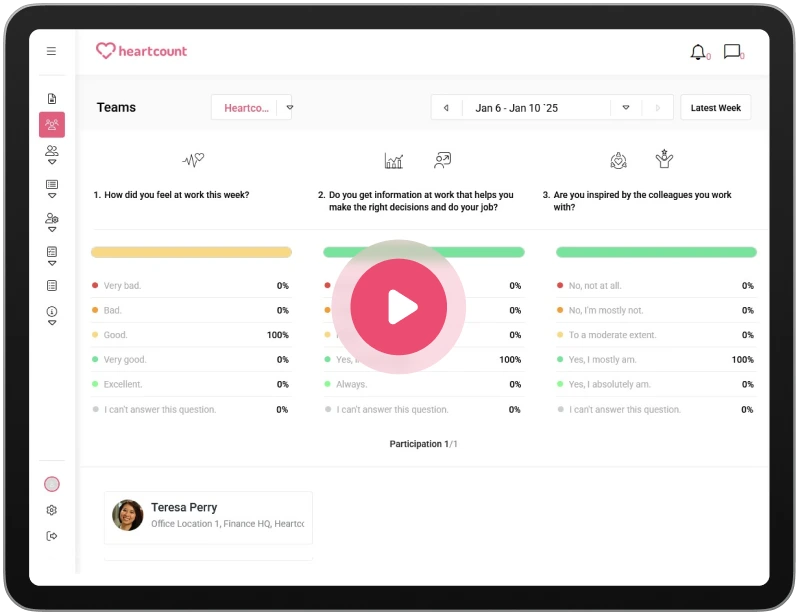
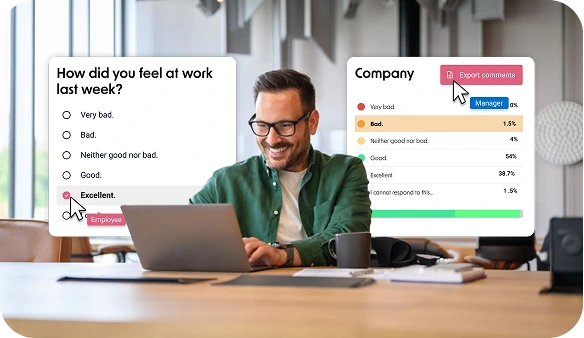
Heartcount is an AI-powered tool that measures happiness at work in a new, more effective way.
It is a tool for tracking results and relationships (personal fulfilment, progress, relationships with colleagues and managers) that influence happiness at work. It also provides immediate feedback and operational information to everyone in the ecosystem, improving decision-making and outcomes through real-time analysis. Heartcount system brings the entire ecosystem together, from employees, through the HR office, to managers.
The value of the tool is not just the data it provides; it is how it helps you act on that data and bring the results back to employees. This tool provides you with valuable data weekly so you can react in time.
Here’s how it works:
Every Friday, everyone gets 3 questions that can be answered in about 20 seconds. They immediately see their own results and can compare them with the rest of the company’s results. HR and top leadership can see overall trends in the data and get notified about employees who may need extra help and attention.
Check it out and book a demo.
Minimize Rules and Red Tape
The financial sector is, understandably, highly regulated. That said, internal rules and bureaucracy can sometimes go further than necessary and make it harder for employees to take initiative and feel ownership of their work.
When people are trusted to do their jobs in their own way, they are much more likely to feel proud of the results. When everything is tightly prescribed, work can start to feel less personal and less meaningful.
Many organizations try to create rules for every situation. I once saw a bereavement policy that spelled out exactly how much time employees were allowed to take off, depending on their relationship to the deceased. While clear, it left very little room for human judgment.
Middelfart Sparekasse follows a different approach. In the event of a death in the family, their policy is simple: “Talk to us, and we’ll figure out how much time you need off.”
They recognize that people handle difficult situations differently, and that flexibility matters.
This mindset extends beyond bereavement. Middelfart Sparekasse has removed as much unnecessary bureaucracy as possible and instead relies on trust and judgment. There is no formal dress code, and managers are encouraged to make sensible decisions without needing approval for every detail.
One branch manager once asked about a budget for an internal team event. The response was simply: use your judgment. The result was a small, personal gathering that was both meaningful and effective.
The goal is not to remove rules entirely, but to use them where they add value and trust people everywhere else.
Create a Culture of Positive Feedback
Positive feedback is one of the strongest drivers of happiness at work.
Research from Harvard Business School confirms what most of us already know. When people receive positive feedback, they feel better, less stressed, and perform better. In one study, participants who were reminded of moments when they were at their best were more creative, more successful at solving problems, and less stressed than others.
Positive feedback is powerful for two simple reasons. It works, and it is often missing from everyday work life.
One effective way to strengthen positive feedback is to actively collect positive comments from customers and make sure they reach the employees involved. Small moments of recognition can have a big impact.
NBK has many strong initiatives, but one of my favorites is their MVP program. Each year, employees nominate colleagues for the “Most Valuable Team Player” award. The focus is not only on performance, but on teamwork, support, and collaboration.
Leadership selects a winner in each division and personally recognizes them, highlighting what made them an MVP. Teams also receive a “Most Collaborative Team” award.
This kind of program helps make values visible and reinforces the behaviors the organization wants to see more of. What makes it especially effective is that:
- Employees recognize each other
- Collaboration and support are celebrated, not just individual results
- Leadership is present and actively involved
Positive feedback does not need to be complicated. When it becomes part of everyday work, it strengthens relationships, motivation, and performance.
Communicate Results, Not Gaps
I once worked with a large insurance company that had a strong focus on KPIs and metrics. Employees were measured on many factors, including average customer wait time on the phone.
The problem was simple: wait time was largely outside of the employees’ control. A period of extreme weather led to a surge in incoming calls, which pushed wait times up, even though employees were working hard and doing everything they could.
Still, every week they received reports showing they were “behind” on their targets. These results were discussed repeatedly, which slowly wore down morale, even though everyone understood the situation.
Metrics are meant to improve performance, but they can have the opposite effect when people are judged on things they cannot control. A lack of control creates frustration and stress, not motivation.
In this case, the company changed its approach. Instead of focusing on wait time, they focused on the number of calls handled, something employees could influence directly. The result was immediate. Employees felt better about their work, productivity increased, and performance improved week by week.
The lesson is simple. Organizations need to communicate and celebrate the results employees actually achieve, not constantly highlight the gaps. This gives people a sense of progress and motivates them to keep improving.
This works especially well when results are tied to real impact, whether that is helping customers or supporting colleagues.
Build Great Relationships
Strong relationships at work have a powerful effect on happiness.
I once noticed an employee at a client event carrying a bouquet of flowers. They were a gift from a coworker, along with a handwritten note thanking her for being a great colleague. She was visibly happy, and the moment stayed with me.
Small acts like this matter. Recognition, appreciation, and simple kindness can make a real difference in how people experience their work and their relationships with colleagues.
Many workplaces focus heavily on results and numbers, but relationships are just as important. And the good news is that building them does not require big programs or budgets.
Simple actions can go a long way. Some leaders make time to regularly meet small, random groups of employees in an informal setting. Others create small, unexpected moments that show care and presence.
Sometimes it is even simpler than that. Saying a friendly “good morning,” taking a moment to talk, or acknowledging someone’s effort helps people feel seen and valued.
There are countless small ways to build connections at work. When relationships are strong, work becomes more human, more supportive, and more meaningful for everyone.
Final Words from the Author
Employee happiness matters in financial workplaces. When people feel good about their work, they perform better, stay engaged, and are better able to handle the demands of the job.
The good news is that there are clear, practical ways to improve happiness at work. Many organizations are already doing this well, and the examples in this paper show that small changes can make a real difference.
I hope these ideas have been useful and inspiring, and that they spark reflection on what is already working well and what could be improved further.
Please let me know! You can email me at alexander@woohooinc.com and connect with me on LinkedIn.
You can also read more about my work at woohooinc and follow my blog.
And don’t forget to check out Heartcount and book yourself a demo.
About the Author
Alexander Kjerulf is the founder and Chief Happiness Officer of Woohoo inc and one of the world’s leading experts on happiness at work. He is an author and speaker, presenting and conducting workshops on happiness at work at businesses and conferences in over 50 countries. His clients include companies like Hilton, Microsoft, IKEA, Shell, HP, and IBM.
He has worked at a ton of financial institutions, particularly banks, pension companies, and insurance companies.
Alex is also the co-founder of Heartcount, the best tool for measuring employee happiness.
He has a master’s degree in computer science from the University of Southern Denmark and was a co-founder of the Danish IT company Enterprise Systems.
Alex is the author of 5 books, including the international bestseller Happy Hour is 9 to 5: How to Love Your Job, Love Your Life, and Kick Butt at Work. The book has been extremely well-received worldwide and is available in 11 languages, including English, Spanish, Dutch, Czech, and Chinese. His latest book is Leading With Happiness: How the Best Leaders Put Happiness First to Create Phenomenal Business Results and a Better World.
His work has been featured in CNN, The New York Times, The Times, The Times of India, BBC, Financial Times, and many other outlets.