

Lattice Review 2026: Features, Pros & Cons, Pricing, and Alternatives








If you are trying to bring structure to performance reviews, goal setting, and employee development, Lattice is one of the platforms you will come across quickly. It is designed to help companies replace scattered feedback, inconsistent review cycles, and unclear performance expectations with a single system that tracks everything in one place.
In this Lattice review, I will walk through what the platform actually does, where it performs well, where it falls short, and whether it makes sense for your organization. I will also cover its features, pricing, integrations, user reviews, and how it compares to alternatives, so you can decide if it is the right investment or if another tool would serve you better.

Lattice at a Glance
Lattice is a performance management platform built to help companies track, manage, and improve employee performance in a structured, ongoing way. I see it as a system that replaces scattered spreadsheets, awkward annual performance reviews, and vague feedback with a single central place where managers and employees know where they stand.
At its core, Lattice connects four things that most businesses struggle to keep organized:
- Performance reviews
- Goals and goal tracking
- Continuous feedback
- Employee engagement
Instead of performance being something you talk about once a year, Lattice turns it into a continuous process. Managers can track progress, employees can see their goals, and leadership can see how teams are performing overall.
What makes it different from basic HR tools is the focus on employee development, not just record-keeping. It is designed to answer questions like:
- Who is improving and who is stuck
- Which teams are performing well, and which are struggling
- Whether managers are actually managing effectively
- Who is ready for promotion, and who is not
It is used mostly by small- to mid-size companies and growing organizations that want structure without enterprise-level complexity. HR teams use it to run review cycles, managers use it to manage their direct reports, and leadership uses it to see performance data across the entire organization.
In simple terms, Lattice helps companies get actual data on employee performance, structured feedback, and clear goals.
Latice Pros
After going through the platform, I see why many growing companies adopt Lattice once performance becomes too complex to manage manually. It solves real operational problems that show up when you have more than a handful of employees and need structure.
- Everything related to performance in one place
I like that performance reviews, goals, feedback, and engagement surveys are not scattered across documents, emails, and separate tools. Managers, HR teams, and leadership can open one system and see the full picture of employee performance without chasing information. - Review cycles are structured but still flexible
Lattice makes it easy to run annual performance reviews, quarterly reviews, or custom review cycles. You can include self-reviews, peer review, and manager reviews in the same review packet. This creates a more complete and fair evaluation instead of relying on one person’s opinion. - Continuous feedback becomes part of daily work
Instead of feedback happening once a year, managers and employees can exchange feedback regularly. This helps fix problems faster and supports employee development before issues become serious. - Strong goal setting and goal tracking
The goal-setting system connects individual goals to team and company goals. I can see how this keeps employees aligned with business priorities and prevents people from working on things that do not actually move the organization forward. - Clear performance data and analytics for HR leaders
Lattice gives HR professionals and leadership visibility into performance trends, engagement levels, and employee growth. This makes decisions like promotions, raises, and succession planning easier to justify with actual data. - Good support for employee engagement surveys
Engagement surveys are built in, so companies can measure employee engagement without buying another tool. This helps HR teams understand morale, manager effectiveness, and retention risk.
Lattice Cons
Lattice is a strong system, but it is not perfect. I also see clear limitations, especially depending on company size, budget, and the maturity of your HR processes.
- Pricing can become expensive as you grow
Lattice pricing is based on per-employee subscriptions. This is manageable for smaller teams, but costs increase quickly as your organization grows. For larger teams, it becomes a serious ongoing expense. - Requires time and effort to set up properly
Lattice is not something you turn on and instantly benefit from. HR teams need to configure workflows, review cycles, goals, and templates. Without proper setup, the platform loses much of its value. - Can feel heavy for very small teams
If you have 10 to 20 employees, Lattice may feel like overkill. Simpler teams often do not need structured review cycles, performance analytics, and formalized feedback systems yet. - Managers must actively use it, or it fails
Lattice depends heavily on manager participation. If managers do not give feedback, complete reviews, or update goals, the system becomes empty. The software cannot fix poor management habits on its own. - Engagement surveys can lack depth for complex organizational issues
Lattice’s employee engagement surveys are effective for tracking general trends, but I find they can fall short when you need deeper diagnostic insight. The surveys are structured and template-driven, which makes them easy to run, but they may not fully capture nuanced cultural problems, team-specific issues, or the root causes behind low engagement without additional analysis outside the platform. - Limited value outside performance management
Lattice focuses on performance management. It does not replace core HR systems like payroll, recruiting, or employee records. Most companies still need other HR software alongside it. - Employee experience depends on company culture
If the organization treats reviews as a formality, Lattice becomes just another administrative task. The platform works best in companies that genuinely invest in employee growth and feedback.
Lattice Features
Lattice comes with a full set of features that help companies manage employee performance, track goals, and understand how their teams are really doing. Let’s take a closer look at them:
1. Performance Review Tools
This is the core of Lattice. Instead of chasing documents and emails, the entire review process is handled in a single, structured workflow.
- Performance reviews
Lattice lets you run structured performance reviews that evaluate employees based on their work, progress, and overall contribution. All feedback, ratings, and comments are stored in one place, which makes it easy to track employee performance over time and compare past and current reviews. - Review cycles (annual, quarterly, custom)
You can choose how often reviews happen. Some companies run annual performance reviews, others prefer quarterly reviews, and Lattice allows custom review cycles depending on how the organization operates. This flexibility makes it easier to match the review cycle to the company’s pace. - Self, peer, and manager reviews
Lattice supports multiple perspectives. Employees can review themselves, peers can provide peer review feedback, and managers can evaluate their direct reports. This creates a more balanced and realistic picture of performance instead of relying on a single opinion. - Review packets
All review information is automatically organized into review packets. These packets collect feedback, ratings, and comments in one document-like format. I can open a review packet and see everything about that employee’s review without switching between different tools or files.
2. Continuous Feedback & Conversations
Lattice does not treat feedback as a once-a-year event. It gives managers and employees tools to communicate regularly, so performance improves in real time, not months later when it is too late to fix anything.
- Continuous feedback
Lattice allows managers and employees to share feedback anytime, not just during performance reviews. You can leave feedback tied to specific work, projects, or behaviors. Over time, this builds a performance history instead of relying on memory during annual reviews. - 1:1s and meeting templates
Managers can run structured one-on-one meetings using built-in templates. You can create agendas, track discussion points, and document what was agreed. This helps managers stay consistent and gives employees a clear record of conversations about their performance and growth. - Notifications and reminders
Lattice automatically sends reminders when feedback is requested, reviews are due, or meetings are scheduled. This keeps review cycles and feedback workflows moving without HR constantly having to chase managers to complete their responsibilities.
3. Goals & Alignment
This is where Lattice connects daily work to actual business priorities. You can see what each employee is working toward, how that connects to team goals, and whether progress is moving in the right direction.
- Goals and OKRs (goal setting and tracking)
Lattice allows managers and employees to set goals and track progress over time. These can be individual goals, team goals, or company-wide objectives. You can open the system and immediately see who is on track, who is behind, and which goals are completed. - Benchmarks and trend insights
The platform shows trends and benchmarks based on performance and goal progress. This helps you understand whether performance is improving, declining, or staying flat. It gives context instead of looking at isolated performance data. - Action plans and growth tracking
Managers can create action plans for employees who need improvement or development. I can track progress, document growth, and see whether the employee is improving over time. This makes employee development more structured, rather than informal and inconsistent.
4. Employee Engagement & Surveys
Lattice also helps you understand how employees feel, not just how they perform. This matters because performance problems often start with engagement problems.
- Employee engagement surveys
You can run full employee engagement surveys to measure satisfaction, morale, and how employees view their managers and the organization. The results help identify patterns, like teams with low engagement or managers who may need improvement. - Pulse surveys
Pulse surveys are shorter and faster. You can send them more frequently to check how employees feel in the moment. This helps catch problems early instead of waiting for annual surveys. - Customizable survey templates
Lattice provides templates, but you can also customize questions to match the company’s needs. This allows HR teams to focus on specific issues, such as leadership, workload, or employee growth, and collect more relevant feedback.
5. Analytics & Reporting
This is where Lattice turns feedback, reviews, and goals into actual performance data you can use to make decisions. Instead of relying on opinions, you can see patterns, compare teams, and understand what is really happening inside the organization.
- Performance analytics and reporting
Lattice collects performance data from reviews, goals, and feedback and turns it into reports. You can see employee performance, manager effectiveness, and overall team performance without manually compiling information. - Trend insights
The platform shows trends over time, such as whether performance is improving, engagement is dropping, or certain teams are struggling. This helps spot problems early and track whether changes are working. - Benchmarks
Lattice provides benchmarks that help put performance into context. You can compare employees, teams, or departments and see where performance is strong and where improvement is needed. This makes decisions like promotions, development plans, and succession planning more informed.
6. Admin & Platform Controls
This is the part HR teams use to run the system behind the scenes. It gives control over how performance management works, who can see what, and how review and feedback processes are structured across the organization.
- HR admin controls and workflows
HR teams can create and manage review cycles, feedback workflows, and engagement surveys. You can define who participates, set deadlines, and control how the performance management process runs from start to finish. - Security and permission controls
Lattice allows admins to control access to performance data. You can decide what managers and employees can see, and what stays restricted to HR leaders. This helps protect sensitive performance reviews and feedback. - Customizable templates
The platform provides templates for performance reviews, surveys, and feedback forms, but they can be customized. You can adjust questions, rating scales, and formats to match how the organization evaluates employee performance.
7. Lattice AI
Lattice AI supports the process, but it does not evaluate employees on its own. Managers still make the final judgment. The AI helps with writing and structure, not decision-making.
- AI-assisted performance reviews
You can use Lattice AI to help write performance reviews faster. It can generate summaries, suggest review content, and help structure feedback. This reduces the time managers spend staring at a blank page. - Feedback writing assistance
Lattice AI helps draft feedback based on employee performance data. This is useful for managers who struggle to phrase feedback clearly or professionally. It helps turn rough thoughts into structured feedback. - Review cycle efficiency
During a review cycle, Lattice AI helps speed up administrative work. It assists with writing review packets, summaries, and evaluations, which makes large-scale performance reviews easier to manage.
Lattice Integrations
Lattice integrates with most HR and workplace tools companies already use, so it fits into your existing systems rather than replacing them. I would not need to manually transfer employee data, performance information, or organizational structure, as these integrations keep everything automatically connected.
Here are the main Lattice integrations by category, with the most important names:
- HRIS integrations (core employee data systems)
These integrations sync employee profiles, reporting structure, and job data. They include Workday, BambooHR, Gusto, ADP, HiBob, Personio, Zenefits, UKG, TriNet, Humaans, and Namely. - Communication integrations (feedback and daily workflow)
These enable feedback, reminders, and updates within the communication tools employees already use. These include Slack, Microsoft Teams, Outlook, and Google Workspace. - Applicant Tracking System integrations (hiring data connection)
These connect hiring data to employee performance once someone joins. Available integrations include Greenhouse, Lever, Gem, and Pinpoint. - Single Sign-On and identity integrations (secure login and access control)
These simplify login and improve security: Okta, Microsoft Azure, Microsoft Entra ID, OneLogin, and JumpCloud. - Payroll and benefits integration: ADP Payroll, Employee Navigator, and Sequoia.
- Productivity and business tools: Jira and Salesforce
- Learning and development integrations: WorkRamp and Hone
- Other system integrations: Checkr, Drata, Brex, AccessOwl, and TimeRewards
In total, Lattice offers 39 integrations. This level of integration matters because performance management only works properly when employee data, goals, and reporting structure stay accurate without manual updates.
Lattice Pricing
Lattice uses per-employee, per-month pricing. You pay based on the number of employees you have and the modules you choose. The core platform starts with Talent Management, and then you can add other modules depending on whether you want engagement surveys, employee development, or compensation tools.
- Talent Management: $11 per employee/month
This is the main plan. It includes performance reviews, goal setting, feedback, succession planning, and Lattice AI features. This is the foundation most companies start with because it covers the full performance management process. - Engagement: +$4 per employee/month
This add-on includes employee engagement surveys, pulse surveys, eNPS, and AI-powered survey insights. I would add this to measure employee engagement and track morale across teams. - Grow: +$4 per employee/month
This focuses on employee development. It includes career tracks, competencies, growth plans, and tools to support employee growth and long-term development. - Compensation: +$6 per employee/month
This module helps manage compensation reviews, salary benchmarking, pay bands, and compensation planning. I would use this to run structured salary and promotion cycles.
In practice, the base price looks reasonable, but the total cost can rise quickly once you add multiple modules. If you use Talent Management, Engagement, Grow, and Compensation together, the price can reach $25 per employee per month.
For larger teams, this becomes a significant ongoing investment, especially compared to simpler performance management software.
Lattice Reviews
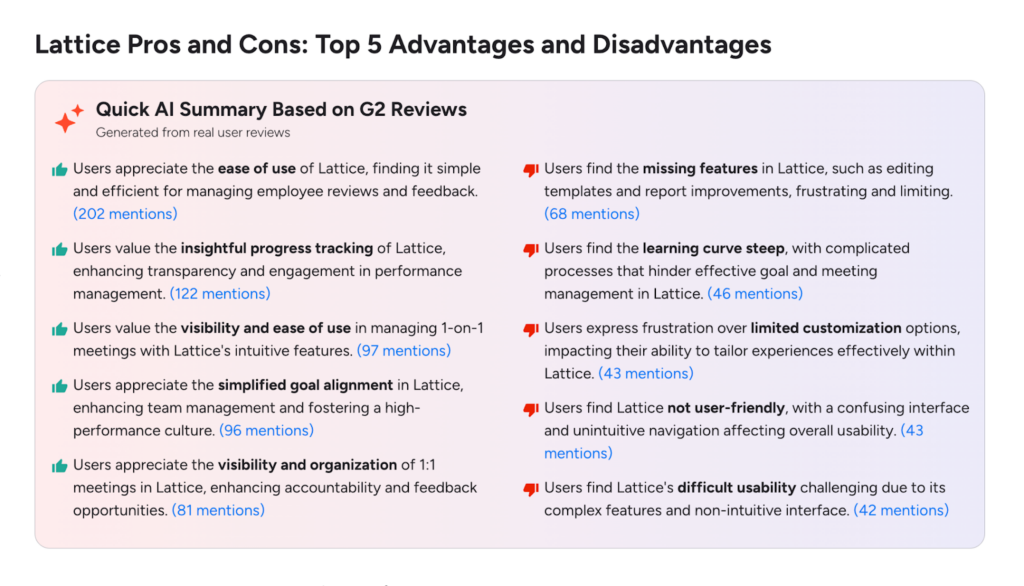
On Capterra, Lattice has an overall rating of 4.5/5 based on 201 reviews. On G2, it has a rating of 4.7/5 based on 4,062 reviews. People generally like it, and the feedback is consistent about what it does well and where it can annoy you.
What users like
I see a lot of praise for Lattice being a solid “system of record” for performance reviews, feedback, recognition, and 1:1s. Reviewers often mention that it makes accomplishments more visible, supports better growth conversations, and helps managers stay organized.
Integrations are called out too, especially Slack and Microsoft Teams, because they make praise and reminders feel more natural. Some users also say it improves engagement and participation, and that the interface feels modern and easy once you get used to it.
What users dislike
The most common complaints are about friction, not fundamentals. People mention a learning curve, clunky navigation, and features that feel buried. Some describe parts of the platform as rigid or process-heavy, especially if their team already runs smoothly. Notifications can get noisy.
Pricing is a practical drawback, especially when add-ons are needed. There are also scattered feature limitations mentioned, like OKR sections feeling awkward, challenges exporting or moving records in certain cases, and small constraints in 1:1s or surveys (for example, re-opening surveys after they close).
Lattice Alternatives
Lattice is a powerful platform, especially if I want structured performance reviews, goal tracking, and a full performance management system. But it is not automatically the best fit for every company. The price can climb quickly, and its engagement features are not the strongest point.
If my main priority is understanding employee engagement earlier and acting on it faster, some alternatives make more sense. One of the strongest options in that area is HeartCount.
HeartCount
If I’m being blunt, the biggest gap Lattice can leave is early, high-frequency engagement visibility. Lattice can run engagement surveys, but if what you really want is to catch burnout, disengagement, and flight risk while there’s still time to fix them, HeartCount is built for that.
Here’s what HeartCount fills in that Lattice often leaves lighter:
- Earlier signals, by design
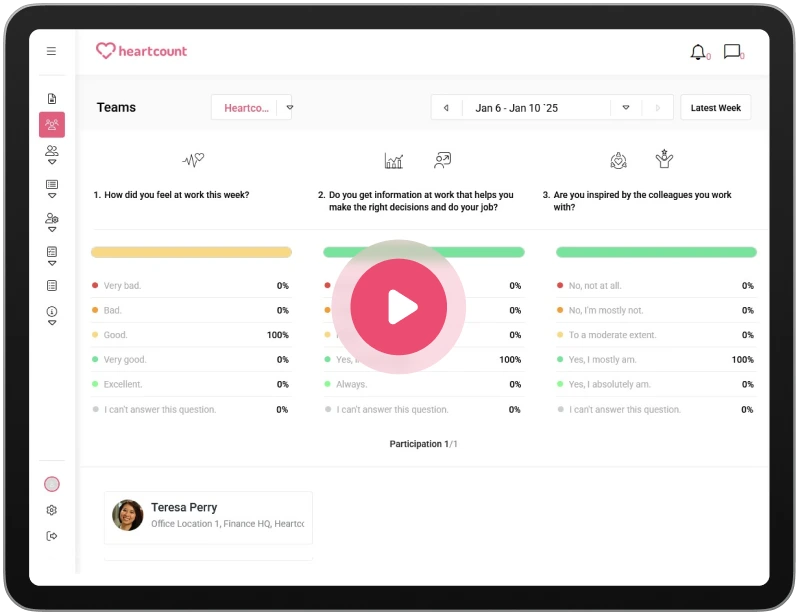
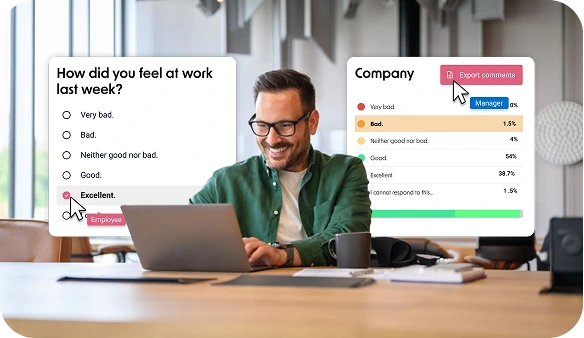
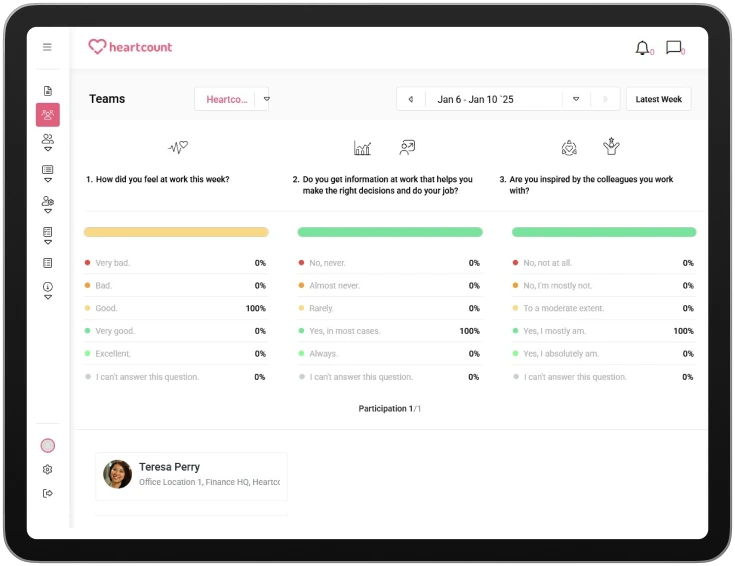
HeartCount runs weekly pulse checks with just three short questions. From my perspective, this solves one of the biggest weaknesses of traditional engagement tools, including Lattice. Instead of waiting months for an engagement or custom survey, I can see changes in employee sentiment almost immediately. If morale drops this week, I know this week, not next quarter. - A structured, science-backed engagement model
These pulse surveys are not random check-ins. HeartCount rotates questions from a large, validated question bank that covers areas like well-being, job satisfaction, relationships with managers, productivity, and overall engagement. This gives me structured, reliable data instead of vague opinions or inconsistent feedback. - Risk detection that works at the employee level
This is a major advantage. HeartCount’s AI analyzes feedback patterns and flags employees who may be at risk of burnout or leaving. It even categorizes risk levels. This allows me to intervene early, support employees, and prevent turnover before it happens. Lattice focuses more on performance outcomes, while HeartCount focuses on early human signals behind those outcomes. - Reporting that actually tells me what to do next
HeartCount provides real-time dashboards, monthly reports, long-term trend reports, and exportable summaries. What I find useful is that it highlights changes, risks, and patterns automatically. I do not have to manually interpret spreadsheets. This makes it easier to connect engagement data to real decisions. - A true feedback loop, not one-way surveys
Employees can send feedback directly to HR or managers, and they can do it anonymously if needed. Managers can respond inside the platform. This turns engagement into an ongoing conversation instead of a survey that disappears into a system with no visible follow-up. - Recognition that strengthens culture, not just performance records
HeartCount includes a built-in recognition system where employees can publicly praise each other. This recognition becomes part of engagement analytics. I can see which teams recognize each other more, which helps me understand the strength of culture across the organization. - Clear engagement metrics connected to real business risk
HeartCount tracks metrics like employee engagement scores, eNPS, motivation, autonomy, and emotional exhaustion. This helps me understand why engagement is changing, not just that it changed. It gives context behind retention risk, performance issues, and team stability.
If I want performance management workflows, promotions, and formal reviews, Lattice is usually the better choice. If I want to detect disengagement early, keep feedback lightweight, and get clearer risk signals with less survey fatigue, HeartCount is the cleaner fit.
Other Lattice Competitors
While HeartCount is one of the strongest options if engagement visibility is your priority, it’s not the only alternative worth considering. Depending on your needs, priorities, and how your HR processes work today, several other tools might fit better:

The Verdict of Lattice Review: Should You Invest in This Platform?
Lattice is a strong performance management platform. If I want structured performance reviews, clear goal-setting, promotion tracking, and a centralized system for managing employee performance, it does the job well. It brings order to performance processes that would otherwise be scattered across spreadsheets, documents, and disconnected tools.
But employee engagement is not its strongest side. While Lattice includes engagement surveys, it is still primarily designed around performance cycles, not continuous engagement visibility.
If your priority is understanding how employees feel week by week, spotting disengagement early, and acting before it turns into turnover or performance decline, HeartCount is the more focused solution.
If engagement, retention, and culture are critical to your business, the best way to understand the difference is to book a HeartCount demo and see how it works in practice.